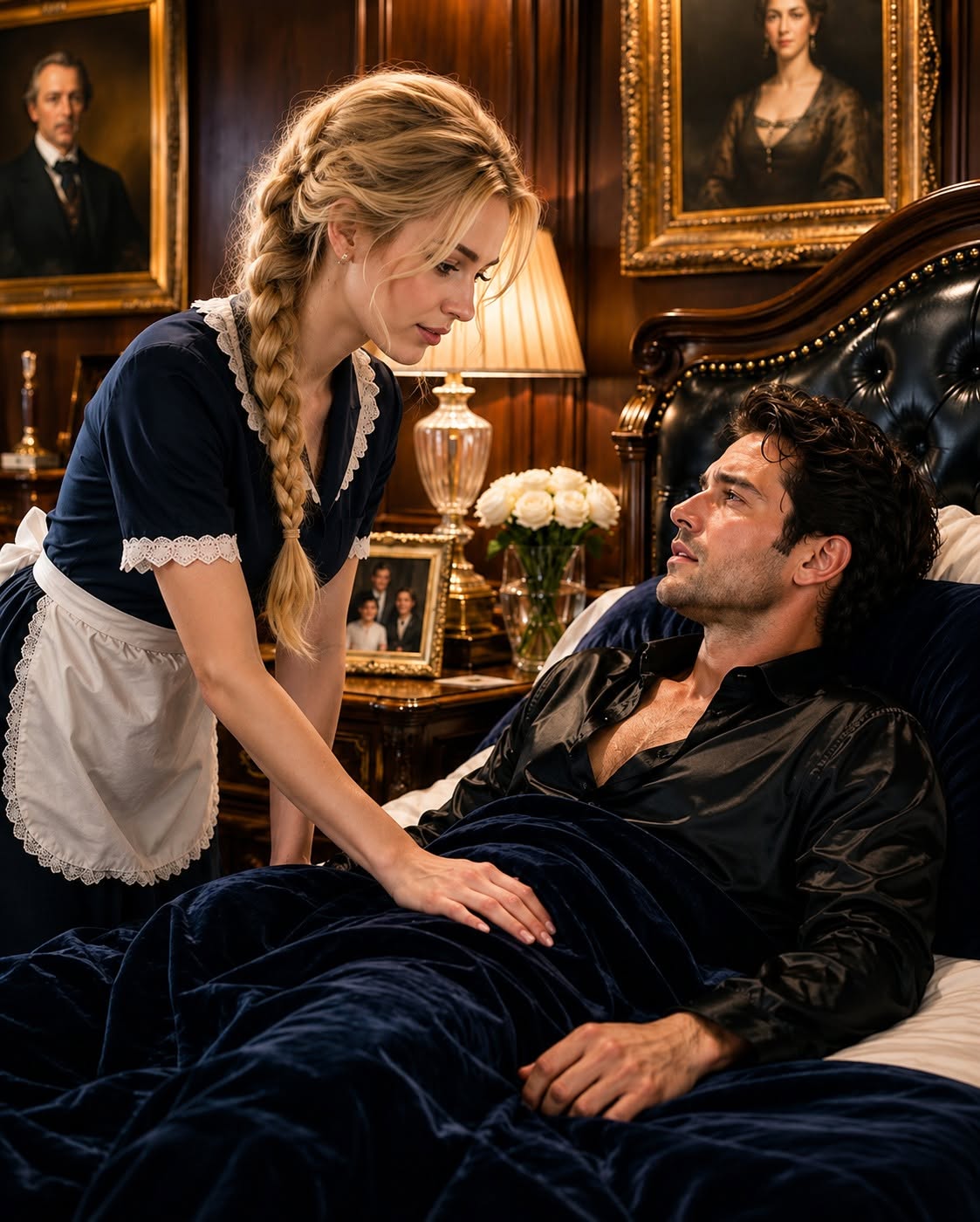

“Elena… who sent you here?”
The question hung in Sofía’s doorway like something living.
For a moment, no one moved.
The music box continued turning on the dresser, its tiny silver ballerina rotating beneath a painted moon. The melody was thin and tender, the same lullaby Elena had heard in the hallway days before, the same song her grandmother had hummed through fevers, storms, and nights when there had been more worry than food in their apartment.
Elena held Isabela’s letter with both hands.
The paper trembled.
“No one sent me,” she said.
Rodrigo did not answer. His eyes remained fixed on her face as if he were seeing two people at once: the young maid in a navy uniform standing barefoot in his grief, and someone from a past he had never known how to open.
Mrs. Herrera slowly lowered herself onto the edge of Sofía’s bed. The room seemed to breathe around her. Three years of dustless waiting. Three years of stuffed animals arranged in perfect rows. Three years of a pink cardigan folded over a chair as though its owner might come running back from breakfast.
“Elena,” Mrs. Herrera whispered, “did your grandmother ever speak of the Cárdenas family?”
Elena’s first instinct was to say no.
Then memory shifted.
Not a story. Not exactly.
A warning.
She remembered Carmen’s hand tightening over hers whenever Cárdenas Tower appeared on the television news. She remembered her grandmother turning the channel when Rodrigo’s face filled the screen after the accident, his suit black, his expression empty. She remembered asking, at nineteen, why Carmen disliked rich people so much.
Carmen had said, “I don’t dislike rich people, niña. I dislike doors that only open from one side.”
At the time, Elena thought it was one of her grandmother’s sayings, half wisdom and half poetry.
Now it felt like a locked room.
“She didn’t talk about you,” Elena said carefully. “But she knew your name.”
Rodrigo looked at the letter again. “Isabela wrote this before the accident.”
His voice was quiet, almost too controlled.
Mrs. Herrera nodded. “Two weeks before.”
“You knew?”
“I knew she left something hidden in the music box.” Mrs. Herrera’s eyes filled, but she kept her voice steady. “I did not know what it said. She made me promise not to open it unless Elena Salgado came to the house.”
Rodrigo turned toward her. “And you waited three years?”
“I waited because no Elena Salgado came.”
Elena looked down at the letter.
If a young woman named Elena Salgado ever comes to this house, do not send her away.
The words made the room tilt strangely around her.
She thought of the agency call. The interview. Mrs. Herrera’s severe gaze as she read Elena’s file. The job offer that had arrived so quickly it felt like luck.
Luck.
Or something else.
“I applied through the agency,” Elena said. “I saw the listing online.”
Mrs. Herrera looked startled. “The agency sent your file to me directly.”
“Because you requested it?”
“No.” Mrs. Herrera stood slowly. “Because the previous candidate withdrew at the last minute. They said they had only one replacement available.”
Rodrigo’s jaw tightened. “Who at the agency?”
“I spoke to a coordinator named Mateo,” Mrs. Herrera said. “But the file came already approved.”
Elena felt suddenly cold despite the warm room.
Rodrigo folded the letter with great care, though his fingers were still unsteady. “We are not discussing this in here.”
He stepped out into the hallway, but Elena stayed where she was.
Her gaze had fallen to Sofía’s corkboard.
Among the drawings of suns, dogs, and crooked castles, there was a picture made in crayon. A little girl with black hair. A smaller girl beside her with brown braids. Above them, in uneven letters, Sofía had written:
LENA AND ME.
Elena walked closer.
Her breath caught.
“Rodrigo,” she said.
He turned.
She pointed to the drawing.
He stepped back inside, saw it, and went completely still.
Mrs. Herrera covered her mouth.
“That wasn’t there before,” Rodrigo said.
“Yes, it was,” Mrs. Herrera whispered. “I kept everything exactly as she left it.”
Elena stared at the little brown-haired figure.
Lena.
Not Elena, but close enough to make the air leave her lungs.
“I don’t understand,” she said.
Rodrigo reached for the drawing, then stopped himself before touching it. “Sofía used to talk about an imaginary friend.”
His voice had changed. It had gone soft, painfully soft.
“She called her Lena. We thought it was a phase. She said Lena sang to her when she was afraid. Isabela used to smile and say children know things adults forget.”
Elena thought of her grandmother’s lullaby.
The same song.
The same name.
A child’s drawing made years before Elena entered this house.
No one spoke for several seconds.
Then Rodrigo said, “We need to speak with your grandmother.”
Elena’s heart tightened. “Not tonight.”
“She may know who arranged this.”
“She’s ill,” Elena said, a sharper edge slipping into her voice. “She’s not evidence. She’s my grandmother.”
Rodrigo looked at her, and for the first time, the billionaire vanished completely. In his place stood a father who understood the terror of losing the person who anchored him.
“You’re right,” he said.
The simple apology disarmed her.
Mrs. Herrera nodded toward the hall. “Then tomorrow. In daylight. Gently.”
Elena looked again at the drawing.
LENA AND ME.
A strange tenderness rose in her, unexpected and impossible to place. She had never met Sofía. She could not miss the child. And yet standing in that room, surrounded by small shoes and storybooks, Elena felt the outline of a loss that belonged not only to Rodrigo but to the whole house.
She turned toward him.
“May I ask something?”
Rodrigo nodded.
“Why did you keep her room locked?”
His eyes moved over the bed, the toys, the cardigan.
“At first, because I couldn’t bear to change anything,” he said. “Then because I couldn’t bear to enter. After a while, grief became habit. Habit became rule. Rule became prison.”
Elena did not respond with comfort. She simply nodded.
Some truths did not need bandages. They needed witnesses.
The next morning arrived bright and sharp after the rain, washing Monterrey clean beneath a pale blue sky.
Elena slept little.
By seven, she was in the kitchen, not because she had been assigned there, but because she needed something ordinary to do with her hands. She sliced mango, rinsed cups, wiped counters already clean. Every few minutes, her gaze flicked toward the hallway.
Rodrigo entered at seven-ten.
The room stopped as usual.
But he did something no one expected.
He sat down.
Not at the head of the table. Not with the stiffness of a man tolerating breakfast. He sat near the window, where sunlight touched the edge of the white cloth, and looked at the plate placed before him.
Mrs. Herrera blinked.
The cook pretended not to notice while clearly noticing everything.
Rodrigo picked up his fork, cut a piece of toast, then paused.
“Elena,” he said.
She stepped forward. “Yes, sir?”
His expression flickered at the word sir, as if it had become uncomfortable overnight.
“After breakfast, we will go to your grandmother’s apartment. Only if you agree.”
It was the “only if” that changed the room.
Elena felt Mrs. Herrera glance at her.
“I agree,” Elena said.
Rodrigo nodded once. Then, as though remembering something from another life, he added, “Thank you.”
The cook nearly dropped the coffee pot.
They drove to Independencia in a black car without the driver. Rodrigo insisted on driving himself. Mrs. Herrera came with them, seated in the back, hands folded around her purse.
The city changed as they crossed it. Glass towers gave way to faded buildings, murals, busy markets, wires looped between rooftops, children in uniforms walking with backpacks too large for their shoulders. Elena watched Rodrigo notice everything. Not with disgust. Not with pity. With a kind of quiet attention that made her wonder how long it had been since he had driven anywhere without tinted distance between himself and the world.
“My grandmother doesn’t like surprises,” Elena said as they neared the apartment.
“Then we will not make this feel like one.”
“She also doesn’t like powerful men.”
Mrs. Herrera gave a tiny cough that might have been a laugh.
Rodrigo’s mouth moved almost into a smile. “Then I’ll try not to behave like one.”
Elena looked at him.
It was the first time she had seen humor in him, faint as morning light through curtains.
Carmen Salgado opened the apartment door before Elena could knock twice.
She wore her blue sweater despite the warmth, her silver hair pinned back, her oxygen tube resting against her cheek. Her eyes went immediately past Elena to Rodrigo.
For one second, the old woman did not breathe.
Then she said, “So the house finally called you.”
Elena froze. “Grandma?”
Carmen stepped back. “Come in before the neighbors turn this into a telenovela.”
The apartment was small, clean, and full of life in a way the mansion was not. Crocheted blankets. Old photographs. Potted basil on the windowsill. Medicine bottles lined neatly beside a chipped statue of the Virgin Mary.
Rodrigo stood awkwardly near the couch, too large for the room and too careful not to touch anything.
Carmen pointed to a chair. “Sit, Mr. Cárdenas. You look like a man who hasn’t sat properly in years.”
To Elena’s surprise, he obeyed.
Elena crouched beside her grandmother. “You knew about them?”
Carmen’s face softened. “I knew of them.”
“That is not the same thing.”
“No,” Carmen agreed. “It is not.”
Rodrigo took Isabela’s letter from his jacket pocket and handed it to her.
Carmen accepted it with hands that trembled before she even unfolded the page.
As she read, tears gathered in the lines around her eyes.
“Isabela,” she whispered. “Brave girl.”
“You knew my wife?” Rodrigo asked.
“Briefly.”
“Through Lucía Salgado?”
Carmen closed the letter and placed it on her lap.
At the sound of her mother’s name, Elena’s chest tightened.
“Grandma,” she said, “tell me.”
Carmen looked at her granddaughter for a long moment, and Elena saw the struggle there. Not because Carmen wanted to hide the truth, but because she feared what the truth might cost.
“Your mother worked as a nurse’s aide at Santa Lucía Hospital,” Carmen began. “She was young. Too young for how tired she always looked. But she had a gift with children. They trusted her before adults did.”
Elena swallowed.
Carmen rarely spoke of Lucía for long. She kept her daughter alive in fragments: Lucía loved guava candy. Lucía danced while sweeping. Lucía had terrible handwriting. But she avoided the center of the story, the part where Lucía died and left behind a baby girl.
“Eight years ago,” Carmen continued, “there was a private pediatric wing at the hospital. Wealthy families came and went quietly. Your mother was assigned there some nights. One evening, a little girl was brought in with a severe allergic reaction.”
“Sofía,” Rodrigo said.
Carmen nodded. “She was very small. Frightened. Your wife was there, terrified but kind to everyone. Your daughter clung to Lucía’s hand and would not let go.”
Rodrigo lowered his eyes.
“I remember that night,” he said. “I was out of the country. Isabela called me after. She said a nurse saved Sofía because she noticed the medication dosage was wrong before anyone else did.”
“That was Lucía,” Carmen said.
Elena stared at her grandmother. “Mom saved Sofía?”
“She helped save her,” Carmen said. “And afterward, Isabela did not forget.”
Rodrigo’s voice was quiet. “Why didn’t I know her name?”
“Because men like you are often protected from ordinary names,” Carmen said, not unkindly.
Rodrigo accepted the rebuke with a slight nod.
Carmen looked down at the letter. “After that, Isabela visited Lucía twice. Not publicly. She brought books for Elena. Medicine when Lucía became ill. She offered help, but your mother had pride. Too much at times.”
Elena sat back on her heels. “You never told me.”
“I wanted you to grow without feeling indebted to strangers.”
“Were they strangers?”
Carmen did not answer immediately.
Rodrigo leaned forward. “Mrs. Salgado, my wife believed Elena might help us learn why she was followed that night. What did Lucía know?”
Carmen’s gaze shifted to the window.
Outside, traffic moved slowly under the sun.
“Your wife came to see Lucía one week before the accident,” Carmen said. “She was frightened. Not dramatically. Isabela was not that kind of woman. She was frightened in a controlled way, which is worse.”
Mrs. Herrera, who had remained silent near the door, whispered, “She told me she was visiting a charity office.”
“She came here,” Carmen said. “Sat where you are sitting. She asked Lucía about a name from the hospital.”
“What name?” Rodrigo asked.
Carmen closed her eyes, searching memory.
“Dr. Matías Rivas.”
Rodrigo stiffened.
Elena noticed.
“You know him?” she asked.
“He was on the hospital board,” Rodrigo said. “He also advised my company’s medical foundation.”
Carmen nodded grimly. “Lucía believed he was involved in falsifying patient records. Not only records. Private adoptions. Medical transfers. Things that should never have happened without consent.”
Elena felt the room tilt.
The words struck too close to the wound of the previous chapter, to forged consent and hidden children, though she did not yet understand why.
“My wife knew this?” Rodrigo asked.
“She suspected. Lucía had found files, but she was scared. She planned to report them, then she got sick.”
Elena’s throat tightened. “Sick how?”
Carmen looked at her.
This was the part she had protected too long.
“Your mother’s heart failed after an infection,” she said softly. “The official story was simple. Too simple. She died before she could give testimony.”
Elena’s hands went cold.
“No,” she whispered.
Carmen reached for her. “I had no proof, niña. Only fear. And a baby to protect.”
Rodrigo stood and walked to the window, one hand pressed against the frame.
For years, he had believed the tragedy in his life began on a wet highway. Now a line was appearing before it, stretching backward through hospitals, names, favors, sealed files.
“What does this have to do with Elena?” Mrs. Herrera asked.
Carmen lifted her chin. “Lucía hid something before she died.”
Elena turned toward her. “What?”
“A copy of a file.” Carmen’s voice lowered. “She made me promise never to touch it unless someone from the Cárdenas family came asking with Isabela’s name.”
Rodrigo turned.
Carmen pushed herself slowly to her feet. Elena reached to help, but Carmen waved her off with familiar stubbornness. She crossed to the small bookshelf beside the kitchen and removed a faded cookbook.
Inside, between recipes for mole and arroz con leche, was a flat envelope wrapped in plastic.
Carmen held it for a moment before giving it to Elena.
“It belongs to you more than anyone now.”
Elena opened it carefully.
Inside were photocopied medical documents, a hospital access badge with Lucía’s photograph, and a small USB drive taped to a note.
The note was written in Lucía’s messy handwriting.
For Elena, when truth is safer than silence.
Elena pressed the paper against her chest.
She had spent her whole life missing a mother made of stories. Now Lucía’s handwriting sat in her hands like a voice crossing years.
Rodrigo’s phone rang.
He looked at the screen, and his face changed.
“Rivas,” he said.
No one moved.
The name had barely been spoken, and now it appeared.
Rodrigo answered on speaker.
“Matías.”
The voice that came through was warm, polished, almost friendly. “Rodrigo, forgive the interruption. I heard an interesting rumor.”
Rodrigo’s eyes moved to Elena.
“What rumor?”
“That you’ve taken a personal interest in a new employee.” A soft laugh. “You must be careful. Grief makes men sentimental.”
Carmen’s hand tightened around Elena’s wrist.
Rodrigo’s voice became stone. “Why are you calling?”
“Because some doors should remain closed. For everyone’s comfort.”
Mrs. Herrera went pale.
Dr. Rivas continued, “Isabela understood that too late. I would hate for another woman in your household to repeat her mistake.”
Elena felt Rodrigo’s control flicker, but when he spoke, his voice remained even.
“My household is no longer your concern.”
“Everything built with my help is my concern,” Rivas said. “Including your foundation. Including your reputation. Including the stories people may choose to believe about your wife’s state of mind before the accident.”
Rodrigo’s eyes sharpened.
There it was.
A familiar pattern. Question the woman. Cloud her judgment. Turn truth into instability.
“No,” Rodrigo said quietly. “Not this time.”
The line went silent for a beat.
Then Rivas said, “You always were more like your father than you knew.”
The call ended.
The apartment seemed to shrink around them.
Rodrigo stared at the phone.
“My father died when I was fourteen,” he said.
Carmen’s face changed in a way Elena could not read.
Mrs. Herrera whispered, “Rodrigo…”
But he held up a hand.
Elena looked at him and saw the emotional conflict of the chapter reach its breaking point: a man who had locked grief behind a door now faced a living enemy who had built walls from lies.
“You don’t have to do this alone,” Elena said.
The words surprised both of them.
Rodrigo looked at her.
For years, perhaps, people had offered him service, loyalty, obedience, fear. But not companionship. Not that steady, simple sentence.
You don’t have to do this alone.
Something in his expression eased, not healed, but unclenched.
“No,” he said. “I don’t.”
They returned to the mansion before sunset.
This time, Elena did not enter through the staff door.
Rodrigo brought her, Carmen, and Mrs. Herrera through the main entrance. The gesture was small to anyone outside that world. Inside it, it rang like a bell.
Carmen glanced at the chandeliers. “Too many lights. Who dusts all this?”
Despite everything, Elena laughed.
The sound startled the house.
Rodrigo heard it and looked toward the staircase. For a moment, Elena wondered if he was thinking of Sofía’s laughter, whether it hurt. But his face did not close.
Instead, he said to Mrs. Herrera, “Open the curtains in the west sitting room.”
Mrs. Herrera blinked.
“All of them?” she asked.
“All of them.”
By evening, golden light filled rooms that had not seen an open window in years.
The staff moved carefully at first, unsure whether this change was permitted. The cook carried coffee into the sitting room. The driver helped Carmen settle into an armchair. Mrs. Herrera stood near the piano, one hand resting on its covered top.
Rodrigo approached the instrument.
No one breathed.
He pulled the silk cover away.
Dust motes rose in the sunlight like tiny spirits released.
Rodrigo sat on the bench and placed his hands above the keys.
“I don’t remember how,” he said.
Mrs. Herrera’s eyes filled. “You played for Sofía every Sunday.”
“I know.”
Elena stood nearby, holding Lucía’s envelope.
“Start with one note,” Carmen said from the armchair. “That is how all songs forgive us.”
Rodrigo looked at her.
Then he pressed a key.
A single note rose through the house.
Not painful this time.
Awake.
He pressed another. Then another. The melody stumbled, stopped, began again. Mrs. Herrera covered her mouth. Elena’s eyes burned, not from sadness alone, but from witnessing a room rejoin the living.
When Rodrigo faltered, Elena sang softly.
“Duérmete, mi cielo…”
Mrs. Herrera joined on the second line, her voice thin but true.
Then Carmen, smiling through tears.
The lullaby filled the sitting room, crossed the marble floor, climbed the staircase, and touched the locked door that was no longer locked.
For the first time in three years, the Cárdenas mansion did not feel haunted.
It felt like a home remembering itself.
Later, after Carmen fell asleep in the guest room Mrs. Herrera prepared without asking permission, Elena and Rodrigo sat in the study with the USB drive plugged into his secure laptop.
Mrs. Herrera stood behind them.
The files opened one by one.
Scanned hospital records. Names. Dates. Transfers. Payments hidden under foundation grants. Some documents were corrupted, others incomplete. But one folder was labeled clearly:
S.C. / PROTECTED MINOR.
Rodrigo’s hand froze on the mouse.
“S.C.,” Elena whispered.
Sofía Cárdenas.
He opened it.
Inside was not what they expected.
There were medical records from Sofía’s allergic reaction, yes. Notes from Lucía. A warning about medication tampering that had been dismissed by hospital administrators.
But beneath those files was a second folder.
L.S. / INFANT FEMALE.
Elena’s heart began to pound.
L.S.
Lucía Salgado.
Infant female.
Rodrigo looked at her. “Elena…”
She could not speak.
He opened the folder.
A birth record appeared on the screen.
Elena Salgado.
Date of birth correct.
Mother: Lucía Salgado.
Father: Unknown.
But attached beneath the scanned certificate was an amendment request that had never been finalized.
Rodrigo leaned closer.
Mrs. Herrera whispered a prayer.
The document named a confidential paternal match.
Not a full identity. Only initials.
A.C.
And a note:
Match suppressed by order of Dr. Matías Rivas. Do not release to family.
Elena stared at the initials.
A.C.
Rodrigo’s face had gone pale.
“What?” Elena asked.
He did not answer.
“What does A.C. mean?”
Mrs. Herrera gripped the back of the chair.
Rodrigo slowly reached into his desk drawer and removed a framed photograph Elena had never seen before. An older man stood beside a teenage Rodrigo in front of Cárdenas Tower. The man had silver at his temples, proud eyes, and Rodrigo’s same stubborn mouth.
“My father,” Rodrigo said.
Elena looked at the name engraved on the frame.
Alejandro Cárdenas.
A.C.
The room fell away beneath her.
“No,” Elena whispered. “That’s impossible.”
Rodrigo looked from the screen to Elena, his expression torn between disbelief and a dawning grief deeper than shock.
Before anyone could speak, the laptop chimed.
A new file had appeared on the USB drive, hidden until the first folders were opened.
Its title was only one sentence:
ISABELA KNEW ELENA WAS FAMILY.
Rodrigo clicked it.
A video loaded.
The image shook, then settled on Isabela Cárdenas sitting in Sofía’s bedroom, alive and pale with fear. Her eyes looked directly into the camera.
“If you are watching this,” she said, “then Rivas failed to bury everything. Rodrigo, forgive me. I should have told you sooner. Elena is not only connected to Lucía. She is connected to your father—and to the secret your family paid to erase.”
Elena stopped breathing.
On the video, Isabela leaned closer.
“And Sofía’s accident was not the beginning. It was the warning.”
The screen went black.
Then a final line appeared in white text:
ASK CARMEN WHAT HAPPENED THE NIGHT ALEJANDRO CÁRDENAS DIED.
👉 Follow the page and turn on notifications so you won’t miss the next chapter. The story continues in the next post.If you want to know what happened next, please type “YES” and like for more.