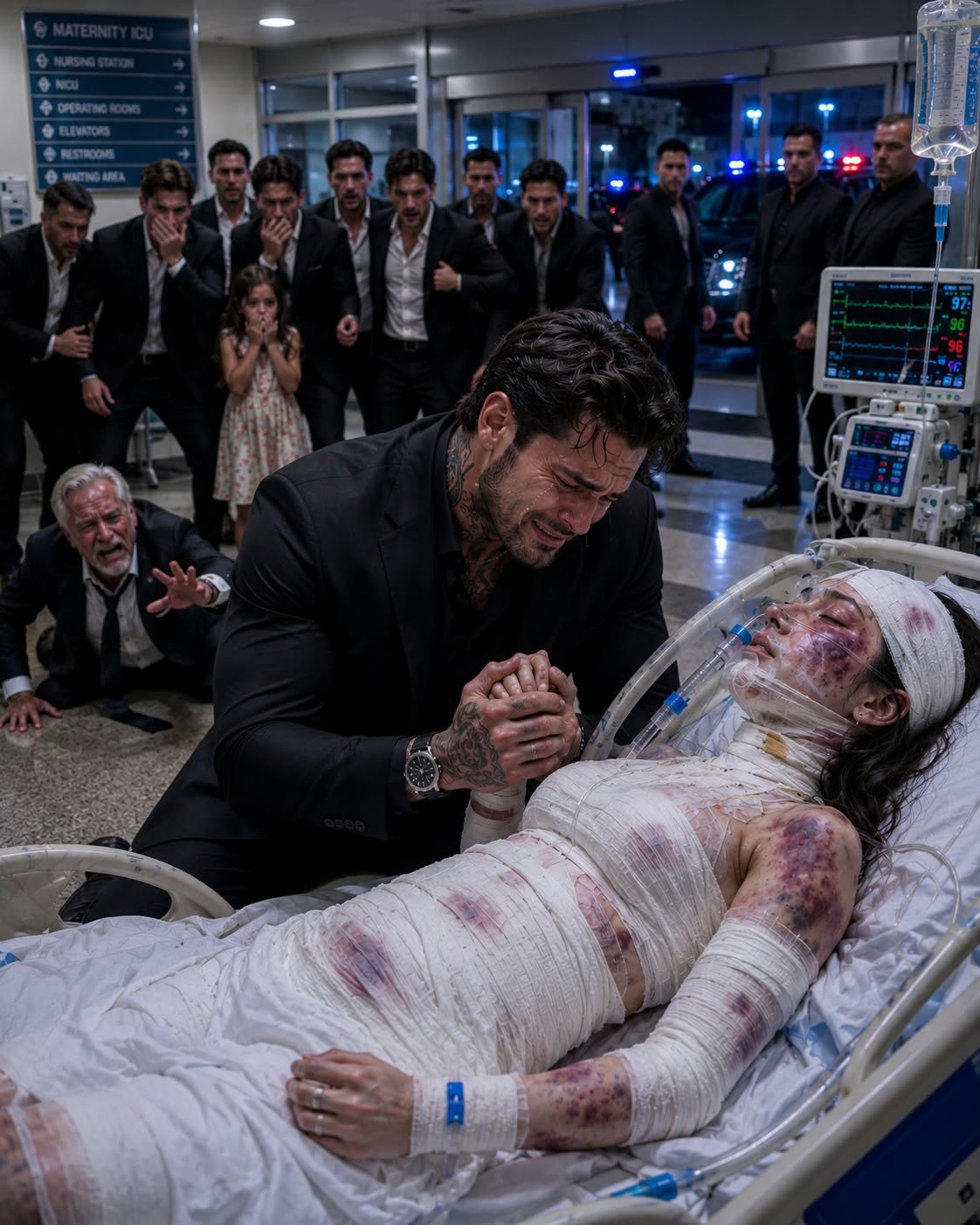

“Sir?”
“No one touches them. No threats. No accidents. Keep them inside the building until the police arrive, and make sure the hospital security footage is preserved.”
There was another pause.
“Understood.”
I ended the call.
Clara’s father watched me carefully.
“You’re calling the police?” he asked.
“I’m calling the truth,” I replied.
His mouth twisted. “You think anyone will believe her over all of us?”
“Her injuries will speak.”
“She has always been unstable.”
The words were spoken calmly, as if he had rehearsed them.
Something colder than rage settled inside me.
Not because the accusation surprised me, but because it explained how long he had been preparing to use it.
Before I could answer, one of Clara’s brothers stepped forward.
His name was Daniel. He was the youngest of the eight, barely twenty-four, with the same gray eyes as Clara and a small scar beneath his chin from a childhood bicycle accident she had once told me about.
Unlike the others, he had not laughed.
He had stood several steps behind them, pale and silent, his gaze fixed on the floor.
Now he looked at me.
“She didn’t fall,” he said.
The hallway became still.
Marcus turned sharply. “Be quiet.”
Daniel swallowed.
“She didn’t fall,” he repeated. “And they know it.”
Clara’s father moved toward him, but two hospital security officers immediately stepped between them.
“You don’t understand what you’re saying,” the older man warned.
Daniel looked at his father for a long moment.
“I understand exactly what I’m saying.”
A uniformed officer entered through the main doors, followed by two detectives. They approached slowly, taking in the family gathered near the ICU, the security guards, and the men visible outside.
The lead detective was a woman in her forties named Lena Ortiz. I recognized her. Years earlier, before she joined homicide, she had investigated a warehouse fire connected to one of my rivals. She had never taken money from anyone, including me.
That was why I had asked for her.
She stopped in front of me.
“Mr. Vale.”
“Detective.”
Her eyes moved to Clara’s family. “I’m told there may have been an assault.”
“There was,” Daniel said.
His father glared at him.
Detective Ortiz opened a notebook. “Then we’ll begin with you.”
Marcus stepped forward. “He’s confused. Our sister had an accident at home.”
Daniel’s voice shook, but he did not retreat.
“No. She came to speak to Father. They argued. Marcus locked the front door.”
“Daniel,” Marcus said through clenched teeth.
“I told you to stop.”
The words seemed to surprise even him.
He looked toward the ICU doors, and his face crumpled.
“I told all of you to stop.”
No one spoke.
Detective Ortiz studied him. “Would you be willing to make a formal statement?”
Daniel nodded.
His father’s expression changed. The arrogance vanished, replaced by something more dangerous because it was quieter.
“You walk out of this family with them,” he said. “You never come back.”
Daniel blinked rapidly.
Then he looked at me, not for permission, but perhaps for proof that there was somewhere else to go.
I thought of Clara lying unconscious beyond the doors. I thought of all the times she had defended her youngest brother, calling him kind, lost, easily frightened by the men who had raised him.
“You won’t be alone,” I said.
Daniel lowered his head.
Detective Ortiz led him toward a consultation room.
The remaining brothers began talking at once. One demanded a lawyer. Another insisted that Daniel had always resented them. Marcus accused me of manipulating him.
Clara’s father said nothing.
He simply looked at me as if memorizing my face.
I returned the look.
“I meant what I said,” I told him. “No one will harm you.”
He gave a humorless smile. “How generous.”
“It isn’t generosity. Clara deserves to wake up in a world where the truth matters more than vengeance.”
For the first time, uncertainty appeared in his eyes.
Perhaps he had expected me to answer cruelty with cruelty. Men like him understood retaliation. It confirmed their belief that everyone was secretly like them.
Restraint frightened them more because it left them with no excuse.
A nurse opened the ICU doors.
“Mr. Vale?”
I turned immediately.
“Your wife is waking.”
Everything else disappeared.
I followed the nurse into Clara’s room.
The machines seemed louder than before. A monitor counted each heartbeat with a steady electronic rhythm. Rain streaked the dark windows, blurring the city lights.
Clara’s eyes were partly open.
I moved to her bedside and took her hand carefully.
“Clara?”
Her fingers stirred against mine.
She tried to speak, but only a faint sound came out.
“You’re safe,” I said. “Don’t force yourself.”
Her gaze moved slowly across my face, searching for something.
Then her hand drifted toward her stomach.
The doctor had warned me that this moment might come.
I wanted to protect her from it, though there was no way to protect someone from the absence inside her own body.
Her eyes widened.
I tightened my grip on her hand.
“I’m sorry,” I whispered.
She looked at me.
I watched understanding arrive.
Not all at once. First confusion, then fear, then a grief so deep that it seemed to empty the room of air.
A tear slipped into her hair.
“No,” she breathed.
I leaned closer.
“No.”
Her voice broke.
I pressed my forehead against her hand.
“I’m here.”
“Our baby?”
I could not speak.
My silence answered her.
Clara turned her face toward the window. Her shoulders shook, but the injuries made even crying painful. The monitor quickened.
The nurse adjusted the medication and asked me to keep her calm.
As though grief could be calmed.
As though there were words capable of placing a lost future back inside us.
I sat beside her for more than an hour. I did not tell her about the police or Daniel or the men waiting outside. I told her only that she was safe, that she was not alone, and that she did not have to say anything until she was ready.
Near dawn, she fell asleep again.
I remained there, holding her hand while the sky slowly turned gray.
For most of my life, I had believed strength meant never allowing another person to see where you could be wounded.
Clara had changed that without trying.
She had made me imagine an ordinary future.
Sunday mornings with sunlight in the kitchen. A child asleep against my shoulder. Clara laughing because I had burned breakfast again. A house where no one checked the windows before entering a room.
I had wanted those things so badly that I had hidden the truth about myself, telling myself I was protecting her.
Now, sitting beside her hospital bed, I began to wonder whether secrecy was simply another kind of betrayal.
At seven in the morning, Detective Ortiz appeared at the door.
I stepped into the hallway.
“Daniel gave a statement,” she said. “A detailed one.”
“Will it be enough?”
“It’s a beginning. The medical evidence is strong, and we obtained a warrant for the house.”
She glanced toward Clara’s room.
“There’s something else.”
“What?”
“According to Daniel, your wife went there voluntarily.”
“I know. Her father called her yesterday afternoon.”
“Do you know why?”
“No.”
Ortiz closed her notebook.
“Daniel says Clara brought a folder with her. She accused her father of stealing money from a trust in her mother’s name.”
I stared at her.
“Clara never mentioned a trust.”
“Daniel says most of the argument was about documents. Your wife demanded that her father explain several transfers made over the last eighteen years.”
“Did you find the folder?”
“No.”
“Then one of them took it.”
“That’s likely.”
She studied me with the expression of someone deciding how much truth I could handle.
“There may be another problem. Your father-in-law claims Clara attacked Marcus first.”
“Clara has a fractured collarbone.”
“I’m not saying I believe him. I’m telling you what he is saying.”
“And the others?”
“Their stories are almost identical.”
“Because they rehearsed them.”
“Probably. But Daniel’s statement is not as complete as I would like. He admits he was present, but he says he left the room for several minutes after the argument became physical.”
“Why?”
“He says his father ordered him to get something from the study.”
“What?”
“A document Clara was supposed to sign.”
A chill passed through me.
“What kind of document?”
“He says he didn’t read it.”
“But he brought it?”
Ortiz nodded.
“When he returned, Clara was on the floor. He says Marcus was holding her shoulders while their father demanded she sign.”
I looked through the glass panel in the ICU door.
Clara slept beneath a thin white blanket, one hand curled near her face.
“What happened to the document?”
“Daniel says Clara tore it before she lost consciousness.”
“And then?”
“He called the ambulance from the bathroom. He didn’t give his name.”
That explained how help had arrived.
It also meant the youngest brother had stood in that house, terrified and surrounded, and had still chosen to make the call.
“Where is he now?”
“In protective custody until we determine whether anyone intends to intimidate him.”
“No one connected to me will go near him.”
“That isn’t the only direction intimidation can come from.”
She glanced toward the waiting room where Clara’s father sat with his sons and their attorneys.
“What was on that document?” I asked.
“We’re trying to find out.”
Detective Ortiz started to leave, then stopped.
“Mr. Vale, I need to ask you something directly.”
“Go ahead.”
“Why did nine different financial institutions freeze or restrict access to their accounts within five minutes of your arrival?”
I held her gaze.
“Because I was angry.”
“That isn’t an answer.”
“No,” I said. “It’s the truth.”
She waited.
I could have lied. I had people who could build a convincing explanation by noon. Suspicious transfers. Routine audits. Automated compliance procedures.
But I was tired of explanations designed to hide what I was.
“I made calls,” I said.
“Were laws broken?”
“Not by me.”
“That is a carefully chosen sentence.”
“I choose most sentences carefully.”
Her expression remained hard.
“Whatever influence you have, keep it away from my investigation.”
“You have my word.”
“I don’t know what your word is worth.”
“Then judge it by what I do next.”
She left without answering.
When I returned to Clara’s room, her eyes were open.
She had heard us.
I knew it immediately.
Her gaze rested on me with a quiet distance I had never seen before.
“What calls?” she asked.
I closed the door.
“You need to rest.”
“What calls, Adrian?”
There was no strength in her voice, but there was determination.
I sat beside her.
“Your father and brothers had access to money, companies and people who protected them. I took some of that protection away.”
“How?”
I looked at our joined hands.
For years, I had told her pieces of the truth.
I owned logistics companies. That was true.
I managed investments. Also true.
I knew politicians and judges. True again.
But I had never told her why they returned my calls, or why powerful men lowered their voices when I entered a room.
“My business isn’t what you think it is,” I said.
Clara watched me.
“What is it?”
The machines continued their steady rhythm.
“Some of my companies are legitimate. Some began as fronts for people who moved goods through the ports without asking permission.”
Her brow tightened.
“You said you bought failing shipping firms.”
“I did.”
“From whom?”
“Men who did not usually sell.”
The silence between us grew.
“Are you a criminal?” she asked.
I could have given her another careful sentence.
Instead, I said, “Yes.”
Her fingers went still in mine.
The word changed the room.
I told her more.
Not everything. There were names and details that would only place her in greater danger. But I told her that I had inherited a small organization from my uncle after his death, that I had spent fifteen years turning it into a network built as much on influence as fear, and that many of the businesses I controlled had once been used for smuggling and extortion.
I told her I had ended some operations and allowed others to continue under rules I had invented to make myself feel different from the men before me.
I told her that people obeyed me because they knew what had happened to those who did not.
Clara listened without interrupting.
When I finished, the rain had stopped.
“Were you ever going to tell me?” she asked.
“Yes.”
“When?”
I had no answer that did not sound like a lie.
“Before the baby was born,” I said finally.
She turned toward the window.
“That was months away.”
“I know.”
“You let me marry you without knowing.”
“I thought I could leave it behind.”
“Did you?”
“No.”
Her face tightened with pain, and I reached for the call button, but she shook her head.
“Not that kind.”
I lowered my hand.
She closed her eyes.
“My father always said powerful men hide the cost of loving them until it is too late.”
The comparison struck deeper than any accusation.
“I am not your father.”
“No,” she whispered. “He never made me feel safe.”
I waited.
“You did.”
The past tense frightened me.
“Clara—”
“But now I don’t know what was real.”
“All of it.”
“Except your name?”
“My name is real.”
“Your work?”
“Some of it.”
“The men at our wedding?”
“Most were business associates.”
“The security system you said came with the house?”
“I installed it.”
“The driver who followed me to the clinic last month?”
My silence answered.
A tear moved slowly down her cheek.
“I thought I was building a life with someone who trusted me.”
“I was trying to protect you.”
“You were deciding for me.”
I looked down.
She was right.
That was the unbearable part.
For years, I had believed my secrecy was love because it was motivated by fear of losing her. But love did not become honest simply because the lie was told gently.
“I’m sorry,” I said.
Clara breathed carefully through the pain.
“Leave.”
I looked up.
“Please.”
“I don’t want you alone.”
“There is a nurse outside.”
“Clara—”
“I need one decision in my life to belong to me.”
I stood.
Every instinct told me to remain, to guard the door, to fix what could not be fixed.
Instead, I released her hand.
“I’ll be nearby.”
She said nothing.
I walked into the hallway and closed the door softly behind me.
For the next six hours, I sat in the waiting room.
Clara’s father and brothers had been taken to the station for questioning. Their attorneys came and went. Daniel remained elsewhere.
My own men kept their distance.
I canceled every meeting.
At noon, an older woman wearing a hospital volunteer badge placed a cup of coffee beside me.
“You look like you need this,” she said.
“I do.”
She sat across from me.
Her name tag read MIRIAM.
For a moment, I assumed she was there because she recognized me. Then I saw that she looked at me without fear, curiosity or calculation.
Only kindness.
“My husband spent four months in intensive care,” she said. “I learned that waiting can make a person forget to eat, drink or breathe.”
“Did he recover?”
“No.”
“I’m sorry.”
“So am I.”
She folded her hands.
“But I survived the waiting.”
I stared at the untouched coffee.
“How?”
“I stopped trying to control the ending.”
I almost laughed.
Control was the foundation of my life.
“You make it sound simple.”
“It wasn’t.”
She stood and adjusted the volunteer badge on her sweater.
“Drink before it gets cold.”
I did.
That afternoon, Detective Ortiz returned with news.
The police had found blood in the dining room of Clara’s childhood home, along with a broken chair and fragments of a torn legal document in the fireplace.
“Most of it burned,” she said, “but our lab may recover enough to identify it.”
“And the folder?”
“Missing.”
“Did you search the study?”
“Yes.”
“Daniel said he retrieved the document from there.”
“He did.”
She handed me a clear evidence photograph.
It showed a large mahogany desk, shelves lined with law books and a framed portrait of Clara’s mother.
I had seen photographs of Evelyn Harrow before. Clara resembled her strongly, especially around the eyes.
But something in the image felt wrong.
I looked closer.
The portrait had been moved.
A pale rectangle on the wallpaper showed where it had once hung, several inches higher.
“What is behind the picture?” I asked.
“Nothing.”
“Then why was it moved?”
Ortiz studied the photograph.
“We wondered the same thing.”
She took it back.
“A crime scene technician found fresh marks on the frame. We’re checking for prints.”
“What did Clara’s father say?”
“That his housekeeper dusted it.”
“Does he have a housekeeper?”
“Not for the last three years.”
The first real crack had appeared in his story.
Still, it did not explain why Clara had gone there without telling me.
When the doctor finally allowed visitors again, Clara asked for Daniel.
Not me.
I arranged it through Detective Ortiz.
Daniel entered the room late that evening under police supervision. I watched through the glass from the hallway.
He stopped just inside the door.
Clara looked small against the pillows, her shoulder secured, bruises dark along her arms.
Daniel began to cry.
Not loudly. He simply folded forward as though the sight of her had removed the strength from his body.
Clara lifted her uninjured hand.
He approached and took it.
I could not hear most of their conversation through the glass, but I saw him apologize again and again.
Clara listened.
At one point, she turned her face away.
Later, she touched his cheek.
Forgiveness, if that was what she offered, did not come as a grand gesture. It looked fragile, incomplete and painful.
After twenty minutes, Daniel left.
He stopped beside me in the corridor.
“She wants to see you.”
I nodded.
He started toward the elevator.
“Daniel.”
He turned.
“You saved her life.”
His expression twisted.
“I should have stopped them.”
“You called for help.”
“I waited too long.”
“Fear makes seconds feel like choices we had time to consider.”
He looked at the floor.
“I knew Father had a temper. I knew Marcus did whatever he asked. But I never thought…”
He could not finish.
“Why did Clara go there?” I asked.
Daniel wiped his face.
“She found something in Aunt Lydia’s storage unit.”
“Who is Lydia?”
“Mother’s sister. She died in January.”
Clara had mentioned an aunt who lived abroad, but I had never met her.
“What did she find?”
“I don’t know exactly. Letters, bank records, old photographs. She called me three days ago and asked whether Father had ever talked about a place called Bellweather House.”
The name meant nothing to me.
“What did you say?”
“I told her no.”
“Did your father hear about the call?”
Daniel hesitated.
“He checks my phone records.”
Even now, the control in that family reached farther than I had understood.
“Father called Clara the next morning,” he continued. “He told her he wanted to make peace before the baby came.”
“And she believed him?”
“She wanted to.”
That sounded like Clara.
Hope had always been her most beautiful and most dangerous quality.
Daniel looked toward her door.
“She brought the folder because she thought the evidence would force him to tell the truth.”
“What truth?”
“I don’t know.”
“Daniel.”
“I swear.”
His fear seemed genuine.
Then he remembered something.
“When I went into the study, Father was standing under Mother’s portrait.”
“The one above the desk?”
“Yes. He had taken it off the wall.”
“What was behind it?”
Daniel frowned.
“A safe.”
Detective Ortiz had said there was nothing behind the picture.
Either the safe had been hidden before the police arrived, or someone on the search team had overlooked it.
I called her immediately.
She answered on the second ring.
“There’s a safe behind the portrait,” I said.
“We checked the wall.”
“Check it again.”
“We had the frame removed.”
“Daniel saw it.”
Silence.
“When?”
“During the assault.”
Ortiz’s tone sharpened. “Where is Daniel now?”
“Outside Clara’s room.”
“Keep him there.”
“I told you I won’t interfere.”
“This is not about you interfering. We just received a security alert from the Harrow residence.”
“What kind?”
“A rear door was opened nine minutes ago.”
The house was supposed to be sealed.
Ortiz ended the call.
I turned toward Daniel.
“Is there another way into the study?”
He stared at me.
“A passage from the old library.”
I thought I had misheard him.
“A passage?”
“The house was built during Prohibition. There’s a narrow door behind the shelves.”
“Who knows about it?”
“Father. Marcus. Me.”
“Anyone else?”
Daniel looked through the glass at Clara.
“She does.”
Twenty minutes later, Detective Ortiz called again.
Someone had entered the house through a basement window, passed through the concealed corridor and removed a section of the study wall.
The safe was gone.
No usable image appeared on the exterior cameras. The intruder had known exactly where the blind spots were.
“Your father and brothers were still at the station,” I said.
“I know.”
“Then someone else is involved.”
“Yes.”
“Could it have been one of your officers?”
“I am investigating everyone who had access to the warrant.”
Her anger was quiet but clear.
“What was in the safe?” I asked.
“We don’t know.”
I looked toward Clara’s room.
Perhaps she did.
When I entered, she was awake.
Daniel had gone to speak with the detective.
I remained near the door.
“You asked to see me.”
Clara nodded.
Her eyes were tired, but clearer than before.
“Daniel told you about Aunt Lydia?”
“Yes.”
“I should have told you.”
“You had reasons not to trust me.”
“I didn’t know there was anything not to trust.”
The truth sat between us.
She motioned toward the chair, and I sat.
For a while, neither of us spoke.
Then she said, “Aunt Lydia left me a storage key.”
“What was inside?”
“Boxes from my mother’s house. Father told us he threw everything away after she died, but Lydia kept some of it.”
Clara looked toward the dark window.
“My mother died when I was nine. At least, that is what I was told.”
The words were so quiet that I nearly missed them.
“What do you mean?”
“There was a car accident. Father said she lost control on a mountain road. There was a funeral, but the coffin stayed closed.”
“Did you see a death certificate?”
“Not then. I was a child.”
“And in the storage unit?”
“I found one.”
She swallowed.
“The date was wrong.”
“How wrong?”
“Three days.”
“That could be a clerical error.”
“That’s what I thought. Then I found bank statements in her name.”
“After the accident?”
“For almost fourteen years.”
I leaned forward.
“Regular activity?”
“Small withdrawals every few months. Always from the same branch in a town called Bellweather.”
“Bellweather House.”
“That’s what I asked Daniel about.”
“Did you go there?”
“No. I called the bank. They would not give me information, but the clerk became nervous when I gave my mother’s name.”
“What was the document your father wanted you to sign?”
“A declaration saying the accounts belonged to him and had been opened for tax purposes.”
“You refused.”
“I told him I would take everything to the police.”
Her breathing became uneven.
I waited until she settled.
“Then Marcus took the folder,” she continued. “Father said I was destroying the family over a dead woman.”
Her voice trembled.
“I told him she was my mother.”
I closed my eyes briefly.
“Clara, you don’t have to tell me the rest.”
“Yes, I do.”
“No.”
“I need to know that I can say it and still be here afterward.”
So I listened.
She described the argument without dwelling on every blow. Her father had blocked the door. Marcus had tried to force her into the chair. The others stood around them, some shouting, some insisting she sign, some doing nothing.
The betrayal had wounded her as much as the injuries.
They had been her brothers.
Men whose birthdays she remembered. Men whose children she had carried on her shoulders. Men she had defended when I asked why she returned from family dinners with tears hidden beneath polite smiles.
“I kept thinking one of them would stop it,” she said.
“Daniel tried.”
“Eventually.”
There was no anger in her words, only exhaustion.
“Do you blame him?” I asked.
“I don’t know.”
It was an honest answer.
She looked at me.
“I don’t know what to feel about anyone.”
That included me.
I accepted it.
“The safe is gone,” I said.
Her eyes widened.
“What?”
“Someone entered the house after the police search and removed it.”
She tried to sit up, then winced.
“Careful.”
“There was a blue box inside.”
“You saw it?”
“When Father took the document from the safe. A small metal box with my mother’s initials.”
“E.H.?”
Clara nodded.
“What do you think is inside?”
“I don’t know. But Father looked at it before he told Marcus to lock the door.”
She reached for my hand, then stopped herself.
The unfinished gesture hurt more than distance.
“Adrian, whoever took it knew what happened.”
“Yes.”
“And they may know whether my mother really died.”
Before I could answer, someone knocked.
A nurse entered carrying a large white envelope.
“This was left at the reception desk for Mrs. Vale.”
“By whom?” I asked.
“A woman. She didn’t give her name.”
“When?”
“About ten minutes ago.”
Detective Ortiz had officers at every entrance.
“Where is the woman now?”
“I don’t know. Reception said she left immediately.”
I took the envelope but did not open it.
There was no writing on the front.
I pressed lightly along the edges. Inside was something flat, perhaps a photograph, and a folded sheet of paper.
Clara watched me.
“Open it.”
I tore the seal carefully.
A photograph slid into my hand.
It showed a woman standing near a garden gate.
She was older than the portrait in Clara’s father’s study. Silver ran through her dark hair, and deep lines framed her mouth. But she had Clara’s eyes.
On the back, someone had written a date.
Three weeks earlier.
Clara took the photograph with trembling fingers.
“No,” she whispered.
I unfolded the paper.
The message was handwritten.
Clara recognized the writing before I finished reading.
“My mother,” she said.
The letter contained only four lines.
Clara,
I have wanted to come home for years, but I was told you believed I was dead.
Do not trust the records your father kept.
Ask Adrian what happened at Bellweather House.
The room tilted around me.
Clara slowly raised her eyes.
“What happened at Bellweather House?”
I could not answer.
Because until that moment, I had believed I had never heard the name.
But memory is not always a door opening.
Sometimes it is a lock breaking.
A winter night sixteen years earlier.
My uncle’s car climbing a narrow road.
A frightened woman in the back seat.
A stone house beyond iron gates.
And an order I had spent half my life trying to forget.
Clara gripped the photograph.
“You know that place.”
It was not a question.
Beyond the window, the city lights flickered across the glass, and in Clara’s reflection I saw the exact moment she realized that the secrets of her family and mine had not collided by accident.
They had begun in the same house.
Long before we ever met.
END OF PART 2 – LIKE, SHARE AND COMMENT “THE ENTIRE STORY” IF YOU WANT TO READ THE FULL STORY.