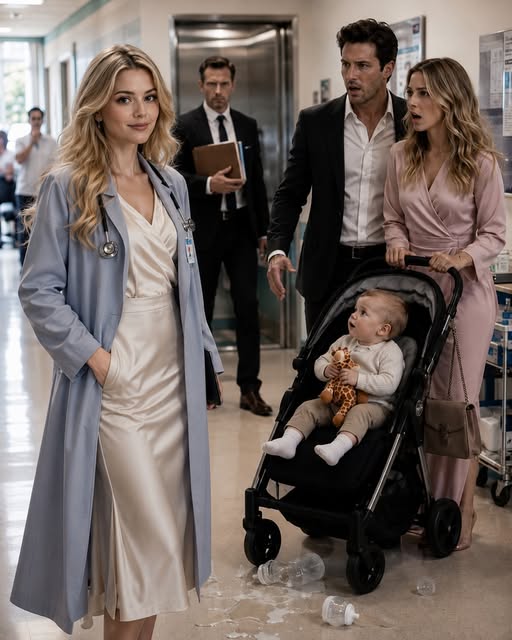

For one suspended second, nobody moved.
The hospital family room seemed to shrink around us—the blue walls, the children’s books, the rain trembling against the window, Oliver asleep in his stroller, and the baby girl in Grace Whitman’s arms blinking at strangers with eyes that looked painfully like mine.
On the phone, the man from Northbridge continued as if he had not just turned the room into a fault line.
“Mr. Fleming? Are you there?”
Kenneth Boyd’s hand tightened around Connor’s phone.
His voice, when he answered, was calm enough to frighten me.
“This is Kenneth Boyd, counsel for Dr. Kirsten Sinclair. Identify yourself.”
The line went silent.
Then a click.
The call ended.
The quiet afterward felt enormous.
Connor stood near the table, all color gone from his face. For the first time since I had known him, his arrogance had nowhere to go. It simply collapsed inward, leaving behind a man staring at the phone as if it had betrayed him.
Melinda clutched Oliver’s stroller with one hand and pressed the other to her mouth. Grace Whitman held the baby girl closer, instinctively stepping back into her husband’s side.
“What does that mean?” Grace asked.
Her voice trembled, but she did not break. Her husband, Daniel, placed one hand gently on the baby’s back, his eyes moving from Kenneth to me to Connor.
“Our daughter’s medical history,” Daniel said slowly. “Someone said it was urgent. We came because we thought she might be sick.”
The baby fussed at the fear in his voice.
Grace bounced her softly. “Shh, Lily. It’s okay.”
Lily.
The name entered me like a whisper through a locked door.
A daughter named Lily.
Nine months old.
Eyes like mine.
I had performed difficult conversations a hundred times as a physician. I had told parents that test results were uncertain. I had explained treatment plans, held mothers’ hands, reassured fathers who wanted clear answers when medicine had none.
But no training prepares a woman to look at a child she did not know existed and feel grief and tenderness arrive together.
I took a careful breath.
“Mrs. Whitman,” I said softly, “I’m Dr. Kirsten Sinclair. I need to say this first: nobody here is trying to take your daughter from you.”
Grace’s eyes filled instantly.
Daniel’s jaw tightened with protective fear.
“Then why are we here?” he asked.
Kenneth stepped forward. “Because there may be irregularities involving the fertility clinic connected to Lily’s conception. We are still verifying information, but it appears her medical history may be incomplete or falsified.”
Grace looked down at Lily.
“We used donor embryos,” she whispered. “Northbridge said everything was anonymous and legally cleared.”
Ruth Ellison, the former Northbridge nurse, began to cry silently.
“I’m sorry,” she said. “I am so sorry.”
Daniel looked at her sharply. “Who are you?”
“My name is Ruth. I used to work at Northbridge.” She clasped her shaking hands together. “I didn’t know about your family specifically. Not then. I only knew records were being coded differently for certain transfers. I told myself it was administrative. Then I told myself asking questions would not change anything.”
Her voice broke.
“But children were born. And now I cannot pretend paperwork is only paperwork.”
Connor gave a bitter laugh.
“Very noble timing.”
Ruth flinched.
I turned toward him.
“No,” I said.
The single word stopped him.
He looked at me.
“You do not get to mock fear in this room,” I continued. “Not hers. Not Melinda’s. Not Grace’s. Not mine. Fear kept people quiet, yes. But your choices created part of what they were afraid of.”
His face tightened.
For once, he did not answer.
Kenneth spoke into his own phone, moving toward the corner. “Emergency injunction. Reproductive material. Northbridge Fertility. Yes, tonight. I need Judge Larsen if available. If not, wake whoever is on emergency civil rotation.”
The ordinary machinery of protection began to move.
Not dramatic.
Not cinematic.
Phones. Documents. Copies. Orders. Names written correctly.
Sometimes justice begins with a man in reading glasses asking a clerk to wake a judge.
Grace sat on the sofa, still holding Lily. Daniel remained standing beside her, one hand resting on Grace’s shoulder, the other curled around the strap of the diaper bag.
Melinda looked at them and then at Oliver.
Her face had changed.
The panic was still there, but beneath it was something else—a painful recognition. She saw in Grace what she had feared for herself: a mother who had built love around a child, only to have adults with hidden records threaten the foundation beneath it.
Melinda crouched beside Oliver’s stroller and adjusted his blanket.
When she looked up at me, tears clung to her lashes.
“I don’t know what I’m allowed to feel,” she whispered.
That sentence moved through the room more gently than any apology.
I walked toward the stroller.
Oliver slept with his cheek turned against the giraffe. His little fist opened and closed in a dream.
“You’re allowed to love him,” I said.
Melinda closed her eyes.
“I do.”
“I know.”
Her mouth trembled.
“I also helped hurt you.”
“Yes.”
“I don’t know how both things fit.”
“Neither do I.”
The honesty settled between us.
For years, Melinda had been a symbol in my mind. The best friend who betrayed me. The woman who took the husband and the baby and the smiling life I could never seem to hold. In that simple story, she had been easier to hate.
But real life is rarely kind enough to give us simple villains.
Melinda had made terrible choices.
She had lied. She had envied me. She had accepted a story about my consent because believing Connor allowed her to receive what she wanted most.
But now she was standing in a hospital room, her hands shaking over a child she loved, learning that her motherhood had also been built on deception.
That did not erase what she had done.
It changed what the next right thing had to be.
Kenneth returned to the table. “The judge will hear the emergency petition within the hour by video. Until then, hospital security is preventing Connor from leaving with Oliver.”
Connor’s head snapped up. “You cannot hold my son here.”
“No one is holding Oliver,” Kenneth said. “He is here for a scheduled pediatric appointment. He remains with Ms. Harper, his primary caregiver, unless a court orders otherwise. You, however, are being advised not to remove a minor connected to an active medical records investigation.”
“I have rights.”
“Yes,” Kenneth replied. “And now you have complications.”
Daniel Whitman spoke for the first time in several minutes.
“What about Lily?”
His voice was controlled, but I heard the strain inside it.
Kenneth turned to him. “No one is challenging your custody tonight. The urgent issue is identifying what happened at Northbridge, securing the remaining embryo, and ensuring no one uses false records to interfere with any child’s stability.”
Grace looked at me. “Is she… yours?”
The question was a knife and a gift.
I sat in the chair across from her, keeping my hands open on my knees.
“I don’t know how to answer that in a way that doesn’t hurt someone.”
Grace’s eyes filled again.
I continued, “Genetically, it seems possible she is connected to me. But you are her mother. I can see that just by the way she turns toward your voice.”
Lily, as if hearing herself discussed, reached for Grace’s necklace with a damp little hand.
Grace gave a choked laugh and kissed her fingers.
“She likes shiny things,” she said automatically.
The ordinary detail broke my heart.
“She hates peas,” Daniel added quietly, looking at his daughter. “Loves sweet potatoes. Falls asleep only if Grace sings the same two lines of a song over and over because neither of us remembers the rest.”
Grace laughed through tears.
I smiled, and somehow it hurt less than I expected.
“That sounds like family,” I said.
Daniel’s shoulders loosened by a fraction.
The emotional storm in the room did not calm all at once. It became breathable in pieces.
Tanya, the nurse, brought bottled water, crackers, and a warmer for Lily’s bottle. She set everything down without asking questions, then looked at me in that steady colleague way that said, You are not alone.
“Dr. Patel cleared exam room four if anyone needs privacy,” she said.
“Thank you,” I whispered.
She squeezed my shoulder once and left.
That small act almost undid me.
A year after my divorce, I had rebuilt my life through work, routine, discipline, and carefully chosen silence. I thought strength meant never needing the hallway to hold me up.
But the hallway was holding me.
Kenneth opened his laptop for the emergency hearing.
Before it began, he looked at me. “Kirsten, we need a clear request. We can ask the court to freeze all Northbridge reproductive material associated with your genetic records, preserve clinic data, prevent transfers, and temporarily restrict parties from removing or destroying documents.”
“The remaining embryo,” I said.
“Yes.”
“What happens to it?”
“For now, nothing. That is the point. It stays exactly where it is until the court can determine lawful control.”
Control.
I hated the word.
“Not control,” I said. “Protection.”
Kenneth’s expression softened. “Protection, then.”
Connor sat rigidly, his eyes moving between Kenneth and the door. I wondered what he was thinking. Whether he feared legal consequence, public embarrassment, or the collapse of a future he had arranged around ownership.
Melinda stood beside Oliver now, no longer seated. Grace and Daniel remained close together, Lily drowsing against Grace’s shoulder.
The hearing happened on Kenneth’s screen.
A tired judge in a black robe appeared from what looked like a home office, hair neatly combed but eyes weary in the way of someone accustomed to late-night emergencies. Kenneth spoke first, precise and calm. He did not dramatize. He did not insult Connor. He presented facts: fertility records, chain-of-custody concerns, genetic irregularities, the recorded call, the immediate risk of unauthorized embryo transfer.
Connor’s attorney appeared by phone twenty minutes later, breathless and poorly prepared.
He tried to argue that the matter was speculative.
Kenneth played the recorded call.
After the phrase “one embryo left is one heir left,” the judge’s face changed.
That was the moment the room understood facts had become protection.
The temporary order was granted.
Northbridge Fertility and all associated storage providers were ordered to preserve all records and reproductive material connected to my name, Connor’s name, Melinda Harper, Oliver Harper, Grace and Daniel Whitman, and any coded file referencing K.S.-F4, K.S.-F5, or related embryo identifiers.
No transfers.
No destruction.
No access without court approval.
For the first time since the bottle shattered in the hallway, I inhaled fully.
The remaining embryo was safe.
For tonight.
Kenneth muted the call and looked at me.
“That is one wall built.”
One wall.
Not a house.
Not a conclusion.
But something standing between innocent life and people who thought secrecy could still move faster than truth.
Melinda sank into the chair beside Oliver and covered her face.
Grace began crying quietly, and Daniel wrapped his arm around her.
I stood perfectly still because my knees did not feel trustworthy.
Connor stared at the floor.
After the hearing ended, hospital security informed us that Connor was not being detained but would be escorted out of the pediatric wing if he attempted to disrupt care. Oliver’s appointment would proceed with Melinda present. Any questions of custody would be handled in family court.
Connor stood, smoothing the front of his jacket.
The old gesture.
The mask returning.
But it did not fit as well now.
He looked at me.
“You think this makes you powerful?”
I felt tired suddenly.
Not weak.
Tired of giving his words more space than they deserved.
“No,” I said. “It makes the children safer. That is enough.”
His mouth tightened.
Then he looked at Melinda.
“You are making a mistake.”
She stood.
Oliver stirred in the stroller, blinking awake.
Melinda looked down at him first. That mattered. She centered the child before answering the man.
“No, Connor,” she said softly. “I think I made one a long time ago. Today I’m trying to stop making it.”
He stared at her.
For a moment, I thought he might say something cruel.
Instead, he walked out.
No dramatic exit.
No final threat.
Just a man leaving a room where his control had finally met witnesses.
The door closed behind him.
Melinda trembled so hard she had to sit down again.
I surprised myself by moving toward her.
“Breathe,” I said.
She gave a broken laugh. “That’s usually my line with Oliver.”
“Then you already know it works.”
Oliver reached for her, fussing.
She lifted him from the stroller with practiced tenderness, settled him against her chest, and rocked. His cries softened immediately.
Grace watched her.
Something passed between the two women—a quiet recognition shared only by mothers who had both just learned love and fear can arrive in the same envelope.
“I’m sorry,” Melinda whispered, not just to me now, but to the whole room. “I’m so sorry.”
Grace looked at Lily.
“I don’t know who I’m angry at yet,” she said.
Daniel kissed the top of his wife’s head. “You don’t have to know tonight.”
I glanced at him, grateful for that answer.
Because none of us had to know everything tonight.
We only had to choose not to lie.
Oliver’s pediatrician, Dr. Patel, arrived a few minutes later. He was patient, compassionate, and clearly briefed only on what he needed to know. He examined Oliver gently while Melinda held him, speaking to the little boy about his giraffe, his toes, and the injustice of cold stethoscopes.
Oliver was healthy.
Lily was checked too, at Grace and Daniel’s request. Healthy as well, though Grace cried again when Dr. Patel said it, as if she had been afraid biology itself might have changed the way her daughter breathed.
It had not.
Children do not become less loved because adults discover paperwork.
That truth held the room together.
By early evening, hospital administration moved us to a private conference space away from the main pediatric corridor. Not to hide us, but to give the children peace. Oliver played on a blanket with stacking cups Tanya brought from the child-life office. Lily sat nearby, fascinated by his giraffe and unimpressed when he refused to share it.
For one strange, aching minute, two children connected through hidden medical records looked like any other babies meeting on a play mat.
Oliver babbled.
Lily clapped.
Melinda laughed through tears.
Grace smiled despite herself.
And I stood near the window, watching the life that had emerged from other people’s lies behave with complete innocence.
Kenneth came to stand beside me.
“You did well today.”
“I feel like I did nothing but react.”
“Sometimes reacting with integrity is the work.”
I looked at him.
He smiled faintly. “You kept seeing the children first. That matters.”
Through the glass, I watched Melinda show Grace how Oliver liked to chew the corner of his blanket. Grace shared a pouch of baby snacks. Daniel sat cross-legged on the floor, looking slightly terrified when Oliver crawled toward his shoe.
A year ago, I would have thought seeing Melinda as a mother would destroy me.
Instead, it complicated me.
Maybe healing was not the absence of pain. Maybe it was becoming large enough to hold more than one truth.
“She betrayed me,” I said quietly.
“Yes.”
“She was lied to.”
“Yes.”
“I don’t know how to forgive one without excusing the other.”
“You don’t have to solve forgiveness tonight.”
I watched Melinda wipe Oliver’s chin with her sleeve because she couldn’t find the cloth.
“She loves him.”
“She does.”
“And I…” My voice caught. “I don’t know what I am to him.”
Kenneth’s expression softened. “You are someone whose rights were violated. You are someone connected to his origin. What you become in his life should be decided carefully, with his wellbeing first.”
Not mother.
Not stranger.
Something unnamed.
For once, the lack of a label did not feel like erasure.
It felt like patience.
My phone buzzed.
I flinched, expecting another unknown message.
But this one came from Dr. Patel.
Need you briefly in consult room two. Patient family requested you. Non-urgent, but meaningful.
I stared at it, torn between the storm I was in and the job that had saved me.
Kenneth noticed. “Go.”
“I can’t just leave.”
“You are not abandoning anyone by continuing to be who you are.”
That sentence found the part of me Connor had once taught to feel guilty for working.
I looked toward Melinda and Grace.
“I’ll be back,” I said.
Melinda nodded.
Grace gave a small, tired smile.
In consult room two, a mother and father waited with their six-year-old daughter, Mia, whose leukemia treatment had been one of my department’s long, hard battles. Mia wore a pink beanie and had a sticker sheet in her lap.
When she saw me, she grinned.
“Dr. Kirsten! I got the good numbers.”
Her father started crying before I even reached the chart.
Her mother held out the lab results with shaking hands.
Remission markers.
Beautiful, hard-won numbers.
For ten minutes, I was fully Dr. Sinclair again. I hugged parents who asked permission first. I let Mia place a glittery star sticker on my lab coat. I reminded them this was a milestone, not a finish line, but joy deserved room anyway.
When I left, my eyes were wet.
Life, stubborn and luminous, had kept moving.
Back in the conference room, I found the atmosphere changed.
Melinda stood with Oliver in her arms, speaking quietly to Grace. Daniel listened, one hand on Lily’s stroller. Ruth sat at the table with Kenneth, giving a recorded statement.
No one looked peaceful.
But they looked less alone.
Melinda turned when I entered.
“Can we talk?” she asked.
I nodded.
We stepped into the hall.
For a moment, we simply stood there. Once, Melinda and I had shared everything—coffee orders, lecture notes, ugly bridesmaid dress opinions, dreams so private we whispered them under blankets during college storms.
Now we stood like two women on opposite sides of a bridge neither knew how to cross.
“I wrote you a letter after the divorce,” she said.
I looked at her.
“I never sent it.”
“Why?”
“Because every version sounded like I wanted you to comfort me for hurting you.”
That answer was too honest to dismiss.
She shifted Oliver against her shoulder.
“He’s sleepy,” she said automatically.
I looked at him. His cheek rested against her sweater, eyes heavy.
“He trusts you,” I said.
She began to cry again, silently this time.
“I don’t deserve that.”
“Children don’t love according to what adults deserve.”
Melinda closed her eyes.
“I know I can’t ask for forgiveness.”
“No.”
“I won’t. Not now. Maybe not ever.” She looked at me. “But I want to cooperate. Completely. I’ll give Kenneth everything Connor gave me, every message, every clinic contact, every document. I’ll testify if I have to.”
“Even if it puts your custody at risk?”
Terror flashed across her face.
Then she looked at Oliver.
“Yes,” she whispered. “Because if I protect a lie to keep him, what kind of mother does that make me?”
The question hung between us.
I did not answer.
She already had.
I reached into my lab coat pocket and removed the glittery star sticker Mia had placed there. Without thinking too much, I held it out to Oliver.
He blinked at it, then reached with clumsy fascination.
Melinda watched him take it.
A small sob escaped her.
It was not forgiveness.
But it was something gentler than war.
Night settled over the hospital.
Grace and Daniel took Lily home after providing contact information, copies of their Northbridge paperwork, and a promise to return for any medically necessary genetic review. Grace hugged Lily so tightly before leaving that the baby squeaked in protest.
At the door, Grace turned to me.
“I don’t know what happens next,” she said.
“Neither do I.”
“If she needs your medical history…”
“I’ll provide it.”
Her face softened with relief so raw it made my chest ache.
“And if you need to know her,” Grace said carefully, “we can talk. Slowly.”
Slowly.
The kindest word anyone had offered me all day.
“Thank you,” I said.
After they left, Oliver finally fell asleep in his stroller again. Melinda sat beside him, exhausted beyond tears. Ruth completed her statement and agreed to meet Kenneth the next morning at the bank to retrieve the ledger.
The ledger.
A book that might identify the hidden transfers, the private clients, the remaining embryo, the person who had called Connor’s phone, and whoever believed children could be moved like assets through coded files.
Kenneth closed his laptop near midnight.
“We have enough for tonight,” he said.
I almost laughed. Enough felt like a strange word for a day that had blown my past open and scattered pieces across a hospital.
He walked me to the elevator.
“You should go home,” he said.
“I don’t want to be alone.”
The admission came out before pride could stop it.
Kenneth’s face softened.
“My wife made lasagna,” he said. “She always makes too much. Our guest room is clean, and she has wanted to mother you since the divorce but restrained herself admirably because I asked her to.”
I laughed then.
A real laugh.
Small, exhausted, but mine.
“I have rounds in the morning.”
“Then you will leave early after being fed.”
The elevator arrived.
Before I stepped inside, I looked back through the glass doors of the pediatric wing.
Melinda sat beside Oliver.
Ruth spoke softly with Tanya.
Hospital lights glowed warm over the hallway where the bottle had shattered that morning.
Everything had changed there.
Not because Connor was punished.
Not because anyone had won.
Because the truth had finally found people willing to hold it carefully.
At Kenneth’s house, his wife, Marjorie, opened the door wearing a robe, slippers, and an expression that suggested she had been waiting all evening with soup and opinions.
“You look like someone who needs both tea and carbohydrates,” she said.
I blinked.
Then began crying.
Marjorie pulled me into her arms without asking questions.
It was the first time that day I let someone hold me.
Not as a doctor.
Not as evidence.
Not as a wronged ex-wife or genetic link or legal claimant.
Just Kirsten.
A woman who was tired.
In the guest room later, I lay beneath a quilt smelling faintly of lavender detergent and listened to the house settle around me. Kenneth and Marjorie murmured downstairs. A clock ticked. Somewhere outside, rain softened into mist.
My phone lit up at 1:13 a.m.
Unknown number.
My heart instantly began to pound.
I sat up, turned on the lamp, and opened the message.
It was not a threat.
It was a photograph of a page from a ledger.
The heading read:
Northbridge Private Transfer Index — Sinclair Cycle.
Three entries were visible.
K.S.-F4 — Harper, Melinda — Live birth male.
K.S.-F5 — Whitman, Grace — Live birth female.
K.S.-F6 — Pending transfer.
Beneath the third line, another note had been handwritten:
Hold for C.F. authorization.
C.F.
Connor Fleming.
I took a screenshot and sent it to Kenneth immediately.
Before I could lower the phone, another message arrived.
You’re looking for the wrong villain.
Then a third.
Connor signed what he was told to sign. Ask who paid Northbridge before your first failed cycle.
My skin went cold.
Attached was a bank transfer receipt dated seven years earlier.
The year my fertility treatments began.
The sender line read:
Sinclair Family Medical Trust.
I stared at it.
There was no such trust.
My parents had died before I finished medical school. I had paid for treatment through savings, insurance appeals, loans, and eventually Connor’s accounts. At least, that was what I believed.
My hands shook as I zoomed in on the authorization line.
The signature was blurred, but the name beneath it was clear enough to stop my breath.
Dr. Elaine Sinclair.
My mother.
Impossible.
My mother had been dead for nine years.
The phone buzzed once more.
This time, the message contained only one sentence.
Your mother arranged the first transfer before Connor ever knew the embryos existed.
The room seemed to fall away.
I could hear Kenneth moving downstairs after receiving my forwarded screenshot, his footsteps quickening toward the staircase.
I sat frozen beneath the quilt, staring at my dead mother’s name on a transfer that should not exist.
And for the first time all day, I wondered whether the truth had not begun with Connor’s betrayal at all.
Maybe it had begun with the person I trusted most before any of them.
Maybe it had begun with my mother.
👉 Follow the page and turn on notifications so you won’t miss the next chapter. The story continues in the next post.If you want to know what happened next, please type “YES” and like for more.