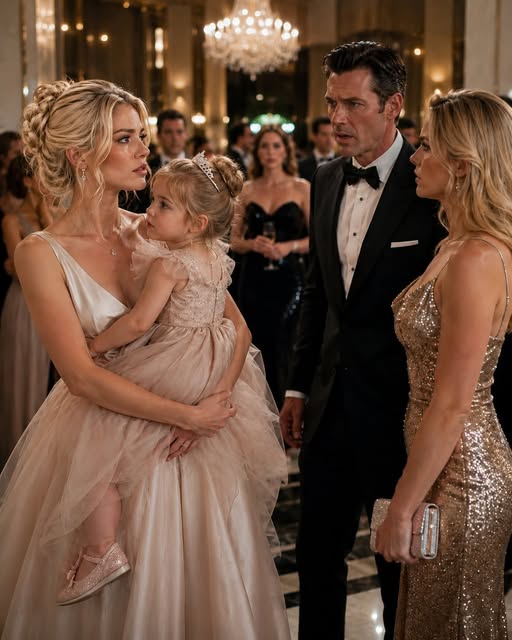

For a moment, the archive room had no air.
The message on my phone glowed beneath the fluorescent lights, colder than the rain-dark window behind us.
Too late.
Two small words, and somehow they made the gala above us feel impossibly far away. Upstairs, a string quartet was still playing. Donors were still laughing softly over champagne. Olivia was probably at the children’s table with frosting on her fingers, entirely unaware that her name had just been pulled into a secret older than her life.
Ethan read the message over my shoulder.
His face changed slowly.
Not with defensiveness.
With fear.
“Harper,” he said, “I swear to you, I don’t know who sent that.”
I looked at him.
Two years ago, I might have mistaken fear in his voice for proof of innocence. Two years ago, I might have rushed to comfort him because his discomfort felt louder than mine.
But I was not the woman in the robe with a pregnancy test hidden in her pocket anymore.
“I believe you don’t know,” I said quietly. “That doesn’t mean your family isn’t involved.”
The words hurt him. I saw it.
He accepted them anyway.
That mattered.
Jessica stood near the doorway, holding her silver clutch against her stomach as if she had walked into the wrong story and found herself unable to leave. My mother sat heavily in a chair by the flat files, one hand pressed to her chest.
“Mom,” I said, crossing to her, “breathe.”
She looked up at me with tears in her eyes.
“I should have told you.”
“Yes,” I said.
Her face crumpled.
I crouched in front of her and took her hands. “I am angry. I am scared. And you should have told me. But right now, Olivia is upstairs, and whatever this is, it has reached her. So we cannot fall apart here.”
My mother swallowed hard.
Then she nodded.
The room shifted.
Not because the fear disappeared, but because we had chosen what came first.
Olivia.
Always Olivia.
Ethan moved toward the door. “I’ll get her.”
“No.”
He stopped immediately.
I stood.
“I’ll get her.”
“Harper, I only meant—”
“I know what you meant.” My voice softened, because this was not the same Ethan who once left me in a hallway of silence. He had stopped when I said no. He had asked before entering the archive. He had looked at me before reaching for the envelope.
But the old wound still knew its shape.
“I need to be the one who decides where she goes.”
He nodded.
“Okay.”
Jessica’s eyes moved between us, and something like understanding passed over her face.
“I can stay with your mother,” she said softly.
My mother looked surprised.
So did I.
Jessica gave a small, sad smile. “I know I’m not your first choice for anything.”
No one corrected her.
“But I can stay,” she continued. “No one will look twice at me, and if someone comes down here, I can call you.”
Ethan looked at her, startled by the offer.
Maybe, I thought, he had underestimated both the women in his life in different ways.
My mother wiped her cheeks and straightened.
“I would appreciate that.”
Jessica’s eyes filled, but she only nodded.
I went upstairs with Ethan behind me, not beside me. That distance was deliberate. He seemed to understand.
The gala had softened into the golden blur of late evening. The early family reception was ending, and attendants were gently guiding children toward coat check while formal dinner guests moved toward the ballroom. Laughter drifted under the glass atrium. Crystal lights shimmered overhead like captured stars.
And there was Olivia, standing beside Noah at the cake table, both of them wearing evidence of chocolate on their faces.
Amara Cole was crouched between them with a napkin in one hand and the expression of a woman negotiating with tiny pastry criminals.
“Liv,” I called.
My daughter turned instantly.
“Mommy!”
She ran toward me in her blue dress and tiny gala slippers, pearl clip hanging by one stubborn curl. I dropped to my knees and caught her in my arms.
She smelled like sugar, baby shampoo, and the warm certainty of home.
For a second, I held her too tightly.
“Mommy squish,” she protested.
I laughed through the sudden pressure in my throat and loosened my arms.
“Sorry, bug.”
Ethan stopped a few feet away, watching us with an expression I could not fully read. Not ownership. Not jealousy. Something softer and sadder.
He finally understood, perhaps, what I had protected from the beginning: not merely a child, but the peace around her.
Amara stood. “Everything okay?”
I looked at my friend, at her warm eyes and steady presence. She had worked with frightened families for years. She knew when a room had changed.
“I need to leave early,” I said.
“Of course.” Her eyes flicked toward Ethan, then back to me. “Do you need help?”
“Yes.”
The answer came easily now.
That was another thing motherhood and healing had taught me: refusing help did not prove strength. Choosing safe help did.
“Can you take Noah and Olivia to the coat area with my mother’s ticket? I’ll meet you there in five minutes.”
“Done.”
Olivia immediately reached back toward the cake table. “Cake job!”
“No more cake job,” I said.
Noah patted her shoulder with great seriousness. “Work is done.”
Olivia sighed deeply, as if toddler employment had exhausted her.
Ethan almost smiled.
The smile vanished when his phone buzzed.
He looked at the screen.
His face tightened.
“My mother,” he said.
I went still.
Ethan’s mother, Caroline Parker, had remained distant since the divorce. She sent birthday gifts for Olivia through assistants, never attended visits, and once informed Ethan that “children adapt better when adults don’t dramatize family transitions,” which was a remarkably cold description of a toddler’s life.
“Answer it,” I said.
He glanced at Olivia.
“Not here.”
“On speaker. Away from her.”
We stepped behind a column near the atrium entrance while Amara guided the children toward coat check.
Ethan answered.
“Mother.”
Caroline Parker’s voice came through smooth and strained.
“Ethan, where are you?”
“At the Children’s Harbor gala.”
A pause.
“You need to leave.”
His eyes met mine.
“Why?”
“Because Harper should never have brought that child there.”
My blood went cold.
That child.
Ethan’s jaw flexed. “Her name is Olivia.”
His mother inhaled sharply, displeased.
“You do not understand what you’re doing. Your father’s old associates are there tonight.”
“What associates?”
“People who do not need reminders.”
I stepped closer to the phone.
“Reminders of what, Caroline?”
Silence.
Then Caroline said, “Harper.”
My name sounded like an accusation in her mouth.
“Yes.”
“I always wondered when your mother would stop pretending she could outrun Daniel’s mistakes.”
Ethan’s eyes widened.
“My father’s mistakes?” I said. “Or yours?”
Another silence.
Then Caroline’s voice changed.
Lower.
Less polished.
“You have no idea what Daniel Bennett designed.”
I looked toward the staircase leading down to the archive room.
“He designed hospital access routes. Family spaces. A building that helped children.”
“He designed a trust structure hidden inside a foundation project. Your father was not merely a gentle engineer with sketches in the margins.”
My hand tightened around the phone.
Ethan looked shaken. “Mother, what are you talking about?”
Caroline ignored him.
“Harper, listen carefully. Take Olivia home. Do not open the safety deposit box. Do not let your mother tell you half the story and call it truth.”
The call ended.
I stared at Ethan.
For once, he looked as lost as I felt.
“She knew,” I whispered.
His face was pale. “Yes.”
“And she never told you.”
“No.”
The bitterness in his voice was not directed at me.
That mattered too.
I had spent years believing Ethan and his family were one wall. Now I saw cracks there as well—old loyalty, withheld truth, an adult son learning his parents had managed his life in ways he never understood.
“Harper,” he said, “I’ll call Marianne. Your attorney should be involved.”
That practical offer surprised me.
Not because Ethan could not be practical, but because once he would have called his own lawyer first. His own people. His own version of authority.
I nodded.
“I’ll call her.”
“And I’ll call mine,” he said. “Not to fight yours. To make sure I don’t step on anything.”
I looked at him.
He gave a small, humorless smile.
“I’m learning.”
The answer did not heal the past.
But it made the next step possible.
Downstairs, my mother and Jessica were waiting in the archive room when we returned. Jessica stood by the door, phone in hand, while my mother held my father’s letter like it was both treasure and accusation.
I told them about Caroline’s call.
My mother closed her eyes.
“She always frightened me,” she whispered.
“Caroline?”
She nodded. “Not because she was loud. Because she was never surprised by anything.”
Jessica spoke quietly. “She called Ethan’s apartment the week after Olivia was born.”
Ethan turned. “What?”
Jessica’s cheeks flushed.
“You were in the shower. She asked whether Harper had filed any trust paperwork for the baby. I told her I didn’t know. She said, ‘Then at least someone is being sensible.’”
He stared at her. “Why didn’t you tell me?”
Jessica’s eyes filled. “Because I was trying not to know things.”
The sentence landed heavily.
Then she looked at me.
“That isn’t an excuse. I’m just telling the truth now.”
I did not thank her.
But I did not dismiss it either.
Marianne arrived forty minutes later, still wearing the courtroom suit she had apparently been in since morning and carrying a leather work bag large enough to frighten donors. She walked into the archive room, took one look at all of us, and said, “I leave you unattended at one gala and suddenly we have a multigenerational trust mystery.”
My mother blinked.
Ethan almost laughed.
I did laugh, because if I did not, I might cry.
Marianne hugged me with one arm, then went directly to business. She read my father’s letter. Studied the photograph. Photographed the donor record. Read the anonymous texts. Asked Jessica to repeat exactly how the envelope had been delivered upstairs.
“A waiter brought it,” Jessica said. “Or someone dressed like one. Young, dark hair, no name badge. He handed it to the gala coordinator and said it belonged to Harper Bennett-Parker. I followed because I thought…” She swallowed. “I thought it might be something ugly from a reporter. I didn’t want Olivia near it.”
I looked at her sharply.
Jessica’s face colored.
“I know that sounds strange.”
It did.
It also sounded true.
Marianne wrote everything down.
Then she looked at my mother.
“Joyce—sorry, Lillian. I need clarity. Did Daniel ever explain what the restricted beneficiary clause meant?”
My mother shook her head. “I never saw that donor record before tonight. I knew there was a safety deposit box, but not what was inside it.”
“You kept the key,” I said.
My mother nodded miserably. “Yes.”
“Where?”
“In our Portland house. In your father’s old drafting box.”
“Then we get it.”
Marianne held up a hand. “Carefully. If someone is warning you not to open it, that means either it contains something dangerous, or someone wants you to believe it does. Either way, we document everything.”
Ethan stepped forward. “I can arrange security.”
I stiffened.
He noticed and stopped.
“I mean,” he corrected, “I can offer names for Marianne to vet. Not my family’s people. Not my company’s.”
Marianne looked at him with mild surprise. “That was almost perfectly phrased.”
Ethan sighed. “I accept the almost.”
For a moment, absurdly, the room breathed.
Then my phone buzzed again.
Unknown number.
This time, the message contained only a location.
Bennett Engineering Association Archive Vault. 11:00 p.m. Tonight.
Below it:
Daniel left Olivia more than money.
Marianne read it and frowned.
“Do you know that place?”
My mother answered before I could.
“Yes.”
We all looked at her.
“It’s downtown,” she said. “A private archive for old engineering firms. Daniel stored project plans there sometimes.”
“You said the key was in Portland,” I said.
“It is. But the association may have duplicate project files.”
Marianne checked her watch. “It’s 9:18. We are not rushing into an unknown location because a stranger texts a riddle.”
“No,” I said. “We are not rushing.”
Ethan looked relieved.
Then I continued, “But we are going.”
His face changed.
“Harper—”
“Not alone. Not recklessly. But whoever sent that photograph knows Olivia was here tonight. They know about my father, your mother, the trust, and the safety deposit box. If there are archived documents, I want them before someone else removes them.”
Marianne nodded slowly. “That is not unreasonable.”
Ethan looked at her. “You’re supposed to be the cautious one.”
“I am. Cautious does not always mean still.”
My mother reached for my hand.
“I’ll stay with Olivia,” she said.
I hesitated.
She saw it.
“I will not let her out of my sight,” she whispered. “Not this time.”
The words hurt both of us.
But they also healed something small.
“I know,” I said.
Olivia was half-asleep by the time I returned upstairs. Amara had kept her entertained with Noah and an emergency sticker book. My daughter’s blue dress was wrinkled, one shoe missing, curls wild from gala rebellion.
“Mommy,” she murmured, reaching for me.
I lifted her.
She rested her head on my shoulder.
“Home?”
“Soon, baby.”
“Daddy come?”
The question caught me off guard.
Ethan stood behind me, motionless.
Olivia lifted her sleepy face toward him.
“Daddy come home?”
Not our home.
Not the old house.
Just the place where she felt safe enough to sleep.
I looked at Ethan.
His face had softened with pain and longing, but he did not answer for me.
“No, bug,” I said gently. “Daddy has his home. We have our home. But Daddy will say goodnight.”
Ethan stepped closer slowly.
“Goodnight, Livvy.”
She reached out and patted his cheek.
“Night, Fancy Daddy.”
His eyes shone.
“Goodnight, Cake Boss.”
She giggled sleepily.
My mother took Olivia from me with careful arms.
“I’ll take her to the car with Amara,” she said. “We’ll go straight to your apartment. Marianne’s assistant will meet us there.”
That should have reassured me.
It did, mostly.
Still, letting Olivia out of my arms that night felt like placing my heart in moving traffic.
Ethan noticed.
“She’ll be safe,” he said quietly.
I looked at him.
“I know.”
Then I added, because the truth mattered, “And I am scared anyway.”
He nodded.
“Me too.”
That shared fear was not romance.
It was parenting.
It was the first honest bridge between us that had nothing to do with regret.
At 10:37 p.m., Marianne, Ethan, Jessica, and I arrived at the Bennett Engineering Association building downtown.
Jessica had surprised everyone by asking to come.
“No,” Ethan said immediately.
She looked at him. “I wasn’t asking you.”
The sentence stopped him.
Jessica turned to me. “I saw the person who delivered the envelope. If he appears again, I can identify him.”
Marianne considered. “That is useful.”
I studied Jessica.
There was no performance in her face now. No silver-gown confidence, no polished assistant charm. Just a woman who had learned too late that being near powerful men did not make her powerful.
“Fine,” I said. “But you follow Marianne’s instructions.”
Jessica nodded quickly.
The archive building was narrow and old, wedged between a law office and a closed tailor shop. Its brass plaque was tarnished, the letters partly obscured by rainwater.
Bennett Engineering Association.
My father’s surname stared back at me from the door.
A security guard buzzed us in after Marianne presented identification and a letter from the foundation’s legal office. The lobby smelled of dust, old paper, and lemon polish. A portrait of founding engineers hung on the wall, all serious men in dark suits.
My father was not among them.
The archivist on duty, a thin man named Paul, looked nervous when he saw us.
“We weren’t expecting visitors this late,” he said.
“You confirmed access with counsel,” Marianne replied.
“Yes, but…” His eyes flicked toward Ethan. “We received another call afterward asking us to delay until morning.”
“From whom?” I asked.
Paul swallowed. “Caroline Parker.”
Ethan’s face hardened.
“My mother has no authority over Bennett records.”
“No, sir. That’s why I called our director. He told me to follow the original legal request.”
Marianne smiled faintly. “Your director is wise.”
Paul led us down a narrow staircase to a lower archive room lined with compact shelving. He pulled project boxes associated with Children’s Harbor, Daniel Bennett, and Parker Development Trust.
My father’s handwriting appeared everywhere.
On folder labels.
On rolled plans.
On tracing paper overlays.
I touched one margin gently.
It was like touching a voice.
Ethan stood beside me, quiet.
“I’m sorry,” he said.
I did not ask for what.
There were too many answers.
Jessica stood near the door, scanning the hallway.
Suddenly, she stiffened.
“That’s him.”
We all turned.
Through the small glass panel in the door, a young man in a dark catering jacket walked past the hallway.
The same person from the gala.
Marianne immediately pulled out her phone.
“Paul, lock the archive.”
The archivist obeyed so quickly I almost loved him.
Ethan moved toward the door, but stopped when Marianne shot him a look.
“Do not chase mysterious men through archival basements,” she said.
His mouth tightened. “I wasn’t—”
“You were.”
He stepped back.
Even Jessica looked as if she wanted to smile.
A phone rang on Paul’s desk.
He answered, then turned pale.
“Yes,” he whispered. “She’s here.”
Marianne snapped her fingers for the receiver.
Paul handed it over.
“This is Marianne Ellis.”
A distorted voice spoke loudly enough for us all to hear.
“You are looking in the wrong box.”
Marianne’s eyes sharpened.
“Identify yourself.”
“Tell Harper the plans matter less than the waiting room.”
My heart stopped.
The waiting room.
My father’s letter had mentioned patient-family housing. Caroline mentioned a trust structure hidden inside a foundation project. Waverly had praised my father’s patient-family circulation designs.
Marianne kept her voice calm. “Which waiting room?”
The line clicked dead.
I turned back to the boxes.
“Family waiting,” I said, searching through the sketches. “He kept designing family spaces. Quiet rooms. Stroller clearance. Circulation.”
Ethan pulled another folder. “Here. East wing waiting room revisions.”
We spread the plans across a large table.
At first, they looked like ordinary architectural drawings: walls, doors, furniture layouts, notes in my father’s hand. But then I saw something strange in the dimensions.
A pattern.
Not structural.
Numerical.
“Wait,” I whispered.
My fingers moved across the measurements.
8.12.
4.03.
12.09.
Numbers repeated in the family waiting room grid, written just slightly darker than the others.
“My father loved ciphers,” I said.
My mother used to complain about the puzzle notes he left in lunchboxes. I remembered sitting at the kitchen table, decoding grocery lists for fun.
Marianne leaned closer. “Can you read it?”
“Maybe.”
The numbers corresponded to letters if read as month and day. August 12. D. April 3. C. December 9. I.
No.
Not months.
Architectural grid references.
A-8. C-4. I-12.
I grabbed tracing paper and overlaid the room grid.
Letters emerged slowly.
Not a message.
A location.
SAFE ROOM BELOW EAST WAITING.
Paul looked confused. “There is no safe room under the east waiting room.”
Ethan and I looked at each other.
The original Children’s Harbor building had been renovated multiple times. Hidden mechanical rooms, sealed spaces, forgotten storage corridors—older buildings kept secrets in walls because every generation assumed the last had documented everything properly.
“Can we access the old basement plans?” I asked.
Paul rushed to another shelf.
He returned with a tube of rolled drawings.
My hands shook as I unrolled them.
There it was.
A small unlabeled rectangle beneath the east waiting room.
No door shown.
Only a maintenance hatch drawn faintly near a service corridor.
Ethan stared.
“I know that corridor.”
“You do?”
“My father took me there once when I was little during a donor event. I thought it was a storage area.”
Marianne’s phone buzzed.
She read the message and looked up.
“Your mother and Olivia are safe at your apartment.”
Relief washed through me so strongly I had to brace against the table.
Then another message came through on my phone.
Unknown number again.
You found the room. Now decide whether Ethan deserves to know why his father protected it.
I looked at Ethan.
He had read it too.
His face went pale.
“My father protected it?”
The basement lights flickered once.
Paul cursed softly. “Old building.”
But Jessica, still by the door, whispered, “No.”
We turned.
Through the glass panel, the young man in the catering jacket stood at the far end of the hall.
He lifted one hand.
Not threatening.
Pointing.
Toward another staircase.
Then he disappeared.
Marianne called security.
This time, no one stopped Ethan from moving to the door, but he did not run ahead. He looked at me first.
“Together?” he asked.
That single word carried two years of failure and one night of learning.
Together.
Not as husband and wife.
Not as a couple.
As Olivia’s parents.
As children of two fathers who had left secrets beneath a hospital.
I nodded.
“Together.”
We followed Paul and building security through the lower corridor to a connecting tunnel that once linked the archive building to the old hospital service basement. The tunnel had been sealed for years, but Paul’s master key opened the first gate. Beyond it, the air smelled colder, older, touched by dust and concrete.
Marianne stayed close.
Jessica walked behind her, phone ready.
At the end of the corridor, a narrow stairwell led upward to a locked metal door marked HARBOR EAST — MAINTENANCE.
Paul’s key did not fit.
Ethan reached into his pocket and pulled out his own keys, then stopped, surprised.
“What?” I asked.
“My father’s old key ring. My mother gave it to me when I took over some family foundation duties. I never knew what half of them opened.”
He tried a small brass key.
The lock turned.
No one spoke.
The door opened into a dim service corridor beneath the hospital’s old east wing. Emergency lights glowed red along the floor. Far above us, faintly, life continued—elevators, footsteps, the distant hum of the building my father had helped shape.
We found the hatch behind a row of stacked maintenance panels.
Ethan helped pull them aside.
There was no dramatic vault. No golden plaque. Just a narrow door built into the wall, painted the same gray as the concrete around it.
Marianne photographed everything before we opened it.
Inside was a small room.
Dry.
Dusty.
Preserved.
Metal shelves lined one wall. Boxes sat neatly arranged and labeled in my father’s handwriting.
Children’s Harbor Trust.
Patient Housing Transfers.
Parker Development Correspondence.
Restricted Beneficiary Documents.
My breath caught.
On the center table sat a sealed envelope.
Harper.
Again, my father’s handwriting.
I picked it up with trembling hands.
Inside was a letter, a cassette tape, and a small velvet pouch.
My father’s letter was shorter this time.
Harper,
If you are reading this, the room survived and so did the truth.
The trust was created to protect families who had no power inside expensive hospital systems. Robert Parker helped me hide it after discovering his own company had been used to divert funds. He was not innocent in everything, but he chose to repair what he could.
The restricted beneficiary clause names the first female descendant in my line because I needed someone outside the Parker and Waverly control structures. I chose the future because the present was too compromised.
If that descendant exists, she does not inherit wealth to own.
She inherits authority to restore.
Do not let anyone turn her into a symbol, a weapon, or a prize.
The pouch contains the original key.
The tape contains the confession.
Trust evidence.
Trust your mother, even when fear made her late.
And Harper, if Ethan Parker stands beside you when you read this, judge him by what he protects now, not only by what his father broke.
Dad.
Tears fell before I could stop them.
Ethan stood beside me, reading silently over my shoulder.
When I looked at him, his eyes were wet too.
“My father tried to help?” he whispered.
“It seems so.”
For the first time that night, something softened in his face that had nothing to do with me.
A son receiving back one small piece of his father.
I understood the feeling too well.
Marianne opened the velvet pouch carefully.
Inside was a key engraved with the Children’s Harbor crest and a tiny set of initials.
O.B.P.
Olivia Bennett-Parker.
My daughter’s initials.
Impossible, because my father had died years before she was born.
Unless the initials did not mean her.
Unless there had been another.
Jessica, who had been reading labels on a nearby shelf, suddenly said, “Harper.”
Her voice was thin.
I turned.
She held a file with shaking hands.
The label read:
Original Beneficiary — O.B.P.
Marianne took it carefully and opened it.
Inside was a birth certificate.
A little girl born twenty-five years earlier.
Name: Olivia Beth Parker.
Mother: Caroline Parker.
Father: Robert Parker.
Ethan stared at it.
“No,” he whispered.
I looked at the certificate, then at Ethan.
“Did you have a sister?”
His face had gone completely white.
“No.”
The room seemed to tilt.
Marianne lifted another document from the file.
A hospital transfer record.
Infant female placed in private care following medical emergency.
Authorized by Caroline Parker.
Witnessed by Charles Waverly.
Ethan gripped the edge of the table.
“My mother told me I was an only child.”
Jessica whispered, “Ethan…”
He shook his head, unable to speak.
My phone buzzed one final time.
Unknown number.
A photograph appeared.
It showed my apartment lobby in real time.
My mother stood near the elevator holding Olivia.
Beside her stood a woman I had never seen before.
Late twenties.
Dark hair.
Serious eyes.
In her hand was the matching key engraved O.B.P.
The message beneath the photograph read:
Olivia Beth Parker has come to meet the niece who inherited her name.
👉 Follow the page and turn on notifications so you won’t miss the next chapter. The story continues in the next post.If you want to know what happened next, please type “YES” and like for more.