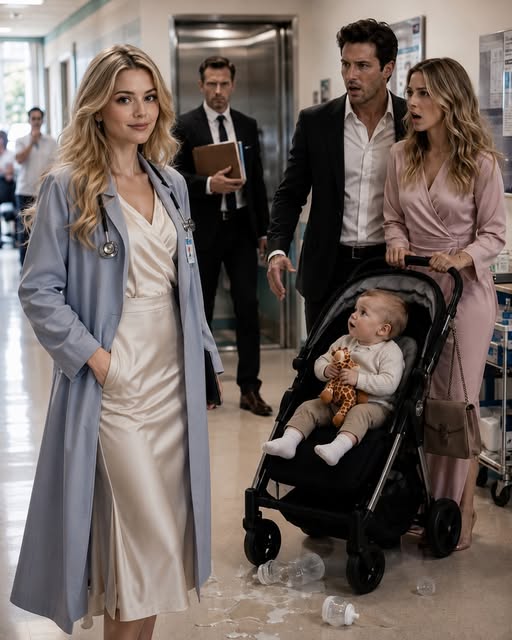

The shattered bottle seemed louder than it should have been.
Plastic pieces skittered across the polished hospital floor, spinning through a small puddle of milk until one fragment bumped gently against the toe of Connor’s expensive shoe. The baby in the stroller startled at the sound, his face crumpling before a soft cry escaped him.
That cry snapped me out of the silence first.
Because no matter what Connor had done, no matter what Melinda had hidden, the little boy in the stroller had done nothing.
I stepped forward before either of them moved.
“Careful,” I said, holding one hand out to stop Connor from stepping back into the broken pieces. Then I turned toward the nurses’ station. “Tanya, could we get housekeeping to the east corridor? Broken bottle near pediatrics.”
The nurse nodded immediately, already reaching for the phone.
Connor stared at me as if I had ruined a scene he had rehearsed in his head.
He had expected tears. He had expected embarrassment. Maybe he had expected me to crumble in front of the families waiting outside exam rooms, so he could walk away with proof that leaving me had made him victorious.
Instead, I had become the doctor in the hallway.
Calm hands.
Clear voice.
Eyes on the child first.
Melinda sank down beside the stroller, her fingers trembling as she tried to soothe the baby without touching the scattered plastic.
“It’s okay, Oliver,” she whispered. “It’s okay, sweetheart. Mommy’s here.”
The little boy’s cries softened when she placed one hand on his chest. He blinked up at her with damp blue eyes, trusting her completely.
Oliver.
So that was his name.
I had not known. I had made a point of not knowing. After the divorce, mutual acquaintances occasionally tried to deliver fragments of Connor’s new life like gossip wrapped in pity. Melinda gave birth. Connor bought a house near the lake. They posted family photos. He looked so happy. Did I want to see?
I never did.
I had protected my peace with the same discipline I brought into emergency rooms.
But now the child was in front of me, small and frightened, reaching for the stuffed giraffe that had fallen sideways in his stroller.
I picked it up carefully, checked it for broken plastic, then handed it to Melinda.
She took it without meeting my eyes.
“Thank you,” she whispered.
The word was so small I almost did not hear it.
Connor recovered first.
He always did. His charm and cruelty shared the same quick reflex.
“What is he doing here?” he demanded, glaring at Kenneth Boyd.
Kenneth stood a few feet from the elevator with the sealed folder tucked beneath one arm. He was in his late fifties, tall and lean, with silver at his temples and the kind of quiet steadiness that came from decades of watching people underestimate paperwork until it stood up in court.
He looked at Connor with professional politeness.
“Mr. Fleming.”
Connor’s jaw tightened. “This is a hospital. You can’t just appear here waving legal documents.”
“I’m not waving them,” Kenneth said mildly. “I’m carrying them.”
A father seated nearby covered a cough that sounded suspiciously like a laugh.
Connor shot him a look, then turned back to me.
“What is going on, Kirsten?”
I glanced toward the families in the hallway. A little girl with a cast on her arm watched us with wide eyes. A mother pulled her toddler closer. Nurses pretended to work while missing nothing.
This was exactly what Connor wanted: a public stage.
I would not give him one.
“Kenneth,” I said, “my office.”
Connor stepped into my path. “No. You don’t get to walk away after that little performance.”
I looked at him calmly.
“The performance was yours.”
Color rose in his face.
Melinda looked up sharply. “Connor, please.”
He ignored her.
“You think because you’re wearing a white coat, everyone here will take your side?”
“My side?” I repeated. “This is not a contest.”
“It always was with you.”
There it was. The old revision. The marriage rewritten into a story where my ambition was aggression, my pain was manipulation, and my boundaries were attacks.
I had spent years trying to argue with that version of myself.
Now I simply stepped around him.
“Housekeeping is coming,” I told Tanya. “Please make sure no one slips.”
Then I turned to Melinda.
“Oliver should be moved away from the broken pieces.”
She nodded quickly and rolled the stroller back with shaky hands.
I did not ask why she was trembling. Not yet.
Kenneth walked beside me toward my office, but before we reached the staff corridor, Connor followed.
“Whatever he has, it can wait,” Connor said. “We’re here for our son’s appointment.”
I stopped.
That part mattered.
“Oliver is a patient here?”
Melinda’s face tightened.
Connor answered for her. “Routine pediatric follow-up. Not that it’s any of your business.”
“If he is a patient in this wing, then this hallway will remain calm.” I looked directly at Connor. “Not for me. For him.”
He glanced back at the stroller.
For one second, embarrassment crossed his face.
Then pride buried it.
“Fine,” he said. “Let’s hear what your lawyer has to say.”
“No,” Kenneth said.
Connor blinked. “Excuse me?”
“This conversation involves Dr. Sinclair and, potentially, Ms. Harper.” Kenneth’s gaze moved to Melinda. “Not you. Not yet.”
Melinda went perfectly still.
Connor’s head turned slowly toward her.
“Melinda?”
She clutched the stroller handle.
“What does he mean?” Connor asked.
“I don’t know,” she whispered.
But she did.
Everyone in that hallway saw that she did.
I should have felt satisfaction.
Instead, I felt a deep, tired sadness.
Because secrets never stay buried quietly. They rise through floorboards and hospital corridors. They arrive with legal folders and trembling hands. They shatter baby bottles, startle children, and force the innocent to cry while adults face what they refused to say.
Kenneth lowered his voice.
“Kirsten, this should happen privately.”
I nodded.
“Melinda,” I said gently, “would you like to come with us?”
Connor’s eyes flashed. “She’s not going anywhere with you.”
Melinda looked at him.
Something passed through her face then—fear first, then exhaustion, then a thin line of courage so fragile I almost missed it.
“Yes,” she said.
Connor stared.
“What?”
“I said yes.” Her voice trembled, but she kept going. “I need to hear what this is.”
“Melinda, don’t be ridiculous.”
She flinched at the tone.
I had heard that tone in my own kitchen. My own car. My own bedroom.
Don’t be ridiculous.
Don’t be dramatic.
Don’t embarrass me.
Words that looked small until they became walls.
I stepped closer to her, careful not to crowd. “There’s a family waiting room down this hall. It’s private. Oliver can come with you.”
Melinda nodded.
Connor stepped forward again. “That is my son.”
Kenneth looked at him. “No one is disputing your right to remain near your child. But I strongly advise you not to interfere with Ms. Harper’s decision to speak privately.”
Connor gave a sharp laugh. “Advise me? You’re her attorney.”
“I am Dr. Sinclair’s attorney,” Kenneth said. “I have not yet determined whether Ms. Harper requires one.”
The sentence quieted the hallway more effectively than shouting would have.
Melinda’s face went white again.
I looked at Kenneth.
“What does that mean?”
His expression softened toward me, but only slightly. “That is what we need to discuss.”
We moved into the family waiting room.
It had soft blue walls, a small table with children’s books, and a window overlooking the hospital garden where rain-dark leaves trembled in the wind. I had sat with parents in this room when diagnoses changed lives. I had watched fear turn fathers silent and mothers fierce. I had learned to keep tissues in the cabinet beneath the sink because hospitals never provided enough.
Now I was not the doctor delivering news.
I was part of the news.
Melinda parked Oliver’s stroller near the sofa. Connor insisted on standing by the door until Kenneth gave him a look.
“If you remain,” Kenneth said, “you listen. You do not interrupt.”
Connor sneered. “You don’t give orders to me.”
“No,” Kenneth replied. “But judges do. And you may want to consider how your behavior sounds when described later under oath.”
Connor’s mouth shut.
He sat.
Melinda took the chair nearest Oliver. She kept one hand on the stroller canopy as if anchoring herself.
I remained standing for a moment, then sat across from her.
Kenneth placed the sealed folder on the table.
“Kirsten,” he said, “I came because the lab report arrived this morning.”
My pulse changed.
One year earlier, after the divorce, Kenneth had encouraged me to review financial and medical records connected to my fertility treatments. At first, I refused. I wanted freedom, not another tunnel back into grief. I had survived seven years of injections, tests, losses, and monthly hope collapsing into shame. When the divorce finalized, I told myself never again.
But Kenneth was careful.
He did not push.
He simply said, “Connor controlled too many files during the marriage. Make sure your past belongs to you before you leave it behind.”
So I requested everything.
Every clinic report.
Every embryo storage document.
Every billing record.
Every signed consent.
And that was when the inconsistencies began.
One missing vial.
One altered consent date.
One storage transfer no one remembered authorizing.
For months, Kenneth and I had followed records quietly through clinics, courier logs, invoices, and signatures. I had not told Connor. I had not told Melinda. I had not told anyone at the hospital.
Because some truths are too delicate to carry into daylight until they can stand on their own.
I looked at the folder.
“What lab report?” Connor demanded.
Kenneth ignored him.
“Kirsten,” he said gently, “the independent genetic analysis confirms that one of the embryos created during your final fertility cycle was transferred without your knowledge to a secondary storage account.”
Melinda closed her eyes.
The room shifted.
Connor sat forward. “What nonsense is this?”
Kenneth removed a document and placed it on the table.
“A chain-of-custody review of reproductive material from Northbridge Fertility Center.”
I stared at the words.
I had known this was possible. Suspected it. Feared it. But hearing it spoken aloud still made the room feel unsteady.
“One embryo,” Kenneth continued, “was listed as nonviable in the patient portal provided to Kirsten. However, the original embryology report marked it viable and suitable for transfer.”
My breath left me.
Nonviable.
That word had destroyed me.
I remembered sitting on the bathroom floor after reading the clinic message, my body sore from treatments, Connor standing in the doorway with his phone in his hand.
Maybe this is the universe telling us to stop, he had said.
I had cried so hard I could not breathe.
And somewhere, a viable embryo had been moved.
“Who authorized the transfer?” I asked, though I already knew whose signature had haunted the documents.
Kenneth looked at Connor.
“Mr. Fleming did.”
Connor rose halfway from his chair. “That is absurd.”
Kenneth slid a copy of the consent form across the table.
Connor froze.
His signature sat at the bottom.
Beside mine.
Except I had never signed that paper.
The room went very quiet.
Melinda covered her mouth.
I looked at Connor.
For years, I thought his betrayal began with Melinda.
It had begun earlier.
In a clinic.
In a place where hope was supposed to be protected.
“You forged my consent?” I whispered.
Connor’s face hardened.
“I was your husband.”
“That is not consent.”
His eyes flashed. “You wanted a child. I wanted a child. We were drowning in treatments and bills and disappointment. You were falling apart.”
“I was grieving.”
“You were obsessed.”
The old word struck, but it did not enter me the way it once would have.
I had heard too many frightened parents in hospital rooms to mistake grief for weakness anymore.
Kenneth spoke calmly. “Mr. Fleming, I strongly advise you to stop.”
Connor turned on him. “You don’t understand what it was like living with her. Every month, another failure. Another appointment. Another night of crying. I did what had to be done.”
I stared at him.
“What had to be done?”
He glanced at Melinda.
She was crying now, silent tears slipping down her face.
“Melinda wanted a baby,” he said.
The room seemed to fall away.
Melinda shook her head. “No.”
Connor’s expression sharpened. “Don’t start lying now.”
She turned to him, trembling. “You told me the embryo was yours and from a donor. You said Kirsten had signed away unused embryos after the divorce discussions started.”
I gripped the edge of my chair.
“There were no divorce discussions then.”
Melinda looked at me.
“I know that now.”
Connor scoffed. “Convenient.”
She flinched, then looked down at Oliver.
The baby had fallen asleep, one small fist resting near his cheek, the stuffed giraffe tucked beside him.
His innocence filled the room with unbearable tenderness.
Kenneth opened the next document.
“The genetic report also confirms something else.”
I looked at him.
He held my gaze for a long second, the way doctors do before changing a family’s life.
“Oliver is genetically related to you, Kirsten.”
The words entered softly.
Not like thunder.
Like the first note of a song I had once given up hearing.
My eyes moved to the stroller.
Oliver slept peacefully.
His blond lashes fluttered. His small mouth opened in a tiny sigh.
Related to me.
My heart seemed to stop, then restart painfully.
Connor’s voice cut through the moment. “Obviously. The embryo was created from our material.”
Kenneth looked at him.
“No.”
Connor frowned.
“What do you mean no?”
Kenneth turned another page.
“Oliver is not genetically Connor Fleming’s child.”
The room went still.
Connor’s face emptied.
Melinda’s head lifted slowly.
I could hear the rain against the window. A cart rolling somewhere in the hallway. A child laughing in another room, beautifully unaware.
“What?” Connor said.
Kenneth’s voice remained even. “The genetic markers exclude Mr. Fleming as Oliver’s biological father.”
“That’s impossible.”
“It is not.”
Connor stared at Melinda.
She looked just as stunned as he did.
“Kirsten,” she whispered, “I didn’t…”
Her voice broke.
I could not speak.
Oliver was genetically related to me, but not Connor.
My mind moved through years of fertility records. Donor discussions. Failed attempts. Embryo creation. The final cycle. The missing vial.
Then I remembered something the clinic director said in an email three months earlier.
There were irregularities involving donor genetic material during the period in question.
I had assumed it was technical language.
Now it felt like a door opening.
“Who is the father?” Connor demanded.
Kenneth did not answer immediately.
“Kenneth,” I said.
His eyes shifted to me.
“We do not have a confirmed paternal match yet.”
“But you know something.”
“Yes.”
Connor stepped toward the table. “Tell me who.”
Kenneth looked at him coldly. “You do not have standing to demand that information.”
Connor laughed in disbelief.
“I raised him for a year.”
Melinda’s face twisted with pain.
“You held him when cameras were around,” she said quietly.
Connor turned on her. “Excuse me?”
She seemed to shrink for a moment.
Then she looked at Oliver.
And grew still.
“You heard me,” she said.
It was not loud.
It did not need to be.
Connor stared at her as if she had betrayed him.
Maybe she had, but not in the way he thought.
Melinda wiped her face and looked at me.
“Kirsten, I knew about the affair. I knew that was unforgivable. But I did not know he took anything from you. I swear on my son’s life.”
“Don’t,” Connor snapped.
She stood, trembling but upright. “No. I’ve been quiet long enough.”
He moved one step closer. “Melinda.”
Kenneth stood too. “Mr. Fleming.”
The warning stopped him.
Melinda took a breath.
“He told me you had abandoned the embryos. He said you couldn’t bear to destroy them but didn’t want to use them. He said you signed consent for anonymous transfer.”
“That makes no sense,” I said, my voice barely audible. “Embryos cannot simply be given away like furniture.”
“I know that now.” Her face crumpled. “At the time, I wanted to believe him. I wanted a baby so badly. I had lost two pregnancies. I was ashamed. And Connor kept saying you had everything—career, respect, stability—and that you didn’t even want motherhood anymore.”
My throat tightened.
That was how he worked.
He gave people a version of me that made his cruelty seem like balance.
“He lied,” I said.
“I know.” Melinda’s voice broke. “I know.”
Connor laughed harshly. “This is touching, but none of it changes anything. Oliver is my son legally.”
Kenneth turned to him.
“That may be reviewed.”
Connor’s face darkened.
“You try to take my child, and I will bury all of you in court.”
The baby stirred at the harshness in his voice.
I stood.
Every eye turned toward me.
“Lower your voice,” I said.
Connor blinked.
It was not the command itself that surprised him.
It was the person giving it.
Once, I would have begged him not to cause a scene. I would have looked around anxiously, humiliated by attention, desperate to make myself small enough that his anger would pass over me.
Now I stood in a hospital family room with my name on a white coat and a sleeping child between us.
I was not small.
“Oliver is asleep,” I continued. “He is in a pediatric wing. There are sick children, exhausted parents, and staff trying to work. Whatever legal storm you created, you will not bring it down on him in this room.”
Connor’s mouth opened.
No words came.
Kenneth’s expression softened, just briefly.
Melinda looked at me as if she had never seen me clearly before.
Maybe she hadn’t.
Maybe none of them had.
A knock sounded at the door.
Tanya leaned in. “Dr. Sinclair, sorry to interrupt. Your department meeting was moved, and Dr. Patel said to take all the time you need.”
“Thank you.”
Her eyes moved once around the room, protective and curious, then she left.
Connor looked at my badge again.
Dr. Kirsten Sinclair.
He had mocked my work as ambition that ruined our marriage. Yet that work had built the ground beneath my feet when everything personal cracked open.
Kenneth gathered the documents.
“Mr. Fleming, I will be filing today for preservation of all records from Northbridge Fertility, related storage facilities, and the clinic where Ms. Harper underwent implantation. You should retain independent counsel.”
Connor’s face went pale beneath the anger.
“I already have counsel.”
“Then call them.”
Melinda sat back down slowly, one hand on the stroller.
“What happens to Oliver?” she whispered.
That was the only question that mattered.
Not Connor’s pride.
Not my grief.
Not Melinda’s guilt.
Oliver.
A child born from lies but not made of them.
Kenneth’s voice gentled. “Nothing sudden. No one is taking him from the arms that feed him tonight. The court will prioritize his stability. But the truth of how he came to be must be addressed.”
Melinda closed her eyes in relief and fear.
I looked at Oliver again.
Genetically related to me.
Not Connor’s.
A child I had never carried but whose existence was tied to the most painful years of my life.
I did not know what I felt.
Wonder.
Grief.
Anger.
A tenderness I had no right to claim and no way to ignore.
Connor picked up his diaper bag abruptly.
“We’re leaving.”
Melinda looked up. “Oliver has an appointment.”
“We’re leaving.”
“No.”
The word stunned him.
It stunned me too.
Melinda stood slowly.
“We are staying for his appointment.”
Connor’s eyes narrowed. “Don’t start.”
“I am not starting anything,” she said, voice shaking. “I am finishing the part where you decide everything while I pretend it is love.”
The words entered the room and struck places I did not expect.
Connor looked at her with open contempt. “You think she’ll protect you? After what you did?”
Melinda glanced at me.
I said nothing.
I could not promise protection.
Not yet.
But I could offer truth.
“She doesn’t need me to protect her from a pediatric appointment,” I said. “She needs you to stop escalating in front of a child.”
Connor’s face flushed.
For a moment, I thought he might argue.
Then his phone rang.
He glanced at the screen.
His expression changed.
Not anger.
Fear.
Kenneth noticed.
So did I.
Connor silenced the call.
A second later, my own phone vibrated.
Unknown number.
I took it from my coat pocket.
A message appeared.
Do not let Connor leave with the boy. He is not the only child taken from Northbridge.
My blood went cold.
Kenneth read it over my shoulder.
His face hardened.
Another message arrived.
Ask Dr. Sinclair why her final cycle produced three viable embryos, not one.
The room seemed to tilt.
Three.
My hand tightened around the phone.
Connor had gone very still.
Melinda whispered, “What does that mean?”
I looked at Kenneth.
He was already reaching for his phone.
“Kirsten,” he said carefully, “when Northbridge released your patient summary, how many embryos did they report from that cycle?”
“One nonviable,” I whispered. “That was what I was told.”
“And the independent embryology archive showed one viable missing embryo,” he said.
I nodded.
But the message said three.
Three viable embryos.
Oliver slept peacefully while the adults around him silently counted lives hidden in paperwork.
Connor backed toward the door.
Kenneth’s voice sharpened. “Mr. Fleming, do not leave.”
Connor laughed, but it came out strained. “You cannot detain me.”
“No,” Kenneth said. “But if you leave after receiving notice of preservation concerns involving a minor child and medical records, it will be noted.”
Connor’s hand tightened on the diaper bag strap.
Then the waiting room door opened from the hallway.
A woman stepped inside.
She was older, perhaps in her sixties, with neatly pinned gray hair and a hospital visitor badge clipped to her coat. Her face was pale, her eyes wet, and both hands clutched a manila envelope against her chest.
She looked straight at me.
“Dr. Sinclair?”
“Yes?”
“My name is Ruth Ellison,” she said. “I was a senior nurse at Northbridge Fertility.”
Kenneth moved subtly closer to me.
Connor looked as if he might be sick.
Ruth’s gaze flicked to him, then to Melinda and the stroller.
“I’m sorry,” she whispered. “I should have come sooner.”
My pulse roared in my ears.
“Come sooner for what?”
She swallowed.
“The embryos. The records. All of it.”
Connor snapped, “This woman is confused.”
Ruth flinched, but did not retreat.
“No,” she said softly. “Not anymore.”
Kenneth gestured to a chair. “Ms. Ellison, you should speak carefully.”
“I know.” She held out the envelope. “I brought copies. Not originals. I’m not foolish enough to bring originals.”
Her eyes returned to me.
“Your final cycle produced three viable embryos, Dr. Sinclair. One was transferred to Ms. Harper and became Oliver. One was moved to a private storage account. The third…” Her voice broke. “The third was implanted under another patient’s file.”
My knees weakened.
Kenneth took my arm gently.
Another child.
Somewhere.
A child connected to me.
Melinda covered her mouth, sobbing silently.
Connor looked trapped now. Truly trapped.
“Who?” I asked.
Ruth’s eyes filled with tears.
“I don’t know the patient’s real name. Northbridge used coded records for certain private transfers. But I know the child was born nine months ago.”
The world narrowed.
Nine months ago.
Oliver was one.
Another child had been born.
A child whose beginning had been stolen from me, hidden inside a system I had trusted with my deepest grief.
Ruth placed the envelope on the table.
“There is one more thing,” she said.
I could barely breathe. “What?”
“The missing embryo in storage was accessed last week.”
Kenneth’s head snapped up. “By whom?”
Ruth looked at Connor.
Then at me.
“The authorization came from an account linked to Fleming Family Holdings.”
Connor’s voice turned cold. “That is impossible.”
Ruth shook her head.
“It happened.”
My phone vibrated again.
This time, the message contained a photograph.
A clinic storage canister.
On the label was my name.
Kirsten Sinclair.
Beside it was a handwritten note.
One left.
And beneath that:
Tell Connor the twins are ready when he is.
Melinda made a small sound.
I stared at the words.
Twins.
Ready.
Connor’s fear had become unmistakable now.
Kenneth immediately began speaking into his phone, requesting emergency filings, preservation orders, injunctions, things I could barely process through the pounding in my chest.
But I could process one thing clearly.
This was no longer only about Connor’s cruelty in a hallway.
It was not only about Melinda’s betrayal.
It was about children.
Oliver.
The hidden child born nine months ago.
The remaining embryo someone had accessed.
Lives treated like leverage by people who mistook creation for ownership.
I looked at Connor.
For the first time, he did not look smug.
He looked afraid of something bigger than me.
“Who sent that?” I asked him.
He shook his head.
“I don’t know.”
For once, I believed he was not entirely lying.
Ruth Ellison lowered herself into a chair, trembling.
“I kept quiet because I was afraid of losing my license,” she said. “Then I saw the appointment listing this morning. Oliver Harper. Pediatric wing. Dr. Kirsten Sinclair on service. I thought…” She looked at me helplessly. “I thought maybe the truth had found its own way here.”
Melinda reached into the stroller and took Oliver’s tiny hand.
“I thought he was mine,” she whispered.
I looked at her.
“He is yours,” I said, before I could stop myself.
Everyone turned toward me.
I swallowed hard.
“You carried him. You fed him. You know the sound he makes before he cries. You know how he likes his blanket and how to soothe him when he’s afraid.” My voice broke. “The truth matters. What happened matters. But he is not a prize to be passed around because adults lied.”
Melinda sobbed once, covering her face.
Kenneth looked at me with quiet pride.
Connor looked away.
The emotional conflict inside me shifted then.
For a year, I thought Connor and Melinda had taken the family I could not have.
Now I was staring at proof that something had been taken from all of us—my consent, Melinda’s trust, Oliver’s origin, and perhaps the life of another child somewhere who had no idea a hospital waiting room had just begun searching for them.
My anger remained.
But it was no longer empty.
It had direction.
Protection.
“Ms. Ellison,” Kenneth said, “we need names. Files. Anything that can help identify the other child.”
She nodded, wiping tears with a tissue.
“I have a ledger.”
My breath caught.
“A ledger?”
“Northbridge kept informal transfer notes for private clients. Not in the official system. I copied pages before I resigned.”
“Where is it?” Kenneth asked.
Ruth’s eyes moved to the hallway.
“In a safe deposit box. But I brought the index page.”
She opened the envelope and withdrew a folded sheet of paper.
Kenneth put on his reading glasses.
I stood beside him, heart pounding.
The index page listed codes, dates, initials, and outcomes.
One line had Oliver’s date of birth.
Embryo: K.S.-F4.
Recipient: M.H.
Outcome: Male live birth.
M.H.
Melinda Harper.
Below that was another entry.
Embryo: K.S.-F5.
Recipient: Private file A17.
Outcome: Female live birth.
Female.
A daughter.
Somewhere.
My hand pressed against the table.
I had a daughter somewhere.
Not legally. Not emotionally. Not in any way simple enough for language.
But genetically, biologically, impossibly—a child connected to me had been born nine months ago.
And I had not known.
I looked at Kenneth.
“We find her.”
He nodded.
“Yes.”
Before anyone could speak again, the door opened.
This time it was hospital security.
The officer looked apologetic.
“Dr. Sinclair, there’s a couple at the nurses’ station asking for you.”
My breath caught.
“What couple?”
“They say they were told to come here by Kenneth Boyd.” He glanced at Kenneth. “Their names are Daniel and Grace Whitman.”
Kenneth frowned. “I didn’t call anyone.”
Ruth’s face went white.
I turned toward her. “Do you know them?”
She nodded, tears forming again.
“Private file A17,” she whispered. “Grace Whitman.”
The room went utterly still.
Outside the waiting room, I heard a woman’s anxious voice.
“We received a message saying our daughter’s medical history was needed urgently. Please, she’s only nine months old.”
My heart stopped.
A baby began crying in the hallway.
Not Oliver.
Another baby.
A thin, frightened cry that seemed to move straight through my bones.
Connor whispered, “No.”
Melinda clutched Oliver closer.
Kenneth looked at me, silently asking whether I was ready.
I was not.
No one could be ready for a child to arrive at the door of your life through fraud, grief, and a stranger’s fear.
But I stood anyway.
The waiting room door opened wider.
A young woman stepped inside holding a baby girl wrapped in a yellow blanket. Beside her stood a man with protective eyes and one hand on the diaper bag over his shoulder.
The baby turned her face toward the room.
She had soft brown curls, round cheeks, and eyes exactly like mine.
Grace Whitman looked from me to Ruth, then to Kenneth.
“What is going on?” she asked.
No one answered.
Because at that same moment, Connor’s phone rang again.
He did not move.
Kenneth picked it up from the table where Connor had dropped it earlier during the chaos.
The caller ID showed one word.
Northbridge.
Connor closed his eyes.
Kenneth answered on speaker.
A calm male voice filled the room.
“Mr. Fleming, congratulations. The surrogate has arrived in Seattle. If Dr. Sinclair remains difficult, we can proceed with the final transfer tonight.”
My blood turned cold.
Kenneth’s face went hard.
The man continued, unaware the room was listening.
“After all, one embryo left is one heir left. And this time, no one needs to know who the mother really is.”
END OF PART 2 – LIKE, SHARE AND COMMENT “THE ENTIRE STORY” IF YOU WANT TO READ THE FULL STORY