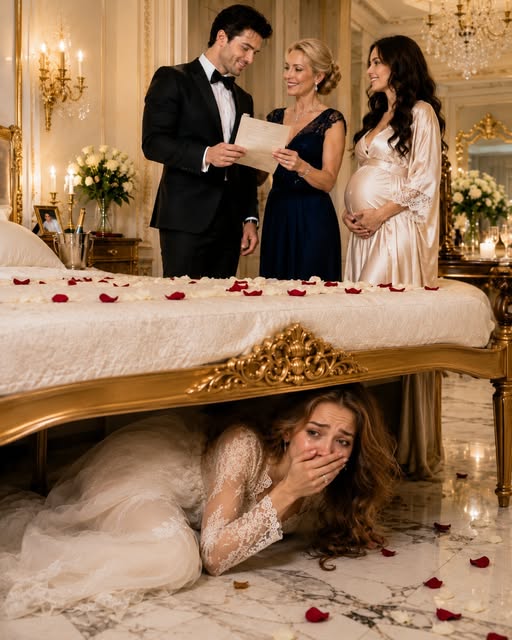
 The gates opened before my car reached them.
For a moment, I simply sat behind the wheel, staring up the long drive toward the house where I had grown up. The Wilson home rose from the hillside in quiet layers of stone, glass, and dark cedar, its windows glowing against the gray-blue hour before dawn.
I had once thought the place too large, too polished, too full of echoes.
That morning, it looked like shelter.
My father was waiting beneath the portico in a wool coat thrown over his pajamas. His silver hair was uncombed, and one side of his collar had folded inward. I had not seen him look so unguarded since my mother died.
He opened my door before I could reach for the handle.
“Ella.”
That was all he said.
I stepped out, and the strength I had been holding together since the hotel suite finally broke. I pressed my face against his chest as he wrapped both arms around me.
For years, I had insisted I did not need rescuing.
My father, to his credit, had learned to let me prove it.
But there are moments when being held is not the same thing as being saved. It is simply permission to stop pretending you are not hurt.
“I married him,” I whispered.
“I know.”
“I stood in front of everyone and promised—”
“I know.”
His hand moved slowly over the back of my head.
Behind him, Rebecca appeared in the doorway. She wore dark trousers and a cream sweater, her hair tied at the nape of her neck. She had been my father’s general counsel for fifteen years and his wife for six, although she never tried to replace my mother or ask me to call her anything but Rebecca.
She took one look at my face and stepped aside.
“Come in,” she said. “We’ll deal with facts first. Feelings can have the rest of the house.”
It was exactly the kind of sentence Rebecca would say, brisk enough to sound practical and gentle enough to keep me from falling apart again.
Inside, the familiar scent of cedar and coffee surrounded me. A fire had been lit in the library. My father guided me toward the sofa while Rebecca closed the curtains, set her laptop on the low table, and placed a legal pad beside it.
No one asked me whether I was sure.
No one told me I might have misunderstood.
Rebecca held out her hand.
“May I hear the recording?”
My fingers tightened around my phone.
The device suddenly felt heavier than it had in the hotel. It held the last moments of my marriage as I had understood it. Once I played it for someone else, the betrayal would become more than a private horror. It would become evidence.
My father sat beside me.
“You decide,” he said.
I looked at him. “If I wait, I might talk myself into forgiving something that hasn’t even stopped happening.”
Rebecca’s expression softened.
“That is a very clear answer.”
I unlocked the phone and handed it to her.
She transferred the file to her laptop, made two encrypted copies, and placed the original device inside a small evidence pouch she retrieved from her workbag.
“You carry evidence pouches to family emergencies?” I asked.
“I carry them everywhere.”
My father gave a tired sigh. “She once bagged a dinner receipt because the waiter altered the tip.”
“The waiter altered the tip,” Rebecca replied.
Despite everything, a small, broken laugh escaped me.
Then she pressed play.
The sound of the hotel room filled the library.
Cynthia’s voice came first, smooth and confident.
“I’m already in the room.”
Hearing it again was worse.
Under the bed, I had been too shocked to understand each sentence fully. My mind had caught pieces—apartment, Brenda, baby, unstable—and built them into something monstrous.
Now, in the safety of my father’s library, every word was distinct.
Every pause had meaning.
Rebecca listened without interruption. My father did not move, except once, when Elias called me plain rice. His hand closed around the arm of the sofa until his knuckles whitened.
I touched his wrist.
“Don’t.”
He looked at me, the anger in his eyes giving way to pain.
“I welcomed him into this family.”
“He didn’t know what family he was entering.”
“That should not have mattered.”
“No,” I said. “It shouldn’t have.”
The recording continued.
Elias discussed the apartment as if it were a prize waiting to be claimed. Cynthia described how they would isolate me from friends, encourage me to leave my job, and create arguments in front of witnesses. They planned to frame their manipulation as concern.
Rebecca paused the recording.
“This part matters,” she said.
“All of it matters,” my father replied.
“Emotionally, yes. Legally, we need to separate cruelty from conduct.” She turned to me. “Did Elias ever pressure you to put the apartment in both names?”
“He said it would make us feel like a real married couple.”
“Did you?”
“No. The trust purchased it through a holding company. Elias thinks the mortgage is in my name.”
My father’s gaze sharpened. “You never told him?”
“I never told anyone.”
The apartment was not a mansion. It was a two-bedroom place in a quiet building near Laurel Heights, with wide windows and pale oak floors. I had chosen it because it felt like a home two ordinary people might build together.
The money had come from a trust my mother created before she became ill. The title belonged to a limited liability company managed by an independent trustee. Elias’s name appeared nowhere.
I had intended to explain it after the wedding.
I had thought marriage required complete honesty.
Apparently, I had been the only one.
Rebecca wrote a note.
“Has he contributed to renovations, taxes, or major repairs?”
“No. He sends money toward utilities and groceries.”
“Document every payment. Do not move funds. Do not threaten him. Do not announce what you know.”
“I’m not going back there.”
“No,” my father said immediately. “You are not.”
Rebecca glanced at him. “That is Ella’s decision.”
“It is.”
They both looked at me.
The fire shifted in the grate with a soft crack.
“I don’t want to see him,” I said. “But I also don’t want to disappear and let them decide what my silence means.”
“Then we proceed carefully,” Rebecca said. “You preserve the recording, speak to a family-law attorney, and make no statement you may later regret.”
“I already regret the vows.”
“That is different.”
She resumed the recording.
Near the end, the voices became less distinct. Someone moved farther from my phone. A drawer opened. Glass touched glass. Cynthia lowered her voice.
At the hotel, I had barely heard the final exchange. I had been watching the shadows beneath the bed, terrified that someone would kneel and see me.
Now Rebecca leaned closer to the speakers.
“Play that again,” my father said.
She rewound ten seconds.
Cynthia’s voice emerged beneath the rustle of fabric.
“…before she finds the file.”
Elias answered, but the first words were muffled.
Then came a sentence I had forgotten entirely.
“If Malcolm kept a copy of the inspection report, it could connect all three of us to Harbor Point.”
Rebecca stopped the recording.
The room went still.
My father stared at the laptop.
I had heard the name before, but only in passing.
Harbor Point was a mixed-use development south of the city, completed nearly eight years earlier. One section had been closed after a parking structure suffered a partial failure. No one had died, but three workers had been injured, one badly enough that he never returned to construction.
The project had not belonged to my father’s company.
At least, I had never thought it did.
“What is Harbor Point?” I asked.
My father did not answer immediately.
Rebecca’s eyes remained on him.
“Jonathan.”
He stood and walked toward the window, even though the curtains were closed.
“Wilson Construction bid on the early phase,” he said. “We withdrew before work began.”
“Why?”
“Because the soil reports were inconsistent.”
Rebecca folded her hands. “That is the public answer.”
My father turned.
“The private answer is that someone tried to bribe one of our engineers.”
The warmth seemed to leave the room.
“Who?”
“Malcolm Pierce.”
The name struck me with a faint sense of recognition.
“Cynthia’s brother?”
My father nodded.
I remembered meeting Malcolm twice. He had lived in Oregon and avoided family gatherings, according to Elias, because he disliked crowds. At the rehearsal dinner, Cynthia had said Malcolm worked in commercial consulting before his death.
“He died three years ago,” I said.
“In a car accident,” Rebecca added quietly.
My father returned to the sofa but did not sit.
“Malcolm was a project broker. He connected developers, lenders, subcontractors, and inspectors. He approached one of our geotechnical engineers and offered him money to approve a foundation plan our team considered unsafe.”
“Did the engineer take it?”
“No. He reported it.”
“What happened?”
“We withdrew. Another contractor took the job. Harbor Point was completed, and five years later part of the lower parking structure failed.”
I looked at the phone sealed inside the evidence pouch.
“And Malcolm kept an inspection report?”
“That appears to be what Cynthia believes.”
“What does it have to do with Elias?”
My father’s expression changed.
Not anger this time.
Recognition.
“I don’t know.”
Rebecca replayed the final minute again, increasing the volume and filtering some of the background noise through her laptop.
A different layer of the conversation became audible.
Elias said, “Malcolm promised the revised report was the only version in circulation.”
Cynthia replied, “Malcolm promised many things. He also left a storage key in that apartment before Ella bought it.”
My mouth went dry.
“That apartment?”
Rebecca rewound it.
Again, Cynthia’s voice: “He also left a storage key in that apartment before Ella bought it.”
The three of us looked at one another.
My father sat down at last.
“Did you ever find a key?”
“No.”
“Anything belonging to a previous owner?”
“The apartment was empty when I moved in.”
Rebecca picked up her pen. “Who selected the apartment?”
I thought back to the first viewing. Elias had been enthusiastic before we even crossed the lobby. He said he had passed the building many times and always liked the neighborhood.
“He did.”
“Who found the listing?”
“Elias sent it to me.”
The truth arrived slowly, one piece at a time.
The wedding had not begun the plan.
The apartment had.
Possibly even our first meeting.
I rose too quickly, and the room tilted.
My father steadied me.
“I need air.”
He led me through the glass doors onto the terrace.
Morning had begun to pale the horizon. The city below was still mostly dark, its lights scattered through the fog. Somewhere beyond the hills, traffic had started moving across the bridge.
I wrapped my arms around myself.
“I thought he loved that apartment because I loved it.”
My father stood beside me.
“People like Elias often borrow the language of affection because it is easier than developing the feeling.”
I looked at him. “You sound like you already decided what kind of person he is.”
“I decided when I heard him laughing.”
“Maybe I should have seen it.”
“No.”
“I ignored things.”
“That is not the same as causing them.”
“He always wanted to know when I would receive money from the trust. He pretended it was about planning. He asked whether my mother had left property. He joked about hidden fortunes.” I shook my head. “I thought he was insecure because I earned more than he did.”
“Ella.”
“I spent two years protecting myself from being loved for money, and I still chose someone who was trying to use me.”
My father’s voice grew quiet.
“You chose someone based on the person he presented himself to be. That is not stupidity. It is the risk every sincere person takes.”
“I lied too.”
He frowned.
“About who I was.”
“You did not invent another partner. You did not plan to remove him from his home. You kept your family’s finances private.”
“I let him think I came from nothing.”
“You told him your mother died, your father lived outside the city, and you wanted to support yourself. All of that was true.”
“It was incomplete.”
“Then perhaps one day you would have owed him an explanation.” My father’s eyes held mine. “You did not owe him access.”
The distinction did not heal anything, but it gave the pain a shape I could hold.
Inside, Rebecca’s phone began to ring.
She answered, spoke briefly, and came onto the terrace.
“That was hotel security,” she said. “Elias reported Ella missing twenty-three minutes ago.”
My father straightened.
“What did they tell him?”
“Nothing. The desk manager confirmed Ella left through a side stairwell, but security will not release footage without consent or legal process.”
“Did he call the police?”
“Not yet.”
My own phone sat sealed on the table inside. I had turned it to airplane mode before leaving the hotel, but once Rebecca removed it from the pouch to create the evidence copies, dozens of messages had appeared.
Elias had called eleven times.
The first messages were almost playful.
Where are you, bride?
Did you sneak out for food?
Very funny, Ella.
Then the tone shifted.
This isn’t like you.
Please answer.
Mom says she hasn’t seen you.
By the final message, he sounded frightened.
Call me now. Something is wrong.
He knew.
Maybe not that I had recorded them, but he knew the room had not been empty.
“Why would he think something is wrong?” I asked.
Rebecca returned to the laptop.
On the recording, after Cynthia and Elias left, there had been several minutes of silence before I crawled out. Rebecca moved to the final seconds.
A door opened.
Elias’s voice sounded again, farther away.
“Her purse is here.”
Cynthia replied, “Then she must be downstairs.”
“No. She never leaves it.”
There was a pause.
Then Elias said, “Mom, the bed skirt is caught.”
I closed my eyes.
They had returned before I reached the stairwell.
They had seen the disturbed carpet.
The dust on my dress might also have marked the edge of the bed frame. Perhaps they found one of the pearl pins that had fallen from my hair.
“Now we know why he is searching,” Rebecca said.
My father glanced toward the gates. “Can he track her?”
“The phone is no longer transmitting. Her car does not have a shared navigation account.”
“He knows where I work,” I said. “He knows my friends.”
“Does he know this address?”
“No. I told him my father lived near Sacramento.”
My father gave me a look.
“You moved the family home sixty miles for him?”
“I was trying to be convincingly ordinary.”
“Your commitment to detail has always been exhausting.”
Another laugh escaped me, softer this time.
Then Rebecca’s expression changed.
“What?”
She turned the laptop so we could see.
An email had arrived in my personal account.
The sender was Elias.
The subject line read: I KNOW YOU HEARD US.
For several seconds, no one moved.
Rebecca opened it.
Ella,
I don’t know how much you heard, but it is not what you think. My mother has been controlling this situation for years. I should have told you before the wedding, and I will explain everything, including Harbor Point.
Please do not speak to anyone until you hear me out.
There are documents in the apartment that could put innocent people in danger if Cynthia reaches them first.
I am going there now.
Please call me.
Elias
My father read it twice.
“He says innocent people are in danger.”
“He is trying to make her respond,” Rebecca said.
“What if he isn’t?” I asked.
They both turned toward me.
I hated that a part of me still wanted there to be an explanation.
Not an explanation that made Elias innocent. I had heard too much for that.
But perhaps an explanation that made the last two years real in some small way. Perhaps he had cared for me and still betrayed me. Human beings were capable of holding tenderness and selfishness in the same heart.
That possibility was almost harder to bear than simple deception.
Rebecca closed the email without replying.
“You cannot go to the apartment alone.”
“I wasn’t going to.”
“You were considering it.”
“I was considering the documents.”
“Those are different statements.”
My father reached for his phone.
“I’ll send security.”
“No,” I said.
He paused.
“I don’t want a team of men surrounding my building before sunrise. My neighbors don’t need to become part of this.”
“Then I will go.”
“You are not walking into an unknown situation.”
His eyebrows rose. “I have been walking into unknown situations since before you were born.”
“And Rebecca has spent half her career stopping you.”
“That is true,” Rebecca said.
My father ignored her.
In the end, we agreed on something less dramatic.
Rebecca would contact a private investigator her firm used for evidence preservation. He would meet us at the apartment, along with a locksmith and an off-duty building manager. We would enter only after confirming Elias and Cynthia had left or agreed to remain in the lobby.
There would be no confrontation.
No accusations.
Only documentation.
While Rebecca made the calls, I went upstairs to change.
My old bedroom had been kept almost exactly as I left it, although the walls were now a warm gray instead of pale blue. A photograph of my mother stood on the dresser.
She was laughing in the picture, her face turned away from the camera, one hand holding down the brim of a straw hat.
I sat on the edge of the bed.
Before she died, my mother had tried to teach me the difference between privacy and fear.
“Privacy protects what is yours,” she once told me. “Fear hides who you are.”
At twenty-three, I had been certain I understood.
I had built a simple life, taken an administrative position under a shortened version of my name, and refused every introduction my father offered. I wanted to know what kind of person I was when the Wilson name opened no doors.
At first, it had felt freeing.
Then hiding became habit.
I let colleagues think I could not afford lunch at expensive restaurants. I let Elias believe the small inheritance I mentioned had been almost exhausted by the apartment deposit. I edited my childhood into a series of vague stories about public schools, summer jobs, and a distant father.
The stories were not entirely false.
That was what made them easy.
I wondered whether my secrecy had created a space where Elias’s lies could grow unnoticed.
Then I remembered his laughter in the hotel room.
Responsibility was not the same as blame.
I could examine my choices without carrying his.
I changed into dark trousers, a sweater, and flat shoes. When I looked into the mirror, faint marks from the wedding makeup remained beneath my eyes.
Less than twelve hours earlier, I had stood before two hundred guests in white silk.
Now my wedding dress lay folded into a hotel laundry bag in the trunk of my car.
I did not know whether I was still married in any meaningful sense.
Legally, yes.
Emotionally, the answer shifted with every breath.
Downstairs, Rebecca handed me coffee and a folder.
“What is this?”
“A timeline. Fill in everything you remember about the apartment purchase, Elias’s questions regarding your trust, Cynthia’s visits, and any mention of Malcolm.”
“You prepared a timeline already?”
“I prepared headings.”
My father appeared wearing a suit, although he had forgotten to shave.
“You are not coming,” Rebecca told him.
“I own the car.”
“You own several cars.”
“I am her father.”
“And you are visibly angry.”
He looked at me for support.
“She’s right,” I said.
His shoulders lowered.
“I dislike both of you.”
“We know,” Rebecca replied.
He touched my cheek before we left.
“Call me before you go inside.”
“I will.”
“And Ella?”
“Yes?”
“You are allowed to grieve before you decide what to do next.”
I nodded, unable to answer.
The city was fully awake by the time Rebecca and I reached my building.
Fog hung low over the streets. Delivery trucks blocked one lane, and a man in a green apron arranged buckets of flowers outside the corner market where Elias had often bought me sunflowers.
I looked away.
The investigator, Daniel Cho, met us in the underground garage. He was in his late forties, dressed in a navy jacket and carrying two compact equipment cases. The building manager stood beside him.
“Mr. Hale arrived at five forty-eight,” Daniel said. “He entered the apartment with his key and left sixteen minutes later carrying a leather document case.”
My pulse jumped.
“Was he alone?”
“His mother waited in a car across the street. They left together.”
“Did he take anything else?”
“Not visibly.”
Rebecca asked, “Did you photograph the case?”
Daniel showed us a time-stamped image on his phone.
The case was dark brown, narrow, and old-fashioned.
I had never seen it before.
We entered the building through the garage elevator.
As the doors rose, I tried to prepare myself for the apartment.
I expected damage.
Open drawers. Papers scattered. Closets emptied.
Instead, the living room looked almost normal.
The throw blanket was folded over the sofa. Two wedding gifts remained unopened on the dining table. A vase of white roses from Cynthia stood beside them, already browning at the edges.
My breath caught when I saw Elias’s coffee cup in the sink.
He had been here minutes earlier, moving through the rooms where we had planned to begin our life.
Daniel photographed the locks, windows, and main rooms before touching anything.
Rebecca stayed near me.
“Where would a storage key be hidden?”
“I don’t know.”
“Did the apartment come with a storage unit?”
“There’s a small cage in the basement. We keep luggage there.”
“Anything built into the walls? A safe?”
“No.”
We searched carefully.
Daniel examined the study first. One bookshelf had been moved slightly away from the wall, leaving a pale line in the dust. Behind it, he found nothing but an electrical outlet.
In the bedroom, a vent cover had been removed and replaced. Inside was empty space.
“He knew where to look,” I said.
“Yes,” Daniel replied. “That does not mean he found what he wanted.”
The thought gave me little comfort.
In the kitchen, Rebecca opened the drawer where I kept spare keys. Several were missing.
“My storage key,” I said. “And the mailbox key.”
Daniel documented the drawer.
We went downstairs.
The basement smelled of concrete, detergent, and cold metal. Rows of storage cages lined the far wall, each secured with a separate padlock.
Mine stood open.
The lock had not been forced. Elias had used the missing key.
Inside, two suitcases had been shifted aside. A box of winter clothes sat open. Dust covered the floor except for a rectangular clean patch near the back wall.
Something had been removed.
“The document case,” I said.
Daniel crouched and photographed the mark.
Rebecca studied the metal shelving.
“When did you last come down here?”
“Three months ago.”
“Was anything stored in that space?”
“I don’t remember.”
I knelt, trying to picture the unit as it had been. Suitcases. Holiday decorations. A broken lamp I kept intending to repair. Several boxes left by the previous owner had been cleared out before I moved in.
Except one.
“There was a wooden wine crate,” I said.
Rebecca looked at me.
“It was empty. At least, I thought it was. It had a false-looking bottom, but I never checked. I used it to hold wrapping paper.”
“Was it here three months ago?”
“Yes.”
“And now?”
We searched the unit.
The crate was gone.
I leaned back against the cold wall.
Elias had not gone to the apartment because he feared for me.
He had gone for the case.
Daniel continued examining the floor. Near the rear corner, he picked up a small torn piece of blue paper with tweezers.
A handwritten number crossed one edge.
Rebecca photographed it.
“Could be a locker number,” she said.
“Or part of an address,” Daniel replied.
I stared at the scrap.
Something about the color bothered me.
My mother had used blue stationery for personal letters. Not ordinary blue, but a muted shade she called harbor blue.
It was probably coincidence.
Still, I asked Daniel to turn the paper over.
On the back, barely visible near the torn edge, was the top of an embossed letter.
W.
Rebecca saw it too.
“Wilson?”
“Maybe.”
My phone vibrated inside the evidence pouch.
Elias was calling again.
This time, Rebecca let it ring out.
A voicemail appeared seconds later.
We returned upstairs before listening.
Elias’s voice sounded strained.
“Ella, the case was gone when I got there. My mother thinks you took it, but I don’t believe her. Listen to me carefully. Do not trust anyone who tells you Harbor Point had nothing to do with your family. Call me from a number Cynthia cannot trace.”
The message ended.
Rebecca and I exchanged a look.
“My father said Wilson Construction withdrew,” I said.
“That may be true.”
“But Elias said my family was involved.”
“He may be lying.”
“He also knew I heard them.”
“Yes.”
“And now the case is missing.”
“Yes.”
I walked to the window.
Below, pedestrians moved along the sidewalk carrying coffee, backpacks, umbrellas. Ordinary lives continuing beneath an ordinary morning.
“I need to ask my father what he left out.”
Rebecca did not respond.
I turned.
She was staring at the blue scrap sealed in Daniel’s evidence sleeve.
“What is it?”
She took a slow breath.
“I have seen that stationery before.”
“At the house?”
“No.”
Her voice had changed.
It no longer carried the steady rhythm of an attorney organizing facts. It had become quieter, almost reluctant.
“Six years ago, before Jonathan and I married, I reviewed a sealed group of files related to Harbor Point. One document came with a handwritten note on blue paper.”
“Written by whom?”
Rebecca looked at me.
“Your mother.”
The room seemed to narrow.
“My mother died ten years ago.”
“Yes.”
“Harbor Point failed three years after that.”
“The failure happened later. The original reports were written while she was alive.”
I stared at the fragment.
“My mother knew Malcolm?”
“I don’t know.”
“You said you reviewed the files.”
“I reviewed what your father gave me.”
“And what did the note say?”
Rebecca’s eyes moved toward the door, as though expecting someone to appear.
“It said the soil report had been altered and that someone inside Wilson Construction helped conceal it.”
The words landed with a dull weight.
“My father?”
“No. Your mother did not name the person.”
“Why didn’t you tell me?”
“Because the allegation was never proven, the company withdrew from the project, and Jonathan believed the matter was closed.”
“But it wasn’t.”
“No.”
I thought of my father standing in the library, insisting the project had never belonged to his company. Perhaps that was technically true. Perhaps he had told me everything he believed mattered.
Or perhaps our family had its own version of incomplete truth.
A knock sounded at the apartment door.
Daniel moved first, checking the hallway through the peephole.
“It’s the building manager,” he said. “He has an envelope.”
The manager entered and handed it to me.
“This was in the outgoing mail slot downstairs,” he explained. “No stamp. Your name is on it. I thought it might be important.”
My name had been written across the front in block letters.
ELLA WILSON.
Not Ella Hale, the name on the apartment mailbox since the civil ceremony paperwork had been prepared.
Wilson.
Daniel photographed the envelope before opening it with gloves.
Inside was a single sheet of harbor-blue paper and a small brass key taped beneath the fold.
The message consisted of four lines.
Ella,
Malcolm did not leave the case for Elias.
He left it for you.
Ask Jonathan why your mother attended the Harbor Point meeting on October 14.
Do not let Cynthia reach locker 417.
I read the note twice.
Then a third time.
My father had said my mother knew nothing about the project beyond the company’s withdrawal.
According to the note, she had attended a meeting.
According to Elias, my family was involved.
And somewhere in the city, a locker numbered 417 might contain the document case everyone seemed desperate to find.
Rebecca carefully lifted the brass key.
A small metal tag hung from it.
On one side was the number 417.
On the other were two engraved initials.
M.W.
My mother’s name had been Margaret Wilson.
But she had been dead for a decade.
I looked at Rebecca.
“Who left this?”
Before she could answer, her phone rang.
My father’s name appeared on the screen.
She answered and put him on speaker.
“Jonathan?”
His voice came through, low and urgent.
“Do not take Ella back to the house.”
Rebecca went rigid.
“Why?”
There was a pause, followed by the faint sound of a door closing.
“Because someone has been inside my study,” my father said. “The Harbor Point file is gone.”
I gripped the blue note.
“Dad, did Mom attend a meeting on October fourteenth?”
Silence filled the line.
Not confusion.
Not surprise.
Recognition.
When my father finally spoke, his voice sounded older than it had that morning.
“Ella,” he said, “who told you about that meeting?”
END OF PART 2 – LIKE, SHARE AND COMMENT “”THE ENTIRE STORY”” IF YOU WANT TO READ THE FULL STORY