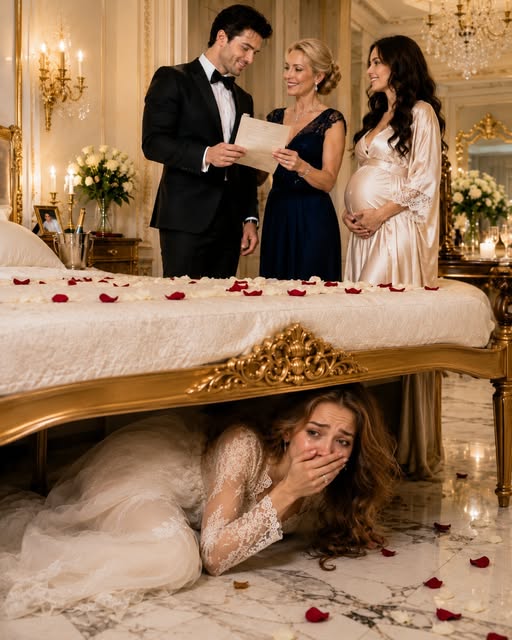
 Part 3 — The House Built on Truth
By the time I reached my father’s house, the fog had swallowed the hills.
The iron gates opened before my car stopped. Beyond them, the old Wilson home glowed against the darkness, every downstairs window lit as though the house itself had been waiting for me.
I had not slept there in almost three years.
I had left because I wanted to know who I was without the Wilson name, without drivers, boardrooms, charity photographs, and strangers who smiled too warmly when they learned what my father owned. I had wanted a simple life built with my own hands.
Now I drove up the familiar stone path in my wedding-day jeans and hoodie, with my dress crumpled in the trunk and my marriage already collapsing behind me.
Dad stood beneath the front portico in a gray robe and house shoes.
Rebecca was beside him, still fastening the belt of her coat over her pajamas. She had been my mother’s closest friend, my godmother, and for the last twelve years, the Wilson family’s attorney. Her silver-streaked hair was tied into a hurried knot, but her eyes were fully awake.
Dad opened my car door before I could touch the handle.
For one suspended moment, neither of us spoke.
Then his expression changed.
Not anger. Not surprise.
Pain.
His gaze moved over my bare ring finger. I had pulled the wedding band off at a red light and placed it in the cup holder because the weight of it had become unbearable.
“Oh, sweetheart.”
That was all he said.
I stepped out of the car and fell against him.
My father had held me after my mother died. He had held me when I left home, insisting I needed to make my own way. He had held me when I announced my engagement and he quietly asked whether I was certain.
But he had never held me while I shook like that.
Rebecca closed the car door and guided us inside.
The house smelled of cedarwood, coffee, and the faint lavender polish my mother had always ordered for the floors. The scent nearly undid me.
In the library, Dad sat beside me on the sofa while Rebecca placed my phone on the low table.
“Start from the beginning,” she said gently.
I told them about the prank.
The silver shoes.
Cynthia’s voice.
Brenda’s pregnancy.
Elias laughing about me beneath the bed while believing I was somewhere nearby, still in my wedding dress, still trusting him.
Dad’s hands curled into fists on his knees, but he did not interrupt. Rebecca remained almost perfectly still.
When I finished, she asked, “Did they know you were recording?”
“No.”
“Did you alter the file?”
“No.”
“Did you send it to anyone?”
“Only myself. I emailed a copy before I left the hotel.”
Rebecca nodded with approval. “Good.”
Dad looked at her. “Good? That is what you have to say?”
“It means the original evidence is preserved.” Her voice softened. “Jonathan, I am furious too. But fury is not a plan.”
I picked up the phone.
“There’s something else.”
I opened the recording and dragged the marker toward the end. My thumb trembled over the screen.
“I didn’t fully understand it at the hotel. I only remembered it while I was driving.”
I pressed play.
The room filled with Cynthia’s voice.
“Once Ella is out, we refinance the apartment through Harbor Crown. Keene can prepare the incapacity declaration.”
Elias answered, quieter than before.
“Are you sure he’ll do it again?”
“He did it for the Vale property. He did it for the Glen Park accounts. He even signed those papers for Margaret Wilson before she died. He never asks questions as long as he is paid.”
The recording continued, but no one in the library moved.
My father’s face had gone white.
Rebecca reached for the phone and stopped the audio.
“What did she say?” I whispered.
Dad stared at the dark fireplace.
“Your mother’s name.”
“I heard that. But what papers?”
He did not answer.
Rebecca sat across from us. Her calm expression had vanished.
“Jonathan.”
“I thought it was a clerical error,” he said.
“What was?”
He rose and walked toward the window. Outside, fog pressed against the glass, turning the garden lights into pale floating circles.
“Six months before your mother died, someone filed a medical declaration claiming she lacked the capacity to manage certain trust decisions.”
I felt the room tilt.
“My mother was sick, not incompetent.”
“I know.” His voice cracked. “She was receiving treatment. She was tired. Some days were difficult. But she understood everything.”
“Why didn’t you tell me?”
“Because the declaration was withdrawn almost immediately. The doctor claimed his office had submitted the wrong patient’s paperwork. Your mother was already fighting for her life. She asked me not to turn her final months into a court battle.”
Rebecca looked toward the phone.
“Dr. Keene?”
Dad nodded.
I remembered the confidence in Cynthia’s voice.
He did it for the Vale property. He did it for the Glen Park accounts.
“This was never only about my apartment,” I said.
“No,” Rebecca replied. “It sounds like a pattern.”
My wedding-night betrayal suddenly seemed smaller, not less painful but part of something colder. Cynthia and Elias had not invented their plan when I became engaged. They had used pieces of it before—false declarations, unstable spouses, property transfers, carefully constructed stories.
“How did Cynthia know my mother?” I asked.
Dad turned from the window.
“I don’t know.”
The security panel chimed from the hall.
A moment later, the intercom rang.
All three of us looked toward the library door.
It was 3:47 in the morning.
Dad crossed the hall and pressed the screen.
A camera showed a black sedan waiting outside the gates.
Elias stood beneath the gate light in his wrinkled wedding suit.
He looked directly into the camera.
“Ella,” he said. “I know you’re there.”
My heart gave one painful beat.
“How?” Rebecca asked.
I looked down at my phone.
“The family location app.”
Elias and I had installed it months earlier after his car broke down near Sacramento. I had forgotten it was still active.
Rebecca took the phone and disabled the app.
At the gate, Elias stepped closer to the camera.
“Please let me in. There’s been a misunderstanding.”
Dad’s jaw tightened.
I touched his arm.
“I need to hear what he says.”
“No, you don’t.”
“Yes.” My voice came out steadier than I felt. “I spent two years listening to the man he pretended to be. I need to meet the one who came here before sunrise.”
Rebecca studied me.
“Not alone.”
Five minutes later, Elias was admitted through the outer gate but not into the house.
We met him in the glass garden room overlooking the inner courtyard. Two security officers remained outside the doors. Rebecca sat at the far end of the table with her legal pad. Dad stood near the windows.
I sat opposite my husband.
The candles from my mother’s old brass holders had been lit, filling the room with soft amber light. Elias looked painfully out of place beneath them.
His boutonniere was crushed. His collar hung open. Without the hotel lights and the wedding music, he looked smaller than he had hours earlier.
He stared at me.
“You left.”
The words were so absurd that I nearly laughed.
“Yes.”
“You should have told me where you were going.”
“You thought I was in the hotel.”
“I did.”
“Then why did you track my phone?”
His mouth opened and closed.
Rebecca uncapped her pen.
Elias glanced at her, then at my father.
“Ella, whatever you heard, it wasn’t what it sounded like.”
I placed my phone on the table.
“What did it sound like?”
He swallowed.
“A stupid conversation. My mother was upset. Brenda was emotional. People say things when they’re under pressure.”
“You said you had to pretend you wanted to sleep with me.”
His eyes dropped.
“You laughed when your mother called me nothing.”
“I was trying to calm her down.”
“You discussed taking my apartment.”
“I never would have done it.”
“You discussed replacing me with Brenda.”
He pressed his palms against the table.
“She’s pregnant.”
“I know.”
“It’s complicated.”
“No, Elias. It is remarkably simple. Is the child yours?”
His gaze shifted toward the courtyard.
“That’s what Brenda says.”
The answer struck me differently than I expected.
There was no pride in his face. No tenderness. Only calculation and uncertainty.
“Did you sleep with her?”
He remained silent.
My father took one step forward, but Rebecca raised a hand without looking at him.
Elias finally whispered, “Once.”
“Before or after you proposed?”
“After.”
The room became very quiet.
I looked at the man I had married.
I waited for tears, rage, or some dramatic breaking inside me. Instead, I felt the strange stillness that comes when a storm has already torn the roof away. There is nothing left to protect from the rain.
“Why did you come here?” I asked.
“To explain.”
“No.”
His face tightened.
I leaned toward him.
“You came because you realized I might have heard something. You checked the suite. You saw my things were gone. Then you tracked me. What are you afraid I heard?”
For the first time, genuine fear crossed his face.
Rebecca’s pen stopped moving.
Elias stood.
“I’m leaving.”
“Sit down,” Dad said.
The words were quiet, but Elias froze.
Rebecca closed her legal pad.
“You are free to go. However, you should understand that the audio Ella recorded may contain evidence of conspiracy, fraud, forgery, and financial crimes involving several properties. I will be contacting the appropriate authorities this morning.”
Elias stared at her.
“Ella, you can’t give them that recording.”
“Why?”
“Because you don’t know what my mother is capable of.”
Something shifted in the room.
Not a threat.
A warning.
Elias looked toward the garden doors as though expecting Cynthia to appear behind them.
“She keeps records,” he said. “Copies of everything. She says records are protection.”
“Protection from whom?” Rebecca asked.
“Everyone.”
“Where are they?”
“I don’t know.”
Rebecca watched him carefully. “But Brenda might.”
At the mention of her name, Elias flinched.
I saw it.
“So Brenda is not part of this in the way your mother thinks,” I said.
He sank back into his chair.
“I don’t know what Brenda is doing anymore.”
“What does that mean?”
“She started asking questions about Harbor Crown. About the Vales. About her grandmother’s house.”
Dad exchanged a glance with Rebecca.
“Her grandmother?” I asked.
Elias rubbed both hands over his face.
“Brenda’s grandmother owned a house in Glen Park. She developed memory problems. My mother helped arrange her care and the sale of the property.”
“The Glen Park accounts,” Rebecca said.
Elias nodded.
“Brenda found out the house sold for almost twice the amount her family received. She confronted my mother last year.”
“And then?” I asked.
“My mother told her the missing money had gone toward medical expenses. Brenda didn’t believe her.”
“Why would Brenda agree to help steal my apartment?”
“She needed access. My mother trusted her because of the baby.”
I felt a sharp pulse of confusion.
“You said you slept with her once.”
“I did.”
“But you don’t know whether the child is yours.”
“No.”
“Does Cynthia?”
“She believes it is. Brenda never corrected her.”
The pieces did not yet form a picture, but something had changed. Brenda was still involved. She had stood too close to my husband, helped plan my removal, and remained silent while Cynthia insulted me.
Yet perhaps her reasons were not as simple as I had believed beneath the hotel bed.
Elias reached for my hand.
I moved it away.
He stopped.
“I didn’t come only for the recording,” he said. “I came because my mother knows you left.”
A chill moved over my skin.
“How?”
“She went back to the suite. She found the dust under the bed disturbed and one of the decorative panels bent. She figured it out.”
Dad immediately took out his phone.
Elias continued quickly.
“She’ll destroy the files before morning. And if Brenda has them, she’ll go after Brenda.”
“Where is Brenda now?”
“I don’t know. She stopped answering.”
Rebecca rose.
“We need to contact the police.”
“Wait,” I said.
Every face turned toward me.
There was one sound on the recording I had barely noticed—three soft electronic notes while Brenda spoke. At the time, I assumed they came from the hotel television.
Now I remembered hearing the same notes every weekday for two years.
The elevator in my office building.
“Brenda wasn’t at home,” I said.
Elias frowned.
“She was at my office.”
My father’s company occupied twenty-three floors downtown, but I had never worked there. To keep my identity private, I had taken a position at a small architectural consulting firm the Wilson Group quietly acquired years earlier.
The office had once belonged to my mother.
More importantly, an archive room behind the executive conference suite still contained sealed project records from the period before the acquisition.
Including records connected to contractors, brokers, and property-management companies.
Including Harbor Crown.
I stood.
“Brenda went there to find something.”
At 4:26 in the morning, Rebecca contacted the police detective who had once investigated financial misconduct involving one of Wilson Construction’s subcontractors. Dad called the head of corporate security. Officers were dispatched to Brenda’s apartment and my office building.
Elias remained in the garden room.
He did not ask to come with us.
As I left, he said my name.
I turned.
He looked at my empty ring finger.
“I did love you.”
I held his gaze.
“Perhaps you loved how I made you feel about yourself.”
He winced.
“That isn’t the same thing.”
Then I walked away.
The city was beginning to lighten when we reached the office.
Fog drifted between the buildings, pale blue now instead of black. Police vehicles waited without sirens near the loading entrance. The lobby guard had found no sign of forced entry, but the building’s security system showed that Brenda’s temporary visitor badge had been used shortly after midnight.
It also showed another access card entering twenty-three minutes later.
Cynthia’s.
“She’s here,” Dad said.
The elevator ride felt endless.
Rebecca stood beside me while two officers rode ahead in the service elevator. Dad remained downstairs at the detective’s insistence, though every line of his body resisted it.
When the doors opened, the office was dark except for the emergency lights.
Rows of empty desks stretched beneath the windows. Wedding congratulations still covered my cubicle wall. Someone had tied a white ribbon around my chair.
For one painful instant, I saw the life I had expected to return to after my honeymoon.
Then a sound came from the corridor.
A drawer closing.
We followed the officers toward the archive room.
The door stood open.
Inside, Brenda sat on the floor between two filing cabinets. Her face was pale, and one hand rested protectively over her stomach. A cardboard records box lay beside her.
Cynthia stood across from her.
She held no weapon. She made no dramatic threat. She simply looked furious that anyone had interrupted her.
When she saw me, her expression changed.
“Ella.”
She said my name with the disappointed tenderness of a mother discovering a child awake past bedtime.
“You should be with your husband.”
“I was under the bed.”
Silence filled the archive room.
Brenda shut her eyes.
Cynthia’s smile disappeared.
“You misunderstood a private conversation.”
“That seems to be a popular explanation tonight.”
One of the officers stepped forward.
“Ma’am, please move away from the box.”
Cynthia did not.
Instead, she looked at Rebecca.
“You have no idea what that girl has taken.”
Rebecca’s gaze settled on the box.
“Then perhaps you should allow the authorities to determine its importance.”
“They are family records.”
Brenda opened her eyes.
“No,” she said. “They’re evidence.”
Her voice trembled, but she did not look away from Cynthia.
For the first time, I saw Brenda clearly.
Not as the woman beside my husband at the wedding.
Not as the voice on the speakerphone.
As a frightened person who had made a chain of terrible choices and finally reached the point where the next choice mattered more than all the ones before it.
Cynthia turned toward her.
“You ungrateful little fool.”
Brenda flinched, then placed both hands on the box.
“My grandmother trusted you.”
“She would have lost the house to medical debt.”
“You sold it through Harbor Crown, hid the real price, and kept six hundred thousand dollars.”
“I arranged her care.”
“You stole from her.”
The words echoed through the narrow room.
Cynthia’s face hardened.
“And you think they will believe you? After your affair? After the wedding? After everything you agreed to do?”
Brenda looked at me.
Shame passed across her features.
“She’s right,” she whispered. “I agreed.”
The officers waited.
So did I.
Brenda rose carefully, using the cabinet for support.
“My grandmother kept saying Cynthia had taken her blue folder. Everyone thought it was confusion. After she died, I found a letter she had hidden inside her sewing machine. She wrote down names, dates, and account numbers.”
She touched the box.
“I started looking. Harbor Crown was connected to six property sales. Every owner was elderly, sick, recently widowed, or involved in a divorce. Dr. Keene signed incapacity declarations in four cases.”
Rebecca stepped closer.
“And Margaret Wilson?”
Brenda nodded.
“There’s a copy of the declaration in here.”
My chest tightened.
“How did it get into this office?”
“Your mother found out what they were doing.”
The room seemed to narrow around me.
“What?”
“She hired an investigator. Some of his reports were stored here after her illness worsened. Cynthia knew they existed but never found them.”
Cynthia laughed, though the sound held no humor.
“Margaret was paranoid.”
“No,” my father said from the doorway.
I turned.
He had come upstairs despite being told to remain below.
His gaze was fixed on Cynthia.
“She was protecting people.”
Cynthia’s composure finally cracked.
“You always believed she was a saint.”
“I believed she was my wife.”
“You had everything,” Cynthia snapped. “Companies. Houses. Lawyers. Margaret could make one telephone call and doors opened. Do you know what it is like to spend your life standing outside those doors?”
Dad’s expression held no anger now. Only sadness.
“I know what it is like to lose someone you love. That does not give me the right to take from others.”
For a moment, Cynthia looked older than she had at the wedding. The elegance, certainty, and sharp control seemed to fall away, leaving a woman who had spent years turning resentment into permission.
She glanced toward me.
“I gave Elias opportunities you never would have given him.”
“I gave him my trust.”
“He needed more than that.”
“No,” I said. “You taught him to believe he did.”
Cynthia’s shoulders lowered.
The officer asked her to step aside again.
This time, she did.
As they led her from the archive room, she passed within a few feet of me.
“I welcomed you into my family,” she said.
I thought of her silver shoes beside my face. Her voice above the mattress. Her public embrace at the wedding.
Then I thought of the frightened woman standing beside the evidence box, my father in the doorway, and my mother’s hidden investigation waiting all these years to be finished.
“You welcomed what you thought you could take,” I replied. “You never met me at all.”
Cynthia looked away.
The sun rose while detectives photographed the files.
The first light of morning entered through the office windows, revealing dust in the air and turning the city rooftops gold.
Brenda sat in the conference room with a blanket around her shoulders and a cup of water between her hands.
I stood outside the door for several minutes before entering.
She looked up.
“I’m sorry.”
I remained near the door.
“For which part?”
“All of it.”
Her eyes filled, but she blinked the tears back.
“I knew Elias was engaged when we slept together. He told me you barely noticed him anymore. He said the relationship was ending.”
“It wasn’t.”
“I know.”
“Did you love him?”
“No.” The answer came quickly. “I was lonely. Angry. And I wanted Cynthia to trust me.”
I sat across from her.
“Is the baby his?”
“I don’t know yet. There is another possibility.”
She folded the edge of the blanket over her fingers.
“The father may be someone I dated before Elias. We ended things badly. When Cynthia learned I was pregnant, she decided the baby was Elias’s before I could even speak. Then she started talking about your apartment and how everything could be arranged.”
“And you let her.”
“Yes.”
“Why?”
“Because she had the original letter from my grandmother. I thought if I stayed close, I could get it back.”
“You could have gone to the police.”
“I was afraid they wouldn’t believe me. Cynthia had documents. Doctors. Lawyers. I had an affair with her son and a dead woman’s letter no one else had seen.”
She looked toward the archive room.
“I convinced myself I was gathering proof. But every day I waited, I became more involved.”
“At the wedding, were you trying to warn me?”
Brenda’s face crumpled.
“I tried twice. In the restroom, then near the elevator. Cynthia interrupted both times.”
I remembered Brenda approaching me before the ceremony, her lips parting as if she wanted to speak. Cynthia had swept between us with champagne and laughter.
At the time, I had thought Brenda looked jealous.
Now I wondered whether she had looked terrified.
“I should have found another way,” she said. “I should have told you even if it destroyed me.”
“Yes,” I replied.
She nodded as though the word hurt but also freed her.
“I’ll cooperate. I’ll tell them everything. Even if I’m charged.”
I studied her hands. They were still shaking.
“Why did you call Cynthia from my office?”
“I found the files and wanted her to admit what she had done. I recorded the call separately. I thought if she believed I was still following the plan, she would talk.”
“She did.”
“Yes.”
“Then why stay here?”
Brenda looked down.
“I found something about your mother.”
She reached into the records box and removed a cream envelope sealed inside a transparent evidence sleeve.
My name was written across the front.
Ella.
The handwriting was my mother’s.
My breath caught.
“She left this with the investigator’s report,” Brenda said. “The envelope says it should be delivered when the truth about the declaration came out.”
Rebecca entered quietly and confirmed that the detective had authorized us to read it in his presence.
My father sat beside me.
For several seconds, neither of us touched the envelope.
Then he nodded.
I opened it.
My mother’s letter was only three pages long.
She wrote that she had discovered Dr. Keene’s false declaration while reviewing unusual property transfers connected to a charitable housing program. She suspected someone had targeted her because they believed her illness made her vulnerable.
She did not know every person involved.
But she had identified Cynthia under her maiden name, Cynthia Mercer, as the administrator who connected several families to Harbor Crown.
My mother had intended to take the evidence to the authorities. Then her health worsened, and the investigator advised her that the case was not yet complete.
The final paragraph was written to me.
My dearest Ella,
You may someday believe that independence means refusing everything your family can offer. It does not. Independence is knowing that love is not ownership, help is not weakness, and a home is not made safe by locked doors but by people who tell one another the truth.
Choose a life that allows you to remain kind without becoming easy to deceive. Trust generously, but never surrender your own voice to keep someone else comfortable.
And should the day come when someone mistakes your kindness for helplessness, do not become cruel in order to defeat them. Become clear.
All my love,
Mom
I read the final sentence twice.
Then the words blurred.
Dad wrapped one arm around me, and for a while, we sat together in the brightening conference room, grieving someone who had been gone for twelve years and had still found a way to reach us before the morning ended.
The investigation lasted eleven months.
Cynthia, Dr. Keene, and two Harbor Crown executives were charged in connection with fraudulent property transfers, forged medical declarations, and the concealment of sale proceeds. Several families recovered money they had believed lost forever.
Brenda accepted responsibility for her role in the conspiracy against me and provided extensive evidence. Because she cooperated early and had preserved documents essential to the larger case, the court approved a plea agreement involving probation, restitution, and community service rather than prison.
The baby was not Elias’s.
The father was Brenda’s former boyfriend, Marcus, a quiet high-school music teacher who had not known about the pregnancy until investigators helped Brenda untangle the lies surrounding it. Their reconciliation was slow and private. They did not pretend the past had been simple, but Marcus attended every parenting class and every doctor’s appointment Brenda permitted.
When their daughter was born, Brenda named her Hope.
Elias pleaded guilty to conspiracy and attempted fraud.
He wrote to me several times before sentencing. I read the first letter and returned the others unopened through Rebecca.
In the one I read, he did not ask me to forgive him.
He said he had spent his life confusing approval with love. Cynthia rewarded obedience, secrecy, and ambition, so he had learned to call those things loyalty. When I offered him something gentler, he did not know how to value it.
His explanation did not erase what he had done.
But it helped me understand that closure was not a door another person opened for me. It was one I could choose to walk through.
Our marriage was annulled.
The apartment remained mine.
For months, I could not enter it without remembering Cynthia’s voice describing how they would force me from my own home. I considered selling it.
Instead, I changed it.
I removed the gray furniture Elias had selected. I painted the kitchen a warm shade of yellow my mother would have loved. I filled the balcony with herbs, climbing jasmine, and two stubborn tomato plants that refused to grow in a straight line.
Then I did something no one expected.
I donated the apartment’s use to a new foundation created with recovered Harbor Crown funds.
The Margaret Wilson Homecoming Project provided temporary housing, legal guidance, and financial counseling for widows, elderly homeowners, and people rebuilding after coercive relationships.
The first resident was an eighty-one-year-old woman named Mrs. Alvarez, whose home had been taken through one of Dr. Keene’s false declarations.
On the afternoon she received the keys, she stood in the yellow kitchen and touched the countertop with both hands.
“This is too beautiful,” she whispered.
“It’s only temporary,” I told her. “Your own house is being restored.”
She turned toward me.
“No, dear. I meant what you did with what happened to you.”
I did not know how to answer.
Mrs. Alvarez smiled.
“Pain enters a house without knocking. But it does not get to choose what the house becomes.”
That evening, I drove to my father’s home for dinner.
Rebecca was already there, arguing with Dad about whether garlic bread could burn if the edges were merely “deeply toasted.” Their voices drifted through the open kitchen windows.
For years, I had believed returning home would mean I had failed at becoming independent.
Instead, I walked inside carrying tomatoes from my balcony garden and understood my mother’s letter at last.
Help was not weakness.
Love was not ownership.
And home was not a prize someone could steal.
Dad looked up from the stove.
“You’re late.”
“By three minutes.”
“Rebecca said you would defend yourself with technicalities.”
Rebecca raised her glass. “She learned from the best.”
I placed the tomatoes on the counter.
Dad inspected them with exaggerated concern.
“They’re crooked.”
“They have character.”
“They look unstable.”
We all went silent.
Then Rebecca laughed.
It began as a small, startled sound. I joined her. A moment later, Dad covered his face, laughing so hard he had to lean against the counter.
It was the first time the word had not hurt.
Months later, on the anniversary of the wedding, I returned to the hotel.
Not because I missed Elias.
Not because I wanted to reopen the past.
The manager had contacted the foundation after reading about the case. The hotel wanted to donate one of its event spaces for our annual fundraiser.
When the meeting ended, I rode the elevator to the suite floor.
The hallway looked smaller than I remembered.
I stood outside the room where my marriage had ended before it began.
A housekeeper pushing a linen cart paused nearby.
“Did you forget something?” she asked.
I looked at the door.
Once, I had believed everything beneath that bed had been stolen from me—my future, my trust, my certainty about who I was.
But the truth was more complicated.
I had crawled beneath the bed as a woman who thought love required proving she needed very little.
I had emerged knowing that love should never require disappearing.
“No,” I said. “I found it.”
The housekeeper smiled politely, though she clearly did not understand.
I returned to the elevator.
In the lobby, a little girl ran toward me on unsteady legs.
Hope.
Brenda followed, carrying a diaper bag while Marcus balanced two paper cups and a stuffed giraffe beneath one arm.
Brenda and I were not friends.
Some wounds healed best with respectful distance.
But she volunteered with the Homecoming Project twice a month, helping families organize documents and recognize the warning signs she had once ignored.
Hope reached me and lifted both arms.
I glanced at Brenda.
“She remembers you,” Brenda said.
I picked up the little girl.
Hope immediately grabbed my necklace and laughed.
“She remembers jewelry,” Marcus corrected.
Brenda smiled.
There was peace in her face now—not innocence, because none of us could return to that, but something steadier.
Honesty.
Before they left, Brenda touched my arm.
“There’s one more thing.”
She handed me a small blue folder.
My heart paused.
“My grandmother’s original file,” she explained. “The case is finished. They returned it to me.”
I opened the cover.
Inside was a photograph of two young women standing at a neighborhood housing fundraiser nearly thirty years earlier.
One was Brenda’s grandmother.
The other was my mother.
On the back, my mother had written:
For Rosa, who reminded me that a safe home can change the direction of an entire family.
I looked at Brenda.
“She knew your grandmother.”
Brenda nodded, tears shining in her eyes.
“Rosa volunteered at your mother’s first housing clinic. That’s why she trusted Cynthia. Cynthia claimed Margaret had sent her.”
The connection settled between us.
Cynthia had used my mother’s good name to open the first door.
Years later, my mother’s hidden work had helped close the last one.
The story had never truly begun beneath the hotel bed.
It had begun with two women at a folding table, helping strangers keep their homes.
One of them had saved a photograph.
The other had saved evidence.
And their daughters, after becoming lost in very different ways, had finally completed what they started.
I hugged Hope a little closer.
Across the lobby, my father and Rebecca entered through the revolving doors for the fundraiser planning meeting. Dad saw the photograph in my hand and stopped.
When I showed it to him, he traced my mother’s face with one finger.
“She never told me about Rosa.”
“Maybe she thought kindness didn’t need an audience.”
He looked at me with the same expression he had worn the night I came home—love mixed with the ache of all the things he could not protect me from.
Then he smiled.
“You look like her.”
For most of my life, people had meant my eyes, my hair, or the shape of my smile.
This time, I knew he meant something else.
Outside, the afternoon fog lifted from the city, revealing blue sky above the rooftops.
I slipped my mother’s photograph into the blue folder and took my father’s arm.
Together, we walked toward the ballroom, where tables were being set for hundreds of people who believed a home was more than property, a family was more than appearances, and a painful ending could become the foundation of something generous.
I had once thought resilience meant surviving alone.
Now I knew better.
It meant telling the truth.
Accepting the hands that reached for you.
And building a door wide enough for someone else to find their way home.
THE END