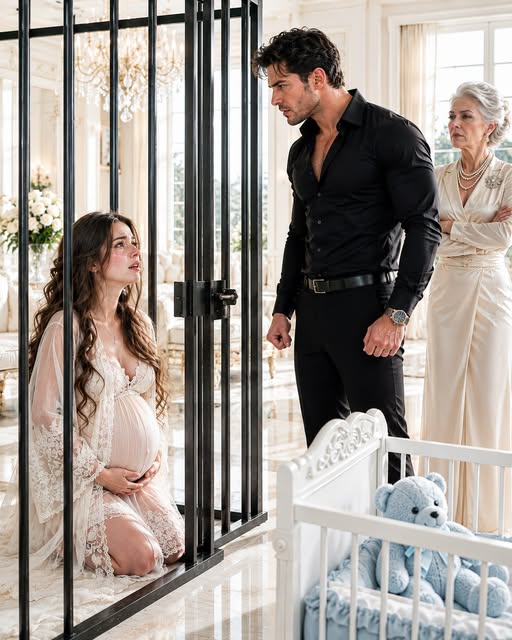

Part 3 — The Door That Opened Home
The breathing stopped the instant I turned.
For one suspended moment, the room held nothing but the thin whistle of wind pressing against barred windows and the violent rhythm of my own pulse.
Then a shape moved beside the steel wardrobe.
“Don’t shout,” a woman whispered.
She stepped into the weak spill of hallway light, both hands raised. She was in her early thirties, dressed in dark trousers and a rain-soaked coat. A leather satchel hung from one shoulder. I recognized her only after she pushed damp hair away from her face.
“Nora?”
Martin Hale’s daughter had grown up on the Caldwell estate. She had left Connecticut years earlier to become a maternity nurse in Boston. The last time I had seen her was at our wedding, standing beside her father near the chapel doors.
“What are you doing here?” I demanded. “Where is Grace?”
Nora’s eyes shifted past me.
My mother stood at the broken door.
Her perfect composure had vanished.
“Nora,” Evelyn said, her voice low. “You should not have come back.”
Nora reached into her satchel.
My mother flinched.
But Nora withdrew no weapon. She pulled out a thick envelope, swollen with papers, and held it against her chest.
“I came back because hiding wasn’t helping anymore.”
I crossed the room in two steps.
“Where is my wife?”
“Safe.”
The word should have relieved me. Instead, it struck like another locked door.
“Where?”
Nora looked at my mother again.
“Tell him,” Evelyn said.
“No.” Nora’s voice trembled, but she did not lower her gaze. “You’ve decided what Ethan should know his entire life. You don’t get to decide tonight.”
Footsteps approached behind us. Martin appeared in the corridor, shoulders bent beneath a guilt I had never noticed before.
My mother turned on him.
“You gave her the key.”
Martin’s face tightened.
“Yes.”
“You betrayed this family.”
“No, Mrs. Caldwell.” His voice was quiet. “I finally stopped betraying it.”
The words landed harder than any accusation shouted in anger.
I opened my hand. Grace’s wedding ring lay against my palm, catching the pale light.
“Take me to her.”
Nora’s expression softened when she saw it.
“She wanted you to find that.”
“You’ve spoken to her?”
“I helped her leave.”
A sound escaped my mother—not quite a gasp, not quite a protest.
Nora continued quickly. “Grace didn’t abandon you. She left the ring because she knew you would understand. She said you would never believe she had gone willingly without it.”
My fingers closed around the band.
The dried drop of blood on the crib rail. Grace’s words carved into the wall. The messages growing shorter. The camera turned off.
Every detail rearranged itself into something unbearable.
“Why didn’t she call me?”
“She tried.”
Nora opened the envelope and handed me several pages. Printed call records. Dates. Times. My number appeared again and again.
Beside each attempt was the same notation.
Blocked.
I looked at my mother.
She did not deny it.
“You blocked her calls?”
“I was trying to prevent panic.”
“You told me she was asleep.”
“She was unstable.”
“No,” Nora said. “She was frightened.”
My mother’s head snapped toward her.
“You were not here at the beginning.”
“I saw enough at the end.”
I stepped closer to Evelyn, searching her face for the woman who had raised me—the woman who had sat beside my hospital bed when I broke my arm at twelve, who had taught me to dance before my first school formal, who had stood beside Grace and me on our wedding day with tears in her eyes.
“What did you do?”
Her lips parted, but no answer came.
From downstairs, a clock began striking midnight.
Each chime traveled through the house like a warning.
Nora touched my arm.
“Ethan, Grace asked me to bring you somewhere if you came home.”
“Then take me.”
A flicker of alarm crossed her face.
“There’s something you need to see first.”
“I’ve seen enough.”
“No,” Martin said behind us. “You haven’t.”
He reached into his jacket and removed an old brass key.
It was small, tarnished, and familiar.
I had seen it every day of my childhood hanging from the chain around my mother’s neck.
Now the chain was gone.
Martin placed the key in my hand.
“It opens the blue room.”
The blue room stood at the northern end of the house, behind the portrait gallery. It had been locked for as long as I could remember.
When I was a boy, I once asked my father what was inside.
He told me it held things the family was not ready to remember.
My mother’s face drained of color.
“Martin, no.”
He looked at her with sorrow rather than defiance.
“It’s time.”
For the first time that night, Evelyn looked afraid of something other than discovery.
She looked afraid of the past.
The blue room smelled of cedar, dust, and dried lavender.
Nora switched on a lamp, revealing shelves crowded with boxes. A faded rocking horse stood beneath one window. Against the far wall rested a cradle covered by a white sheet.
This was not a storage room.
It was another nursery.
My mother remained in the doorway.
She seemed smaller there, no longer the commanding woman beneath the chandelier, but a solitary figure unable to cross into a memory she had spent decades avoiding.
Martin took down a cedar box and placed it on a table.
My name had been written across the lid.
Not Ethan Caldwell.
Only Ethan.
Inside lay a hospital bracelet, a knitted blue cap, a stack of letters, and a photograph of a young woman holding a newborn.
The woman was not my mother.
She had dark hair, kind eyes, and a tired smile. Martin stood beside her, much younger, one hand resting on her shoulder.
The room tilted.
I picked up the hospital bracelet.
BABY BOY HALE.
I stared at Martin.
He closed his eyes.
“No.”
The word barely left me.
Nora moved beside her father, taking his hand.
Martin’s eyes shone when he looked at me.
“You were born on January seventeenth, thirty-five years ago, at St. Matthew’s Hospital. Your mother’s name was Elizabeth Hale.”
“My mother is standing at the door.”
Evelyn’s face tightened as though I had struck her.
Martin spoke gently.
“Elizabeth was my younger sister.”
The hospital bracelet slipped from my fingers.
I had expected another lie, another scheme, another layer of cruelty hidden beneath polished surfaces.
I had not expected my own life to open beneath me.
“My father knew?”
“Charles knew everything,” Evelyn said.
Her voice came from the doorway, fragile and stripped of authority.
I turned to her.
She stepped into the room at last.
“Elizabeth worked here during the summers,” she said. “She was studying music. Charles’s younger brother, William, was reckless and charming and promised her things he had no intention of giving.”
I knew the name only from old family photographs. William Caldwell had died in a sailing accident before I was born.
“Elizabeth became pregnant,” Evelyn continued. “William refused to acknowledge the child. My father-in-law offered her money to disappear. Charles was furious, but by then William had gone overseas.”
Martin’s jaw tightened.
“My sister wanted to raise you,” he said. “She loved you before you were born.”
“What happened to her?”
No one answered immediately.
Then Nora slid the photograph toward me.
“She developed an infection after delivery,” she said. “It progressed quickly. Treatment was different then. She died three days after you were born.”
I looked again at the woman holding me.
My biological mother.
A stranger whose smile somehow felt familiar.
“Why did Evelyn take me?”
“Because I asked her to,” Martin said.
My mother looked at him in surprise.
“You never told him that.”
“You never allowed the subject to be spoken.”
Martin faced me.
“I was twenty-four. Unmarried. Working two jobs. I wanted to keep you, but I was terrified I could not give you what you needed. Charles and Evelyn had tried for years to have a child. Elizabeth trusted them. Before she died, she asked Evelyn to raise you.”
He opened one of the letters.
The paper was covered in faint handwriting.
“Your mother’s last letter.”
I could not touch it.
My mother did.
Her fingers trembled as she unfolded the page.
“She wrote that you should grow up knowing you were wanted,” Evelyn said. “That you should never believe you had been left behind.”
Her voice broke on the final words.
I looked toward the covered cradle.
“Did you ever plan to tell me?”
“Yes.”
“When?”
“When you were old enough.”
“I’m thirty-five.”
“I kept waiting for a time when it wouldn’t change the way you looked at me.”
“And Grace found out.”
My mother’s silence answered.
Nora removed another folder from her satchel.
“Grace found Elizabeth’s letters six weeks ago.”
“How?”
“She was choosing a cradle,” Martin said. “She wanted the one from Ethan’s nursery. Mrs. Caldwell refused. Grace thought it was because the cradle was old, so she asked me where it was kept.”
“You brought her here?”
“I told her about the blue room. She found the box before I could stop her.”
I imagined Grace standing where I stood now, one hand resting over our child, discovering the foundation of my identity in a cedar box.
“She confronted you,” I said to my mother.
Evelyn nodded.
“She demanded I tell you immediately.”
“And you refused.”
“I asked for time.”
“You had thirty-five years.”
Her eyes filled.
“I thought she would take you away from me.”
“Grace is my wife.”
“She would make you see me as a thief.”
“You imprisoned her because she wanted to tell me the truth?”
“It wasn’t meant to become that.”
The sentence was too small for the room.
My mother gripped the back of a chair.
“Grace became upset. Her blood pressure rose. Dr. Mercer said she needed rest and observation.”
“Dr. Mercer is not her obstetrician,” Nora said.
“He has treated this family for twenty years.”
“He is a private physician who accepted your version of events without consulting Grace’s doctor.”
Evelyn looked at me.
“I only wanted a few days. Time to explain. Time to convince her that telling you so close to the birth would be harmful.”
“So you took her phone.”
“She kept trying to leave.”
“You locked the windows.”
“She threatened to go out in a storm.”
“You put bars over them.”
“The old latches were unsafe.”
“Stop.”
My voice echoed through the blue room.
She fell silent.
I had spent my entire life watching people soften facts around my mother. They called her demanding when she was controlling. Protective when she was possessive. Difficult when she was cruel.
I had participated in it.
I had mistaken obedience for peace.
“Did you tell Grace I didn’t want her?”
My mother’s eyes dropped.
The answer was there.
I felt Martin move toward me, but I raised a hand.
“Why?”
“She would not stop asking for you. She said you would come home and end everything. She said you would choose her.”
“I would have.”
“I know.”
The words came out as a whisper.
Not anger.
Not justification.
A confession.
“I knew you would choose her,” she said again. “And suddenly I was back in that hospital, holding you while Elizabeth was dying, terrified someone would take you from me. Then Charles died, and you became all I had. When Grace found the letters, I thought the truth would erase me.”
I stared at the woman who had built her life around never being abandoned and, in doing so, had nearly driven away everyone who loved her.
“You didn’t need to be my first mother to be my mother,” I said.
A tear slipped down her cheek.
It was the first time I had ever seen her cry without turning away.
“But what you did to Grace was wrong. Fear does not make it less wrong.”
She nodded once.
“I know.”
“No more lawyers making things disappear. No more family doctors. No more deciding what the rest of us can survive.”
“What will you do?”
“What you should have done from the beginning.”
I took out my phone.
“I’m calling the police.”
Her eyes closed.
Martin lowered his head.
Nora did not move.
When Evelyn opened her eyes again, the last of her resistance seemed to leave her.
“All right.”
The simplicity of her answer startled me.
Then Nora’s phone rang.
She glanced at the screen, and every trace of color vanished from her face.
“Grace?”
Nora answered immediately.
“Grace, I’m here. I found him.”
A faint voice came through the speaker, followed by another sound—strained breathing.
Nora turned to me.
“She’s in labor.”
Grace had been hiding at St. Anne’s House, a small maternity residence attached to an old convent twenty minutes from the estate.
Nora drove.
I sat beside her, gripping Grace’s ring in one hand and Elizabeth’s letter in the other. Police cars passed us heading toward Caldwell House, their blue lights scattering across the wet road.
I had left my mother in the blue room with Martin.
Not alone.
Not protected from consequences.
But not abandoned.
I did not know whether that was mercy or simply the first honest choice I had made all night.
“Why St. Anne’s?” I asked.
“Grace volunteered there during college,” Nora said. “They help expectant mothers who don’t have safe places to stay.”
“She had a safe home.”
Nora’s hands tightened on the wheel.
“She thought she did.”
The words hurt because they were true.
“What happened the night she escaped?”
“Your mother dismissed most of the staff from the west wing. She said Grace needed quiet. My father called me after he saw Dr. Mercer carrying sedatives upstairs.”
“Was she drugged?”
“Not heavily. Grace refused most of the medication. She hid the tablets in a flowerpot. But she was exhausted and frightened, and no one believed her because your mother controlled who entered the house.”
I looked through the rain-streaked window.
“I should have come home sooner.”
“She asked me to tell you not to say that.”
I turned toward her.
Nora’s mouth softened.
“She knew you would blame yourself. She said your mother had spent years training both of you to trust her judgment.”
“How did Grace escape?”
“My father left the service staircase unlocked. I drove through the north gate. Grace took only a coat and the letters.”
“The letters?”
“She believed Evelyn might destroy them.”
A cold thought passed through me.
“The ring?”
“She placed it in the crib before leaving. She said you once told her that you would always know she had chosen you because she never removed it—not even when her fingers swelled during pregnancy.”
I remembered teasing Grace about having to cut the ring off someday.
She had held out her hand and said, Then you’ll have to marry me again.
I pressed the band against my palm.
“Why didn’t she contact the police?”
“She wanted to. The sisters encouraged her to. But she was afraid the scandal would reach you through the news before she could explain. She also feared your mother would claim she was emotionally unwell and use the family’s influence to question her fitness as a parent.”
It was exactly what Evelyn would have done.
It was exactly what Grace had been told would happen.
“Nora, why did you return to the locked room tonight?”
“To photograph it before your mother had it cleared.”
“You knew I was coming?”
“No. Martin called when your car passed the gate.”
A faint smile touched her face.
“He said you looked angry enough to tear the house apart.”
“I nearly did.”
“He also said that for the first time in weeks, he felt hopeful.”
St. Anne’s appeared beyond the trees, its brick walls glowing amber through the rain.
Before Nora had fully stopped the car, I was out.
A gray-haired sister met me beneath the covered entrance.
“You must be Ethan.”
“Where is she?”
“Upstairs. She has been asking for you.”
Those words undid something inside me.
I followed her through warm corridors smelling of soap, tea, and fresh linen. Somewhere, a baby cried. Somewhere else, women murmured in low, reassuring voices.
At the top of the stairs, Nora touched my shoulder.
“Ethan.”
I turned.
“She may not be ready to forgive you.”
“I know.”
“She loves you.”
“That doesn’t mean she trusts me.”
“No.”
Nora glanced toward the closed door at the end of the hall.
“But you came home.”
I walked the final steps alone.
Grace was sitting upright in bed, her hair loose around her shoulders.
She looked smaller than she had on our video calls, paler and tired, but when her eyes found mine, the entire room seemed to steady.
For a heartbeat, neither of us spoke.
Then she looked at my hand.
I opened my fingers.
Her ring lay in my palm.
Grace covered her mouth.
“I knew you’d understand,” she whispered.
I crossed the room, then stopped beside the bed.
I wanted to gather her into my arms. I wanted to apologize until language failed. But after everything she had endured, I would not assume I had the right to touch her.
“May I?”
Her chin trembled.
She reached for me.
I sank beside her, and she wrapped both arms around my neck.
The first sob came from her.
The second came from me.
“I tried to call you,” she said against my shoulder. “Every day. She said you knew what was happening. She said you told her to keep me calm until the contracts were signed.”
“I didn’t know.”
“I wanted to believe that.”
“You should never have had to wonder.”
She drew back and searched my face.
“Did you find the room?”
“Yes.”
“The wall?”
“Yes.”
“I’m sorry.”
“For what?”
“I believed her for almost an hour.”
Her voice cracked.
“She sat beside the bed and told me you had always valued the company more than people. She said you had doubts about becoming a father. She knew exactly which fears to use.”
I took her hand carefully.
“She lied.”
“I know that now.”
“I wanted this child from the moment you told me. I wanted every sleepless night, every tiny sock, every ridiculous argument about names. I wanted all of it with you.”
Grace’s eyes filled again.
A contraction tightened across her face.
A nurse entered, calm and smiling, checked the monitor, and told us the baby was taking his time but making steady progress.
When she left, Grace leaned back against the pillows.
“There’s something else,” she said.
I felt the letter inside my coat.
“I know about Elizabeth.”
Grace stared at me.
“My mother.”
“Yes.”
She watched as I took out the photograph.
Her expression softened when she saw it.
“She looks like you.”
“I thought so too.”
“I wanted to be there when you learned.”
“I wish you had been.”
“Ethan, Martin didn’t abandon you.”
“He told me.”
“And Evelyn didn’t steal you.”
“I know.”
Grace hesitated.
“There’s more.”
Of course there was.
She reached toward a small table beside the bed and opened a drawer. Inside lay a second envelope, brittle with age.
“This was hidden beneath the lining of the cedar box,” she said. “I found it after Nora brought me here.”
The envelope was addressed to Evelyn.
I unfolded the letter.
The handwriting matched Elizabeth’s.
Evelyn,
If I do not recover, please raise Ethan as your own. But promise me one thing: do not love him from fear. Fear holds too tightly. Tell him about me when the time is right, and tell him Martin gave him his first bath because his hands were the only ones gentle enough to stop him crying.
There was more, but my vision blurred.
At the bottom, one final line stood apart.
You once told me family is not the person who arrives first. It is the person who keeps arriving, especially after the hardest day.
I read it twice.
Then I handed it to Grace.
“She knew my mother,” I said.
“Elizabeth worked at Caldwell House for four summers. She and Evelyn were close before everything happened.”
“So my mother didn’t just take in an employee’s child.”
“No.”
Grace gave the letter back.
“Elizabeth was her best friend.”
The revelation did not excuse anything.
But it changed the shape of it.
Evelyn had not built her love for me from duty or social expectation. She had loved Elizabeth. She had promised a dying friend to keep arriving.
Somewhere along the way, grief had become fear, fear had become control, and control had nearly destroyed the promise.
“I called the police,” I said.
Grace’s fingers tightened around mine.
“Is she under arrest?”
“They’re taking statements. Dr. Mercer too.”
Grace looked toward the rain-dark window.
“I don’t want her protected from what she did.”
“She won’t be.”
“But I don’t want our son’s first story to be about destroying his grandmother.”
I studied her face.
Even now, she was searching for a path that did not require pretending or cruelty.
“What do you want?”
“I want the truth recorded. I want independent doctors to review everything. I want her kept away from us until professionals decide it’s safe. I want her to understand that forgiveness, if it comes, won’t erase accountability.”
I nodded.
“And after that?”
Grace looked down at her stomach.
“After that, we raise him differently.”
Another contraction came.
This one was stronger.
She closed her eyes and gripped my hand hard enough to hurt.
I welcomed the pain.
It meant I was there.
Our son was born just before dawn.
The storm had moved east, leaving the sky washed in pale silver. Rainwater glimmered on the chapel roof outside the window.
Grace held him first.
He arrived furious at the world, red-faced and indignant, with a cry far too powerful for someone so small.
Then the nurse placed him against Grace’s chest.
He became quiet.
I stood beside them, unable to speak.
His fingers opened and closed against the fabric of her gown.
Grace looked up at me.
“You can touch him.”
I rested one finger against his palm.
He grasped it immediately.
Every contract I had chased, every flight I had boarded, every promise I had postponed vanished from importance.
“Hello,” I whispered.
Grace smiled through tears.
“He knows your voice.”
Our son turned his head slightly, as though considering the claim.
“What do we call him?” Grace asked.
We had debated names for months. Daniel. Oliver. James. None felt right now.
I looked at the old photograph resting on the bedside table.
“Martin,” I said.
Grace blinked.
“As a first name?”
“If you like it.”
Her smile deepened.
“Martin Elizabeth would be difficult to explain.”
A laugh escaped me—the first real laugh of the night.
“What about William?” I suggested.
Grace raised one eyebrow.
“After the man who abandoned your mother?”
“Absolutely not. I’m exhausted.”
She shifted the baby carefully.
“What was Elizabeth’s middle name?”
I checked the letter.
“Hope.”
Grace looked at our son.
“Martin Hope Caldwell?”
“He may object in high school.”
“He’ll survive.”
We finally named him Martin Elias Caldwell—Martin for the man who had spent thirty-five years near me without claiming a place he feared was not his, and Elias because it meant the Lord is my God, though Grace said she simply liked the sound of it.
When Martin arrived later that morning, Nora beside him, he paused in the doorway.
The old butler who had faced my mother, helped rescue my wife, and handed me the truth could not bring himself to cross the room.
“Come here,” I said.
He approached slowly.
Grace placed the baby in his arms.
Martin looked down at his namesake.
His shoulders began to shake.
“I gave you your first bath,” he whispered to me.
I remembered Elizabeth’s letter.
“So I heard.”
“You screamed the entire time.”
“I was expressing concern.”
Nora laughed softly.
Martin looked at me, unsure whether he was allowed to ask the question waiting in his eyes.
I answered it before he could.
“I don’t know what to call you yet.”
His mouth trembled.
“Martin has worked for many years.”
“It doesn’t feel like enough.”
“It can be enough for today.”
I put my hand on his shoulder.
“For today.”
It was not a perfect reunion. There was no single embrace capable of restoring three lost decades.
But when Martin Elias curled his tiny hand around Martin Hale’s finger, the oldest man in the room smiled like a young father.
And perhaps, in some quiet way, he finally was one.
The investigation lasted months.
Dr. Mercer lost his medical license and later pleaded guilty to charges related to unlawful confinement, falsifying records, and administering medication without proper consent. He admitted that Evelyn had pressured him, but he also admitted he had chosen reputation over responsibility.
My mother did not contest the central facts.
Against the advice of Caldwell attorneys, she gave a complete statement.
She entered a residential treatment program before sentencing. The court considered her cooperation, age, mental health evaluation, and lack of prior offenses, but the consequences remained real. She received a suspended custodial sentence, strict probation, mandatory treatment, and a permanent protective order preventing unsupervised contact with Grace or Martin Elias.
For the first time in Caldwell history, money did not close the door on truth.
It opened one.
I resigned as chief executive of Caldwell Meridian Group three weeks after my son’s birth.
The board called it impulsive.
My mother’s former advisers called it disastrous.
Grace called it overdue.
I retained a smaller role while an independent team reviewed the company’s culture and policies. Then I used part of my shares to establish the Elizabeth Hale Foundation, providing legal support, safe housing, and medical advocacy for expectant mothers facing coercion or isolation.
St. Anne’s House became its first partner.
Nora became its clinical director.
Martin retired from Caldwell House and moved into a cottage near us, though he appeared most mornings before breakfast with tools, groceries, or some unnecessary reason to check whether we needed help.
We always did.
Caldwell House was sold the following spring.
I kept only three things from it: the cedar box, the faded photograph, and the old cradle from the blue room.
Grace refused to place the cradle in our son’s nursery until I restored it myself.
“You don’t know anything about restoring furniture,” she said.
“I run an international company.”
“You resigned.”
“I used to run an international company.”
“And yet you glued your sleeve to the cradle.”
“It’s part of the process.”
It took me four months.
When I finished, the wood shone warmly beneath a new coat of varnish. On the underside, where no one would see unless they searched, I carved a line from Elizabeth’s letter:
Family is the person who keeps arriving.
Grace found it anyway.
She traced the words with her fingertips, then kissed my cheek.
“You came home,” she said.
“I almost came too late.”
“But you came.”
Her answer did not erase my regret.
It gave it somewhere to go.
My mother wrote every week.
At first, I did not open the letters.
Grace placed them in a drawer without comment.
By summer, there were twenty-three.
One evening, after Martin Elias had fallen asleep against my chest, I opened the first.
Ethan,
There is no apology large enough to cover what I did, so I will not insult you by pretending these pages can repair it.
I told myself I was protecting our family. The truth is that I was protecting the version of our family in which no one could leave me.
Elizabeth warned me not to love you from fear.
I failed her.
I failed Grace.
I failed you.
I will respect every boundary you set. I will not ask you to forgive me. I only want to become someone who no longer needs lies to feel safe.
The remaining letters did not ask for visits.
They described therapy sessions, memories she had avoided, and truths she had once considered weaknesses. She wrote about Elizabeth singing in the kitchen. About my first day of school. About sitting awake after my father died, terrified that grief would consume every room in the house.
Months later, Grace read them.
Not all at once.
Not with easy sympathy.
But she read them.
On Martin Elias’s first birthday, we arranged a supervised meeting in the garden at St. Anne’s.
My mother arrived carrying no gifts.
That surprised me.
She wore a simple navy dress. Her silver-blond hair was shorter, and without the armor of pearls and perfect tailoring, she looked older.
She stopped several feet away from Grace.
“Thank you for allowing me to come.”
“This isn’t forgiveness,” Grace said.
“I understand.”
“It isn’t a promise.”
“I understand that too.”
Grace held our son against her hip.
He studied Evelyn with solemn curiosity.
My mother’s hands remained clasped before her.
She did not reach for him.
That restraint moved me more than tears would have.
“This is Martin Elias,” Grace said.
“I know.”
“He likes music, blueberries, and throwing spoons.”
A faint smile appeared.
“Ethan threw spoons.”
“Then we know where he gets it.”
Silence followed.
Not comfortable.
Not unbearable.
Simply honest.
My mother looked at the child, then at Grace.
“I told you Ethan did not want you because I was afraid he would choose you over me.”
Grace’s expression did not change.
“He should have been allowed to choose.”
“Yes.”
“You hurt me.”
“Yes.”
“You made me doubt the safest person in my life.”
My mother’s eyes filled, but she did not defend herself.
“I know.”
Grace adjusted Martin Elias in her arms.
“He is going to grow up knowing that love never requires captivity, secrecy, or fear.”
“I hope he does.”
“We won’t lie to him about what happened.”
“You shouldn’t.”
“And when he is old enough, he will decide what relationship he wants with you.”
My mother nodded.
“That is fair.”
Martin Elias suddenly leaned forward.
Everyone froze.
He reached toward the small silver locket hanging from Evelyn’s neck.
She looked at Grace before moving.
Grace gave one cautious nod.
My mother stepped closer.
The baby seized the locket with both hands.
Evelyn laughed.
It was not the polished laugh she used at galas.
It was startled, warm, and almost young.
“What’s inside?” I asked.
She opened it.
On one side was a photograph of Elizabeth.
On the other was a photograph of me as a baby.
My throat tightened.
“I thought you destroyed all her pictures,” I said.
“No.” My mother touched the edge of the locket. “I hid them because looking at her reminded me that love had begun before fear.”
She unclasped the chain and held it out to me.
“This belongs to you.”
I looked at the two photographs.
Then I closed her fingers around it.
“Keep arriving,” I said.
She stared at me.
It was not forgiveness.
Not yet.
But it was a direction.
My mother pressed the locket to her heart.
“I will.”
Three years later, on a bright December morning, Grace stood beneath the stone archway of our new home while snow drifted across the garden.
She was holding our daughter, Elizabeth Nora Caldwell, wrapped in a yellow blanket.
Martin Elias raced around the fountain wearing one red mitten and insisting the other had been stolen by a squirrel.
Martin Hale followed him with the patience of a man reclaiming every year he had missed.
Nora arrived carrying too many presents.
My mother came last.
She paused at the gate until Grace waved her in.
Some wounds had become scars. Some apologies still required repetition. Trust had returned not as a miracle, but as hundreds of small choices made correctly after years of being made wrong.
Evelyn never entered our home without permission.
She never contradicted Grace’s decisions about the children.
She never again used love as an excuse for control.
And Grace, without forgetting, allowed compassion to exist beside caution.
That Christmas Eve, we gathered in the nursery.
The restored cradle stood beneath the window, though Elizabeth Nora had already outgrown it. Grace had filled it with letters instead—copies of Elizabeth Hale’s words, my mother’s apologies, Martin’s memories, and a letter from us to our children.
No locked doors.
No hidden names.
No truths postponed until they became dangerous.
I placed Grace’s wedding ring in her palm.
She had not worn it since the night she escaped Caldwell House.
For years, it had rested in a small wooden box beside our bed.
“I’ve been thinking,” she said.
“That usually makes me nervous.”
She smiled.
“Ask me again.”
I looked at the woman who had survived fear without allowing it to define her, who had demanded justice without surrendering compassion, who had taught me that coming home was not a single act but a lifelong practice.
I took the ring and lowered myself to one knee.
Martin Elias gasped dramatically.
My mother covered her mouth.
Grace laughed, already crying.
“Grace,” I said, “will you keep choosing this imperfect, noisy, honest family with me?”
She looked around the room.
At Martin holding our daughter.
At Nora leaning against the cradle.
At Evelyn standing near the open door.
At our son bouncing with impatience.
Then she looked back at me.
“Yes.”
I slid the ring onto her finger.
It fit.
Outside, bells began ringing from the chapel at St. Anne’s, carrying through the clear winter air.
Grace pulled me to my feet and kissed me beneath the soft blue ceiling of the nursery.
Once, I had believed home was the great stone house bearing my family’s name.
Then I believed it was wherever Grace waited for me.
But as our children laughed, Martin wiped his eyes, Nora began singing, and my mother stood quietly within the circle she had once nearly broken, I finally understood.
Home was not a place inherited.
It was the truth we chose to live in together.
And this time, every door was open.
THE END