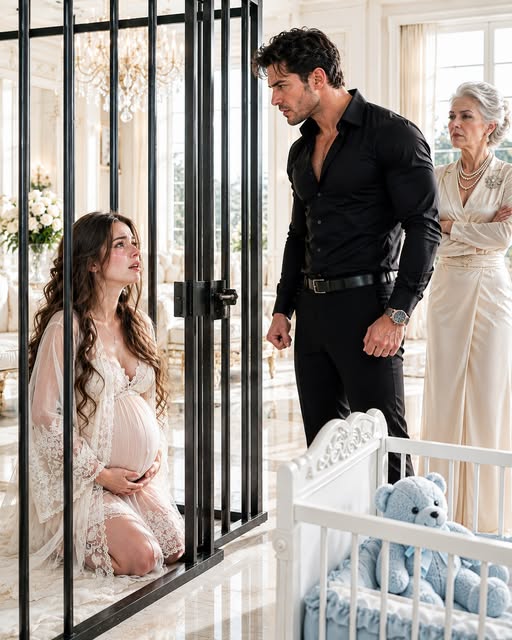
 I turned so quickly my shoulder struck the doorframe.
The darkness behind me seemed to shift.
For one impossible second, I thought Grace was standing there.
Then Martin stepped into the thin spill of hallway light.
He looked older than he had downstairs. Not merely tired, but diminished, as though the past few weeks had hollowed him from the inside. His gray hair clung damply to his forehead, and one hand pressed against the wall for support.
“You knew,” I said.
The words came out quietly.
That frightened me more than if I had shouted.
Martin’s gaze moved from me to the scratched message on the wall. His mouth tightened.
“I knew she had been kept in this room.”
My fingers closed around Grace’s ring until the metal bit into my palm.
“Kept?”
He lowered his eyes.
“Your mother said Mrs. Caldwell had become confused. That she was frightened of the staff. That she might harm herself or the baby if she were allowed to wander.”
“And you believed her?”
“No.”
The answer came so quickly that it stopped me.
Martin drew a slow breath.
“I wanted to.”
Rain tapped against the barred windows with a faint metallic sound. The room smelled of disinfectant, dust, and something stale beneath both. On a small table beside the hospital bed sat an empty glass, a folded washcloth, and a brown medicine bottle with the label torn away.
I picked it up.
“Who gave her this?”
“I don’t know.”
“You brought it to her?”
“Sometimes.”
My head snapped toward him.
He flinched, but he did not step back.
“Your mother kept the key,” he said. “She instructed me to leave meals outside the door. At first, Mrs. Caldwell was allowed to walk in the garden with a nurse. Then the nurse stopped coming. After that, the door remained locked.”
“For how long?”
“Eleven days.”
The same number my mother had used downstairs.
“She wasn’t missing for eleven days,” I said. “She was in here.”
Martin nodded once.
The room tilted around me.
I moved to the bed and saw marks on the metal rail where someone had gripped it repeatedly. The white sheet had been stripped away, but one corner of the mattress still bore a faint rust-colored stain.
I could hear Grace’s voice from our last call.
Please focus on work.
I had believed she was protecting me.
Now I wondered whether the words had even been hers.
“Where is she?” I asked.
Martin did not answer.
I faced him fully.
“Where is my wife?”
“I don’t know.”
“That isn’t good enough.”
“It is the truth.”
“The truth?” I held up the bottle. “You carried medicine to a locked room. You watched my pregnant wife disappear. You stood in the hall and shook your head while my mother lied to me. Don’t speak to me about truth.”
His face folded with pain, but I felt no satisfaction.
“I was afraid,” he said.
“Of her?”
“Of what she could do.”
I almost laughed, but there was nothing humorous in the room.
“My mother is seventy years old.”
“Your mother is Evelyn Caldwell.”
The distinction hung between us.
Martin looked toward the open doorway as though expecting her to appear.
“You have been gone a long time, Mr. Caldwell.”
“Ethan.”
He blinked.
“If you are going to tell me what happened to Grace, you can call me Ethan.”
He nodded faintly.
“Ethan, there are things about this house you have never had reason to notice. People tend to see what they are raised to see. You saw your mother as strict, difficult perhaps, but devoted to the family. The staff saw someone else.”
“What does that mean?”
“She knew everything. Every private phone call, every disagreement, every person who entered through the gates. She had copies made of keys. She opened letters. She listened outside doors.”
“My mother has always been controlling.”
“This was more than control.”
A floorboard creaked in the hallway.
We both turned.
No one stood there.
Martin stepped closer and lowered his voice.
“Mrs. Caldwell began asking questions in October. She noticed invoices from a private nursing service. She found payments made to a physician she had never met. She asked me whether anyone had entered her rooms while she slept.”
My throat tightened.
“Had they?”
“I don’t know. But she believed someone had.”
Grace had complained of headaches during our calls. Fatigue. A strange heaviness in her limbs. I had blamed the pregnancy, the stress, the distance.
Martin continued.
“One afternoon she asked me to drive her into town. She said she wanted to speak to an attorney.”
“About what?”
“She wouldn’t say.”
“And did you take her?”
“No.”
“Why?”
“Your mother stopped us before we reached the car.”
I stared at him.
“She said Grace had been ordered to rest. That leaving the property could cause premature labor. Mrs. Caldwell became angry. I had never seen her angry before.”
I could imagine it.
Grace was patient, but she was not weak. Her quietness had often been mistaken for compliance by people who did not know her. She listened. She waited. Then, when she spoke, she rarely wasted a word.
“What did Grace say?”
Martin swallowed.
“She said, ‘You are not protecting this family. You are protecting a lie.’”
A chill passed through me.
“What lie?”
“She didn’t explain.”
“Then what happened?”
“Your mother dismissed me for the evening. The next morning, Mrs. Caldwell was in this room.”
I walked to the wall and traced the first letter of my name without touching it.
Ethan…
The scratches were uneven. Some deep, some faint. I pictured Grace alone with no pen, no phone, no way to know whether I understood what was happening.
I had not.
I had been sitting in hotel conference rooms debating market projections and construction timelines while she carved a message into a wall.
My mother says you don’t want us.
The shame was physical. It settled heavily behind my ribs.
“Why would she believe that?” I asked.
Martin looked at me with something close to pity.
“Because someone showed her proof.”
I turned.
“What proof?”
“A letter.”
“What letter?”
“I only saw the envelope. It had your company seal.”
“I never wrote her a letter.”
“I know.”
“How?”
“Because Mrs. Caldwell gave it to me.”
He reached inside his jacket.
For a wild second, I expected him to produce the letter itself. Instead, he held out a torn fragment of thick cream paper. It was no larger than two fingers, singed along one edge.
My name was printed at the bottom in my signature font.
Not my signature.
The version used on formal company correspondence.
Above it, only four words remained.
…best for everyone involved.
I stared at the scrap.
“Where did you get this?”
“The fireplace in the library. Your mother burned the rest.”
“When?”
“The night Grace disappeared.”
I stepped past him.
“Where is Evelyn?”
“Ethan—”
I was already in the hallway.
My mother had not moved far. She stood at the opposite end beneath a brass wall lamp, composed as ever, one hand resting on the head of her cane.
I had never seen her use a cane.
Not once.
It was another detail that did not fit.
She regarded the paper in my hand without surprise.
“So Martin finally found his conscience.”
“Where is Grace?”
“I already told you.”
“No, you told me she left. You didn’t tell me you imprisoned her.”
My mother’s gaze hardened.
“Lower your voice.”
The command was automatic, delivered in the same tone she had used when I was twelve and had spoken too loudly at dinner.
I walked toward her.
“Where is my wife?”
“She was not imprisoned.”
“There are bars on the windows.”
“For her safety.”
“A lock on the door.”
“She was unwell.”
“She wrote on the wall with her bare hands.”
A flicker crossed my mother’s face.
Not guilt.
I thought it might have been fear.
“She became agitated,” Evelyn said.
“Because you told her I abandoned her?”
“I told her what she needed to hear.”
The hallway went silent.
Martin remained behind me, breathing shallowly.
I looked at my mother and saw, for the first time, not the woman who had raised me, but someone who had constructed an entire life around certainty. Her posture was perfect. Her suit was immaculate. Even now, surrounded by evidence of something unforgivable, she seemed less ashamed than inconvenienced.
“What did she need to hear?” I asked.
“That you were not coming back.”
My anger sharpened into something colder.
“Why?”
“To stop her from waiting.”
“For what?”
My mother’s fingers tightened around the cane.
“You think this began because I disliked your wife.”
“You never hid that.”
“I disliked her influence. There is a difference.”
“She encouraged me to make my own decisions.”
“She encouraged you to abandon your responsibilities.”
“My responsibility was to her.”
“Your responsibility was to this family.”
“Grace is my family.”
“She was going to take you away.”
I almost answered, but something in her wording caught me.
“Take me where?”
Mother looked toward Martin.
“Leave us.”
“Where?”
Her silence stretched.
I took another step.
“What did Grace find?”
The question landed.
Evelyn’s face remained composed, but the hand gripping her cane trembled once.
Martin saw it too.
“She found something in the west office,” he said.
My mother turned on him.
“You know nothing about that.”
“I know she asked me who occupied the office before it was closed.”
I looked from one to the other.
The west office had belonged to my father. After his death, my mother had locked it and refused to let anyone enter. She claimed she could not bear to see his things disturbed.
I had respected that grief for twenty-two years.
“What was in there?” I asked.
“Nothing that concerned Grace,” Evelyn replied.
“Then why lock her in a room?”
“I did not lock her in that room.”
The denial was so precise that I paused.
“Who did?”
She said nothing.
“Mother.”
A distant clock chimed midnight.
The sound traveled through Caldwell House one slow note at a time.
When the final chime faded, Evelyn stepped away from the wall.
“You came home without warning,” she said. “You are tired, angry, and determined to interpret every unpleasant detail in the worst possible way. Go upstairs. Sleep. In the morning, I will explain what can be explained.”
I stared at her.
“You think I’m going to sleep?”
“I think you are going to make a serious mistake if you continue.”
“Is that a warning?”
“It is advice.”
“No. Advice comes from someone who respects your right to choose.”
Her expression changed then.
Not much. A slight lowering of the chin. A tightening around the mouth.
But I recognized it.
I had disappointed her.
Some buried, childish part of me still reacted to that look. My shoulders stiffened. My heartbeat quickened. I hated that she could still summon that response after all these years.
Grace had noticed it before I did.
You become seventeen around her, she once told me after a Sunday dinner. Not because you’re immature. Because she never stopped speaking to you like you are.
I had defended my mother.
She lost Dad young. She built the company alone. She sacrificed everything for me.
Grace had touched my hand.
Sacrifice doesn’t buy ownership, Ethan.
Standing in that hallway, I finally understood what she had been trying to say.
“I’m opening Father’s office,” I said.
My mother’s face emptied.
“You will not.”
“It’s my house too.”
“It was his room.”
“And he was my father.”
“You knew nothing about him.”
The words were sudden and sharp.
Martin looked away.
I felt them strike somewhere old.
“My father died when I was fourteen.”
“Yes.”
“You told me everything I know.”
“That is precisely my point.”
Before I could respond, a faint sound came from downstairs.
Three short rings.
The house telephone.
None of us moved.
It rang again.
Three measured bursts, then silence.
Martin’s face went pale.
“What is it?” I asked.
He stared toward the staircase.
“The nursery line.”
“What nursery line?”
“The telephone installed beside the crib.”
“There’s no phone in the nursery.”
“There was. Your mother had it removed last week.”
The ringing began again.
Not from downstairs this time.
From somewhere behind the wall.
My mother closed her eyes.
Only for a moment.
Then she turned and walked away.
I followed.
She moved quickly despite the cane, through the long corridor and down the central staircase. Martin trailed us at a distance.
The sound grew louder near the nursery.
Three rings.
A pause.
Three rings.
My mother stopped outside the door.
The crib waited inside exactly as I had found it: empty, white, painfully small. Rainwater streaked the tall windows. Grace’s unfinished mobile turned above the mattress, tiny silver stars circling in the draft.
The telephone rang again.
This time I located the sound behind a built-in cabinet near the changing table.
I pulled open the lower door.
A cream-colored telephone sat inside, its cord fed through a hole in the back panel.
Mother reached for it.
I caught her wrist.
She looked down at my hand as if it belonged to a stranger.
I picked up the receiver.
“Hello?”
At first, there was only static.
Then a woman breathed my name.
“Ethan?”
My knees nearly failed.
“Grace?”
My mother pulled free from my grip.
The line crackled.
“Ethan, listen to me.”
“It’s me. I’m here. Where are you?”
A sound rose behind her voice. Not shouting. A door closing, perhaps. Then the faint hum of an engine.
“I can’t talk long.”
“Are you safe?”
“I don’t know.”
My hand shook so badly I pressed the receiver against my ear with both hands.
“Tell me where you are.”
“Did you find the room?”
“Yes.”
“Then she knows you’re home.”
I looked at my mother.
She stood near the crib, still as a portrait.
“Grace, what happened?”
“I tried to call you. She took my phone. She said you had signed papers giving her authority over my care.”
“I never signed anything.”
“I know that now.”
“Where is the baby?”
The question escaped before I could stop it.
Silence answered.
My heart lurched.
“Grace?”
“He’s alive.”
I closed my eyes.
The relief was so sudden it hurt.
“Is he with you?”
Another pause.
“Yes.”
Something in the word felt wrong.
Not false.
Incomplete.
“When was he born?”
“Five days ago.”
Five days.
My son had been in the world for five days, and I had not known.
“Grace…”
“I’m sorry.”
“No. Don’t say that. Don’t apologize to me.”
“I thought you knew. For a while, I thought you had agreed to everything.”
“Agreed to what?”
The static thickened.
“Grace?”
“Your mother said the baby needed treatment. She said there had been complications.”
I looked at Evelyn.
“What treatment?”
“I don’t know. They kept taking him away.”
“Who is they?”
“A doctor. A woman named Dr. Mercer. And someone else.”
Mother moved toward the phone.
I raised one hand to stop her.
“Grace, where are you now?”
“I found a way out this afternoon.”
“From here?”
“No. From the clinic.”
“What clinic?”
“I don’t know the name. It’s outside the city. Trees everywhere. A stone wall.”
I forced myself to remain calm.
“Can you see a road sign? A building? Anything?”
“I’m in a car.”
“Who is driving?”
There was a pause long enough to terrify me.
“Someone I think I can trust.”
“Who?”
“I can’t tell you yet.”
“Grace, please.”
“I need you to go to your father’s office.”
My eyes shifted toward Mother.
“What am I looking for?”
“The desk has a false bottom in the second drawer.”
“How do you know?”
“I found it before Evelyn caught me.”
Mother took one step closer.
I turned away from her.
“What’s inside?”
“Records. Letters. Photographs.”
“Of what?”
“Children.”
The word seemed to alter the air in the nursery.
“Whose children?”
“I don’t know. Some were taken years ago. Some recently.”
“Grace, none of this makes sense.”
“I know.”
“Come home. Whatever you found, whatever happened, we can face it together.”
“I can’t come back there.”
Her voice broke for the first time.
Not loudly. Just enough for me to hear what she had been holding back.
“I can’t bring him into that house.”
“You won’t have to stay here. I’ll meet you anywhere.”
“No.”
“Why?”
“Because someone followed us.”
A faint voice spoke in the background.
Male, low, indistinct.
Grace covered the receiver, but I still heard the urgency in his tone.
“We have to move,” she said.
“Give me a location.”
“I’ll call again.”
“No. Grace, don’t hang up.”
“Find the drawer. And Ethan…”
“Yes?”
“Don’t let your mother leave the house.”
The line went dead.
I stood with the receiver against my ear, listening to silence.
Then the dial tone began.
Behind me, my mother sat slowly in the rocking chair beside the crib.
For the first time in my life, Evelyn Caldwell looked frightened.
Not cornered.
Frightened.
I placed the receiver back in its cradle.
“She’s alive,” I said.
Mother stared at the empty crib.
“Yes.”
“You knew.”
“I hoped.”
“You said she left.”
“She did.”
“From a clinic you put her in?”
Her eyes closed briefly.
“The situation was not supposed to unfold this way.”
“How was it supposed to unfold?”
“She was meant to remain under observation until after the birth.”
“Observation for what?”
“To protect the child.”
“From Grace?”
“From complications.”
“Stop speaking in riddles.”
“I am trying to decide how much truth will help you and how much will simply cause more harm.”
The calmness in her voice no longer sounded powerful. It sounded rehearsed. A structure she had built around herself and could not abandon, even while it cracked.
“You don’t get to decide that anymore,” I said.
She looked up.
“You think freedom means knowing everything. It does not. Sometimes knowledge is only another form of burden.”
“That’s what you told yourself while you forged a letter from me?”
“I did not forge it.”
“Then who did?”
She said nothing.
“Dr. Mercer?”
A small movement in her eyes told me I was close.
“Who is she?”
“Someone who assisted the family years ago.”
“With what?”
Mother looked toward the rain-dark window.
“After your father died, there were matters requiring discretion.”
“What matters?”
“Medical matters.”
“His medical records?”
“Not his.”
I waited.
She seemed to be listening to something far away.
Then she rose.
“Open the office,” she said.
The sudden surrender unsettled me more than refusal would have.
“What?”
“You intend to do it anyway.”
She moved toward the door.
“Where are you going?”
“To make tea.”
I almost thought I had misheard her.
“My wife is being followed. My son was born in a clinic I’ve never heard of. There are records of children hidden in my father’s desk, and you’re making tea?”
“I need a moment.”
“You need to stay where I can see you.”
Her face tightened.
Then she glanced at the nursery cabinet.
“Grace told you not to let me leave.”
“Yes.”
“She has always been perceptive.”
“You sound almost proud of her.”
“In another life, I might have been.”
The answer stopped me.
Mother left the nursery with Martin beside her. I followed them downstairs and instructed Martin to remain with her in the library.
He hesitated.
“You are giving me responsibility for Mrs. Caldwell?”
“I’m asking you to sit in a room.”
Mother lowered herself onto the velvet sofa.
“You needn’t guard me, Martin.”
“I’m afraid I do, ma’am.”
Their eyes met.
Something silent passed between them. History. Resentment. Perhaps pity.
I headed toward the west office.
The key was not in the cabinet where Mother had always kept it.
I returned to the library.
“Where is it?”
She stirred sugar into the tea Martin had poured.
“In my bedroom safe.”
“The combination?”
“My wedding date.”
I stared at her.
She gave a faint, humorless smile.
“Your father’s idea.”
Upstairs, the safe stood behind a landscape painting in her dressing room. The combination opened it immediately.
Inside lay several velvet boxes, legal documents, cash, and a thick envelope marked ETHAN in my father’s handwriting.
I froze.
I knew the handwriting from old birthday cards stored in a drawer I had not opened in years. Broad letters, slightly slanted.
My name looked younger in his hand.
I took the office key and the envelope.
The lock resisted at first.
When it turned, the door opened with a whisper of swollen wood.
The room smelled of leather and old paper. Dust covered the bookshelves, but otherwise the office appeared untouched. My father’s reading glasses rested beside a brass lamp. A dark wool coat hung behind the door. On the desk sat a framed photograph of the three of us taken one summer in Maine.
I was thirteen, sunburned and smiling.
My father stood behind me, both hands on my shoulders.
Mother stood beside him, beautiful and distant.
For years, I had remembered that trip as one of our happiest.
Looking at the photograph now, I noticed my father was not smiling.
I sat in his chair and opened the second drawer.
Pens. Stationery. An old silver letter opener.
I ran my hand along the bottom.
Nothing.
Then I remembered Grace’s precision.
False bottom.
Not hidden compartment.
I removed the drawer completely and turned it over.
A thin brass latch was mounted beneath it.
When I pressed it, a panel released.
Inside lay three ledgers, a packet of photographs, and several sealed envelopes bound with blue ribbon.
I lifted the photographs first.
Children stared back at me from hospital bassinets, garden benches, school portraits. Boys and girls of different ages. Some photographs were dated more than thirty years ago. Others appeared recent.
None of them were labeled with names.
Only numbers.
C-14.
C-22.
C-31.
The final photograph slipped from my hand.
It showed an infant wrapped in a pale blue blanket.
On the back, written in my father’s handwriting, were the words:
E.C. — final placement approved.
The date beneath it was the day after my birth.
I read it twice.
Then a third time.
The room seemed to contract around me.
I reached for the thick envelope from Mother’s safe.
ETHAN.
The paper had yellowed along the edges. The seal was unbroken.
I opened it carefully.
Inside was a single letter.
My father’s voice emerged from the page with painful clarity.
Ethan,
If you are reading this, then your mother has either chosen honesty or lost the ability to prevent it. I hope it is the first, though experience tells me otherwise.
There is no simple way to explain what was done before you came to us.
I stopped.
Before you came to us.
The words blurred.
I forced myself to continue.
You were loved. Whatever else you learn, do not doubt that. I loved you from the first moment I held you, though I did not understand until much later the conditions under which you had been placed in our home.
Placed.
The word seemed clinical. Impossible.
I looked again at the photograph of the infant.
E.C.
My initials.
My breathing became shallow.
I read on.
Evelyn believed we were rescuing children from dangerous circumstances. Perhaps, in the beginning, that was true. Dr. Mercer presented herself as the director of a private maternal-care program. Women without family support were offered housing and medical assistance. Some later signed adoption papers. Others did not fully understand what they had signed.
When I discovered the discrepancies, I confronted your mother.
She insisted the program had saved lives. She insisted exposure would destroy innocent families, including ours.
I wanted to go to the authorities.
I did not.
That failure is mine.
A sound came from the hallway.
I folded the letter instinctively.
Martin stood in the doorway.
“You found it,” he said.
I could barely speak.
“Did you know?”
His face answered before his voice did.
“I suspected.”
“Am I adopted?”
“I don’t know.”
“Don’t lie to me.”
“I swear to you, Ethan, I do not know the full truth.”
I held up the photograph.
“This is me.”
He looked at the back and went pale.
“Where is my birth certificate?”
“Your mother kept all family records.”
“The certificate says I was born at Greenwich Memorial.”
Martin said nothing.
“Was I?”
“I was not employed here then.”
“You’ve been here thirty years.”
“You are thirty-eight.”
I stared at him.
He stepped into the room.
“Your father hired me after learning I had worked for Dr. Mercer.”
The words took a moment to settle.
“You worked for her?”
“As a driver. Only briefly.”
“What did you drive?”
“Patients. Nurses. Documents.”
“Children?”
His jaw tightened.
“Once.”
My anger returned, but it had nowhere clean to go. Everyone around me seemed connected to the same hidden structure. A clinic, a physician, a series of children reduced to codes.
And now Grace.
My son.
“Why did my father hire you?”
“He wanted someone who knew the routes, the staff, the properties.”
“He was investigating?”
“Yes.”
“Did my mother know?”
“Not at first.”
I looked toward the dark hallway.
“What happened when she found out?”
“Your father died.”
The room went very still.
“My father had a heart attack.”
“That is what the physician certified.”
“Dr. Mercer?”
Martin nodded.
I rose slowly.
“You think my mother killed him?”
“No.”
“You just implied it.”
“I said he died after she discovered his investigation. I do not know more than that.”
“Why stay here all these years?”
“Because your father asked me to watch over you.”
The answer sounded almost absurd.
“You watched my wife get locked in a room.”
His eyes filled with shame.
“Yes.”
“You watched my mother send her to that clinic.”
“Yes.”
“And you did nothing.”
“I called someone.”
“Who?”
“Grace.”
I stared at him.
“The nursery phone,” Martin said. “It has a line separate from the household system. Your father installed it years ago so calls could not be monitored through the main switchboard. I found the number of the clinic in Mrs. Caldwell’s desk. I called and asked for Grace.”
“That was you?”
“The first time, yes.”
“The first time?”
“She called back twice.”
“When?”
“Three nights ago. Then tonight.”
“Why didn’t you tell me?”
“Because I did not know whether your mother was reading your messages or monitoring your travel. Grace asked me to wait until you were physically inside the house.”
I thought of the look on his face when I arrived. His silence. His desperate warning in the west corridor.
“You tried to stop me from opening the room.”
“I tried to stop you from doing it while your mother was standing behind you.”
“Why?”
“Because I did not know what she might do.”
We both looked toward the desk.
The ledgers lay open beneath the lamp.
I chose the newest one.
Most entries consisted of dates, initials, payment amounts, and medical abbreviations I could not interpret. Some pages included typed labels pasted beside handwritten notes.
At the back, one recent entry had been underlined.
G.C.
Grace Caldwell.
Admission date: November 28.
Authorization: E.C.
I stared at my initials.
“No.”
Martin came closer.
“It may be forged.”
“It is.”
Beneath the authorization line was another entry.
Infant transfer pending confirmation of lineage.
“What does that mean?”
Martin read it, and whatever little color remained left his face.
“I don’t know.”
A loose sheet protruded from the ledger.
I pulled it free.
It was a copy of a laboratory request. Most of the terminology meant nothing to me, but I recognized one phrase.
Paternity comparison.
My name appeared under presumed father.
Another name appeared beneath it.
Daniel Mercer.
The same surname as the doctor.
I read the name again.
“Who is Daniel Mercer?”
Martin leaned closer.
His reaction was immediate.
He stepped back as though the page had burned him.
“You know him.”
“I knew of him.”
“Who is he?”
“Dr. Mercer’s son.”
“What does he have to do with Grace?”
“I don’t know.”
“Why would they compare his DNA to my son’s?”
Martin’s gaze moved toward the old photograph in my hand.
Then to my father’s letter.
A terrible possibility began forming, but before I could put it into words, footsteps approached.
Mother entered the office carrying her tea.
Martin moved in front of the desk.
“I told you to remain in the library.”
“And I chose not to.”
She looked at the opened compartment and closed her eyes.
“So,” she said. “Robert kept copies.”
“Copies of what?”
“The program.”
“What program steals babies from women?”
“It did not begin that way.”
“That is not an answer.”
“It began as a refuge. Dr. Mercer cared for women who had nowhere else to go. Some were escaping violent homes. Some were teenagers. Some were ill. Families funded the clinic privately because public scrutiny would have frightened away those who needed help.”
“And then?”
“Then people discovered that desperation could be organized.”
Her voice carried no pride. Only exhaustion.
“Dr. Mercer began matching infants with families. At first, every transfer was legal. Later, documents became less reliable. Consent became less clear.”
“You knew.”
“I knew enough to be concerned.”
“Concerned?”
“I tried to end it.”
Martin gave a bitter laugh.
Mother looked at him.
“You know that I did.”
“You tried to take control of it,” he said.
“I tried to prevent panic.”
“You protected the Caldwell name.”
“I protected Ethan.”
I held up the infant photograph.
“From what?”
Her gaze settled on it.
For the first time, I saw grief strip away her composure.
“Oh,” she whispered.
“Is this me?”
She did not answer.
“Am I your son?”
“You are my son.”
“That wasn’t my question.”
“You are the child I raised. The child I sat beside through every fever. The child your father taught to ride and read and sail. No document can alter that.”
“Where was I born?”
She looked toward the window.
“Not at Greenwich Memorial.”
The room fell silent.
“Who were my parents?”
“I don’t know.”
“You expect me to believe that?”
“I chose not to know.”
“Why?”
“Because knowing made it possible to lose you.”
Her voice cracked.
It was the first raw emotion I had heard from her all night.
For a moment, she was not Evelyn Caldwell, head of a company, guardian of a legacy, architect of secrets. She was simply an older woman facing the son she had feared losing for nearly four decades.
It might once have moved me enough to stop asking.
Not now.
“What does this have to do with Grace?”
Mother glanced at the laboratory request.
Her expression changed.
“Where did you find that?”
“In Father’s ledger.”
“That ledger is decades old.”
“This page isn’t.”
She set down her teacup.
“Someone added it.”
“Who?”
“I don’t know.”
“Daniel Mercer?”
Mother looked at Martin.
He looked away.
“Tell him,” she said.
Martin’s face hardened.
“You tell him.”
I stepped between them.
“Someone is going to speak.”
Mother pressed both hands against the top of her cane.
“Daniel Mercer was a patient at the clinic.”
“You said he was the doctor’s son.”
“He was raised as her son.”
The distinction struck with quiet force.
“Raised?”
“He was one of the children.”
I looked again at the records.
“Then why compare him to my baby?”
“Because Daniel has spent years trying to identify the families involved in the program.”
“Grace met him?”
“I believe so.”
“You believe?”
“I found messages on her phone.”
My jaw clenched.
“You searched her phone.”
“Yes.”
“What did the messages say?”
“They were arranging to meet.”
“About the program?”
“I assumed so.”
“You assumed?”
“Grace never told you everything, Ethan.”
The words were carefully chosen.
Designed to reach the insecure part of me.
I refused to let them.
“She told me enough to know she was afraid of you.”
“She was afraid because Daniel convinced her she was in danger.”
“She was in danger.”
“Not from me.”
“You locked her in a room.”
“I ordered her supervised after she tried to leave in the middle of the night.”
“She was escaping.”
“She was thirty-five weeks pregnant and climbed down a service staircase during a storm.”
“Because you had taken her phone.”
“Because I discovered she intended to remove company records from the house.”
“Records of illegal adoptions.”
“Records containing the names of people who may not know the truth of their own births.”
The argument stopped me.
Not because it excused her actions.
Because it was the first thing she had said that revealed the scale of what lay before us.
Dozens of photographs.
Possibly dozens of families.
Lives built on documents that might be false.
Mother continued, softer now.
“Grace wanted to expose everything immediately. Daniel encouraged her. Neither of them understood what public disclosure would do.”
“So you sent her to Mercer’s clinic?”
“I arranged a medical consultation. Dr. Mercer said Grace was exhausted, frightened, and showing signs of severe prenatal anxiety.”
“Did Grace agree to go?”
Mother did not answer.
“Did she?”
“No.”
I turned away.
There it was.
Beneath every careful explanation, every claim of protection and discretion, there remained a simple fact.
Grace had said no.
And they had taken her anyway.
A sudden ringing cut through the room.
Not the nursery phone.
My mobile.
An unknown number glowed on the screen.
I answered immediately.
“Grace?”
No one spoke.
Then came the sound of a baby crying.
Thin, tired, unmistakably real.
My son.
“Grace, where are you?”
The crying continued for several seconds.
Then a man came on the line.
“Ethan Caldwell?”
“Yes.”
“My name is Daniel Mercer.”
Across the desk, my mother went rigid.
“Where is my wife?”
“She’s safe for the moment.”
“For the moment?”
“We had to separate.”
My chest tightened.
“Separate from whom?”
“The people following us.”
“Where is Grace now?”
“I can’t tell you over the phone.”
“Put her on.”
“I can’t.”
“Why not?”
“Because she isn’t with me anymore.”
The room seemed to drop away.
“What happened?”
“She took the baby and left the vehicle near Stamford. She said she knew somewhere safe.”
“Where?”
“She wouldn’t tell me.”
“Then why are you calling?”
“Because she asked me to make sure you found the ledger.”
My gaze fell to the open page.
“I found it.”
“Then look at the last entry.”
“I did.”
“No. The last page.”
I flipped through the ledger.
Several blank sheets remained after Grace’s entry.
At the very back, a folded document had been pasted to the inside cover.
I tore it free.
It was another laboratory report.
Older than the first.
The date was eight years earlier.
Mother crossed the room.
“Ethan, don’t.”
I stepped away.
Daniel’s voice remained in my ear.
“Read the names.”
The first line identified the subject as Daniel Mercer.
The second identified the comparison sample.
Ethan Caldwell.
My pulse slowed strangely.
“I never gave anyone a sample.”
“Your mother did.”
I looked at her.
She stared at the paper with an expression I could not read.
The report’s conclusion was brief.
The tested individuals shared a strong probability of first-degree biological relation.
I read it once.
Then again.
“First-degree relation,” I said.
Daniel was silent.
“That means brothers.”
“Or father and son,” he replied.
The baby had stopped crying in the background.
I gripped the desk.
“How old are you?”
“Forty-one.”
Three years older than me.
Brothers, then.
Almost certainly.
The conclusion should have felt impossible.
Instead, it settled into the spaces the night had opened.
The coded photographs.
The placement records.
My mother’s refusal to identify my parents.
Dr. Mercer raising one of the program’s children as her own.
“Why didn’t you contact me?” I asked.
“I tried.”
“When?”
“Eight years ago.”
I looked at Mother.
She said nothing.
Daniel continued.
“I sent letters. I called the company. I came to the gates twice. Your mother had me removed.”
“You should have tried again.”
“I did. Grace answered.”
My heart shifted.
“When?”
“Three months ago.”
Before her behavior changed.
Before the headaches, the distance, the fear.
“What did you tell her?”
“The truth about you.”
Mother spoke sharply.
“You told her a theory.”
Daniel heard her.
“So Evelyn is there.”
“Yes.”
“Then ask her why Grace’s baby was entered into the program before he was born.”
I looked at the ledger.
Infant transfer pending confirmation of lineage.
“What transfer?”
Mother shook her head.
“I did not authorize that.”
Daniel’s voice hardened.
“Someone did.”
“Who?”
“That is what Grace was trying to discover.”
I struggled to keep my voice steady.
“Why compare you to my son?”
Silence.
Then Daniel said, “Because the test was not meant to prove whether I was his father.”
Mother closed her eyes.
“It was meant to prove whether you were.”
I stared at the report.
The meaning came slowly.
Not paternity.
Identity.
Lineage.
A family link that could verify where I had come from.
“What does my son have to do with my birth?”
“Ethan,” Daniel said, “the program was never only about placing children.”
“What else was it?”
A faint sound came through the phone.
A car door.
Footsteps.
Daniel lowered his voice.
“Your father discovered that certain infants were being tracked after adoption. Medical histories. Fertility. Inherited conditions.”
“That sounds like research.”
“It was.”
“Legal research?”
“No.”
My hand went cold.
“What were they studying?”
“I don’t know the full answer. Your father hid part of the archive before he died. Grace believed the missing records were in the clinic.”
“Did she find them?”
“Yes.”
“Where are they?”
“She has them.”
Mother moved to the window.
Outside, headlights appeared beyond the iron gates.
A dark sedan turned slowly onto the drive.
Martin stepped closer to the glass.
“Were you expecting someone?”
Mother did not answer.
On the phone, Daniel inhaled sharply.
“They found me.”
“Who?”
The line crackled.
“Daniel?”
“Listen carefully. Do not trust the birth records. Do not trust the clinic records. And do not assume Grace is running only from Evelyn.”
The headlights advanced through the rain.
The car stopped before the house.
The driver’s door opened.
A tall figure stepped out beneath a black umbrella.
Mother whispered something I could not hear.
“What?” I asked.
She turned from the window.
All the color had drained from her face.
“That isn’t possible.”
Martin stared at the man approaching the front entrance.
He looked equally stunned.
The phone line went silent.
“Daniel?”
No answer.
The call had ended.
A moment later, the bell rang.
Once.
Softly.
Mother gripped the curtain.
“Who is it?” I asked.
She did not answer.
The bell rang again.
Martin moved toward the hallway, but Evelyn caught his sleeve.
“No.”
He looked down at her hand.
“You recognize him,” I said.
She released Martin and faced me.
For the first time that night, there was no calculation in her expression. No authority. No attempt to arrange the truth into a safer shape.
Only disbelief.
“That man,” she whispered, “died before you were born.”
A knock sounded at the front door.
Then a voice called through the entrance hall.
Not loud.
Not threatening.
Almost familiar.
“Evelyn,” the man said. “It is time Ethan knew why he was chosen.”
END OF PART 2 – LIKE, SHARE AND COMMENT “”THE ENTIRE STORY”” IF YOU WANT TO READ THE FULL STORY